

Follow ZDNET: Add us as a preferred source on Google.
ZDNET’s key takeaways
- Claude’s SMB tools include 31 skills.
- The contract review skill is the standout.
- Connectors are useful, but permissions are a concern.
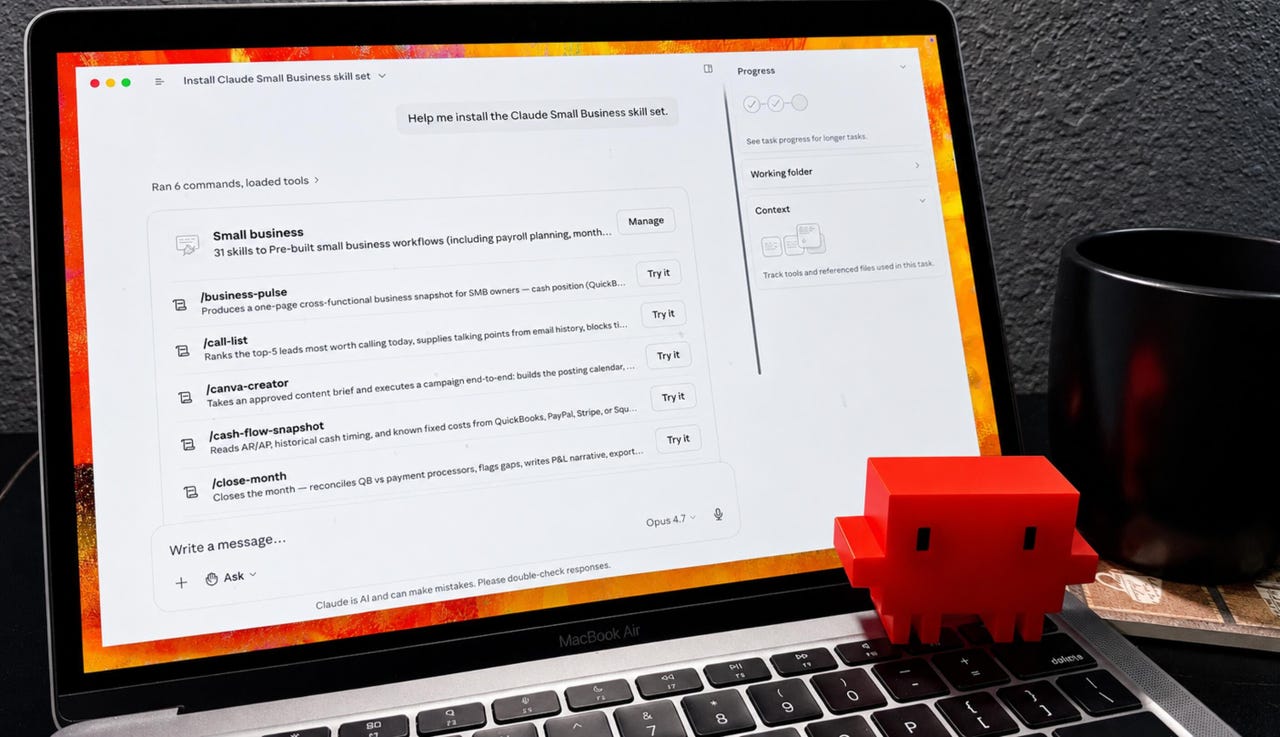
This week, Anthropic announced Claude for Small Business, a library of small business-related connectors and skills for Claude Cowork. That’s interesting enough, I guess, in that every platform vendor benefits from offering some sample solutions.
Also: How to actually use AI in a small business: 10 lessons from the trenches
But while digging around in the new offerings, I found a tool that’s off-the-charts powerful and absolutely worth your attention.
Lawyer in a box
I’ll tell you more about my testing of Claude for Small Business later in this article. But for now, I want to show you the new skill, /review-contract, and what it can do, ‘cuz it’s amaaazing.
Lina Ochman, Anthropic head of US SMB and product-led growth GTM, told ZDNET, “Small businesses deserve the same access to AI that any Fortune 500 company gets. Small businesses make up nearly half the US economy and employ close to half the private-sector workforce, and yet historically, they haven’t been equipped with the right resources, time, and education to effectively learn and use AI. That’s why we’re investing in this community, to help them fully harness AI for their most important work.”
Also: How to learn Claude Code for free with Anthropic’s AI courses – one took me just 20 minutes
This feature fully harnesses AI in a very functional, powerful, and immediately useful way.
Let me set some context first. You’ll need to be running Claude Cowork in the Claude app. That means you’ll need to have, at minimum, the $20-per-month Claude Pro account. For this alone, it’s worth it.
Within the Claude app, select Cowork, and then Customize. Hit the plus button to browse plugins and select the small business plugin. Then, in the prompt box, type /review-contract and choose your contract file. Claude will begin crunching away.
The whole analysis process takes about five minutes. To test this out, I dug into my old records for some sample contracts. As a practice, I keep contracts I sign, as well as those I don’t. These three examples were from vendors I didn’t choose.
Here’s a sample from a window company that bid on installing our windows back when we were in Florida. Note the red-flagged items, how clear they are, and the suggestions.
Here’s one from one of the big national fitness chains. Note specifically the point “Cancellation is deliberately hard,” as well as all the date juggling the contract does.
Finally, here’s one from a caregiving company we evaluated before my parents passed away. Typically, when you’re evaluating these sorts of contracts, you’re under enormous pressure and stress, and it’s the time you’re least likely to carefully evaluate an egregious contract. The companies know this, and as Claude’s analysis shows, they take advantage of it.
Over the years, I have worked with many attorneys and have evaluated a boatload of contracts. While attorneys have provided some feedback, I have never gotten back an evaluation from a multithousand-dollar attorney that came anywhere close to the value and clarity of this Claude feature.
Another benefit is that you can share the results with the party you’re negotiating with. Those red flags are abundantly clear to see in the chat window. It’s possible you’ll get some concessions from the other party when presented with such a clear analysis.
Keep in mind that this feature is available for as little as $20 as part of the Claude Pro tier.
Also: I compared how Gemini, ChatGPT, and Claude can analyze videos – this model wins
Of course, all the usual hallucination disclaimers apply. Claude could get it all wrong. It could decide the contract is crap because it left out the mandatory no-brown-M&M clause. You never know. But I ran /review-contract on a bunch of different contracts. It was spot-on each time.
I don’t say this often, but I’ll say this now: This is a no-brainer, must-be-included-in-your-toolbox solution you need to know about and be ready to call on at any time. You can even start a subscription for just a contract review and turn it back off. If you ever do any sort of contract with anyone, you must use this tool as part of the process.
The rest of the story
There’s nothing new about sets of solutions offered by a platform vendor. Having starting tools makes onboarding and value justification easier for new users. In that context, Claude for Small Business is nothing particularly unusual.
Also: How I used ChatGPT and AI art tools to launch my Etsy business fast
Of course, this is AI. So it’s more than a set of templates. Each solution offered is a structured AI application, like the /review-contract one discussed above. Claude for Small Business includes 31 skills that work with connectors for apps ranging from QuickBooks to Mailchimp to PayPal.
Here are a few examples:
- /business-pulse: Cross-functional SMB snapshot using QuickBooks, PayPal, Stripe/Square, HubSpot, and email context.
- /cash-flow-snapshot: Cash-flow view from QuickBooks AR/AP, PayPal/Stripe/Square timing, and known fixed costs.
- /close-month: Month-end close using QuickBooks and payment processors, with reconciliation gaps and P&L narrative.
- /invoice-chase: Overdue-invoice reminders from QuickBooks and PayPal data, matched to customer context.
- /margin-analyzer: Product or service margin analysis using PayPal merchant insights and QuickBooks cost data.
- /plan-payroll: Payroll-readiness forecast using cash position, overdue invoices, and staged PayPal reminders.
- /quarterly-review: Full QBR narrative using revenue, margin, customer health, opportunities, and risks from business systems.
- /run-campaign: End-to-end marketing campaign using sales analysis, content briefs, Canva assets, and HubSpot sends.
As with most prebuilt solutions from vendors, they assume you have a usage pattern that fits the solution. For example, these solutions rely heavily on PayPal for monetary transactions and QuickBooks for accounting. If you don’t use those tools, they won’t be as helpful.
When looking at the connectors, the API links to outside apps, I saw two for applications I use regularly: QuickBooks and Mailchimp. Very, very carefully, I decided to give both connectors a try.
Limiting access
Let me be perfectly clear here. I do not, not-not-not, like giving AIs access to my mission-critical systems. That’s why I haven’t rushed in to let Claude or ChatGPT manage my email, my files, or any other aspect of how I make a living.
Also: I run a very small business. Here are 21 simple ways AI saves me time every day
I don’t mind the tools contributing value, as I described in this article, but I don’t like the idea of the tools reaching out and having access to my data or my constituents.
I was therefore understandably skittish when considering linking something like QuickBooks to the AI. So I started with a less risky connector, Mailchimp. I use Mailchimp once in a while to send update mailings to my users. I didn’t like the idea of the AI potentially mucking with my user list, but it was a lower risk factor, and I needed to test these tools out.
See, Dear Reader, these are the things I do for you.
It turns out that Claude allows you to specify the rights you grant to the AI as you connect the app. For Mailchimp, I was willing to let Claude read data, but not write anything.
QuickBooks was a little more problematic. Yes, I could limit the write permissions, as shown here.
But those limitations are inside Claude. You’re basically making an agreement with the AI to not do anything you don’t want it to. Somehow, I’m not exactly comforted when our AI overlords say, “Sure Dave, I promise not to try to take over the world. Yeah, that’s my story.”
So when QuickBooks also offered a permission limit option when linking the apps, I turned off write permissions.
Unfortunately, that didn’t work for Claude. When I turned those options off, Claude wouldn’t work. So I gritted my teeth, took a deep breath, and connected QuickBooks. Fingers crossed.
Mailchimp is super limited
The Mailchimp connector is super limited. It can’t tell you how many subscribers you have, what lists you have, what your growth rate is, or anything about your subscribers.
Also: Your Claude agents can ‘dream’ now – how Anthropic’s new feature works
It can, however, create a new mailing. Sort of. It can’t look at your previous mailings to determine style or voice. Basically, all the Mailchimp connector can do is prompt-to-text and then create a default mailing that you’ll need to go in and format completely.
That, there, is an unqualified “meh.”
QuickBooks has some potential
You can talk to Mailchimp and ask for information from QuickBooks. For example, I was able to get a “business pulse,” which is essentially a summary of all the key data elements regarding your business.
Unfortunately, I had to redact everything, but it’s there. It’s a nice analysis, but there’s not much in the AI’s report that I can’t get from a normal QuickBooks report.
I did have the AI scan for interesting items in my books, and it uncovered a 14-year-old overpayment, where we paid the state of Florida $36 more than it was owed for sales tax. While it’s certainly no cause for alarm, I did find Claude’s analysis and suggestions to be helpful and interesting.
After these tests, I immediately disconnected both the Mailchimp and QuickBooks connectors, just to be safe.
Overall assessment
Every small business is different. Many of these prebuilt solutions are designed for specific workflows and probably won’t apply to many small businesses. But since skills are simply text files containing descriptions of what you want the AI to do, you can use the provided skills as samples and build up from them to meet your own business needs. That’s useful.
Also: How I used Claude AI to plan an entire hiking trip to the Adirondacks in 30 minutes – for free
Then, buried in the middle of this rather ho-hum announcement about small business resources, is a super tool that everybody should be able to use and take advantage of. There is something really powerful here. No kidding, it’s well worth your time. It’s a true new asset for your business and mine.
If an AI contract review flagged cancellation traps and hidden risk in plain English, would that make you more confident negotiating terms? Let us know in the comments below.
You can follow my day-to-day project updates on social media. Be sure to subscribe to my weekly update newsletter, and follow me on Twitter/X at @DavidGewirtz, on Facebook at Facebook.com/DavidGewirtz, on Instagram at Instagram.com/DavidGewirtz, on Bluesky at @DavidGewirtz.com, and on YouTube at YouTube.com/DavidGewirtzTV.




