This Safe & Beautiful European Country Is Breaking All Time Tourism Records


Share The Article

Step aside France, Italy, Spain: there’s a new cooler kid in the block, one that isn’t drowing in a wave of crime, or buckling under the weight of overtourism for once.

Tucked away in its well-protected, cozy Central-Eastern European nook, Hungary wrapped up last year hosting a record-breaking 20 million tourists.

As far as foreign visitors go, that’s a 12 percent jump over 2024, according to the Hungarian Conservative, and with demand still going strong, it’s looking like it’ll only get hotter in 2026.

Even if you’re not a seasoned traveler or a full-on Europhile, chances are you’ve heard of Budapest.

But if you’re wondering what else Hungary’s got up its sleeve, think summery lakes lined with resort towns, fairytale castles straight out of a storybook, and medieval villages that feel like time just… forgot about them.
Budapest skyline, Buda castle and Danube river

One City To Rule Them All

Of course, there’s no Hungary without its beating heart, the cultural powerhouse, magnanimous former imperial seat that is Budapest.

A tale of two cities, Buda and Pest, that once sat on opposite sides of the Danube River prior to joining forces, it is simply one of the most beautiful European cities you could visit.

Honestly, if Paris had you staring slack-jawed at those Haussmann buildings, or London charmed you with its decaying Victorian-era polish, nothing can really prep you for a glorious BUD.

Think grand boulevards lined with palatial buildings you’d swear are museums, government offices, or luxury hotels, but are actually just residential apartment blocks dating back to the Habsburg days.

Add in a riverfront straight out of a dream, with soaring domes and spires reflecting off the fast-moving Danube, plus thermal spas tucked inside ornate 19th-century bathhouses, and yeah… It’s kind of on another level, if we’re honest.

Top view of the Hungarian Parliament Building and Danube river, Budapest

How Safe Is Budapest On A Night Out?

Other than admiring the stunning architecture, you should swing by Szimpla Kert, the OG ‘ruin bar’ in town, basically a half-genius maze inside a crumbling building filled with mismatched furniture, loud neon art, bathtubs that double as sofas, and graffiti-splattered corners.

The best thing about Budapest is that, unlike some European capitals that have seen increases in crime in recent years, it remains generally safe and low-risk for travelers.

No getting followed home at night if you’re a woman by sketchy-looking individuals, nor constantly casting one of those “just in case” glances over your shoulder to make sure no hooded figures are lurking in the shadows.

The U.S. State Department currently lists it as a Level 1 destination, the safest classification a city can get.

Tourists Bathing In Széchenyi Baths, Budapest, Hungary

Pickpockets, violent crime, and scams aren’t exactly a major concern in Budapest, but if you’re heading elsewhere in Europe, it’s still a good idea to double-check any Travel Alerts in place at your destination using the Travel Advisory Checker.

Back to Budapest, it currently enjoys one of the highest safety scores of 87/100 in the Traveler Safety Index for any European capital:

Where The Real Magic Happens

Budapest is grand, but the real magic happens when you take that old rattling train out of the sprawling capital and into the virtually untouched Hungarian countryside.

Hollókő Village In Hungary

If you have a soft spot for small villages that look like they’ve jumped out of the pages of a storybook, Szentendre has the cobblestone streets, pastel Baroque houses, and quaint riverside cafés dishing out fresh-out-the-oven pastries and artsy coffee.

Unlike your average Disneyfied European hotspot, it’s completely devoid of the usual selfie-taking hordes.

A UNESCO World Heritage Site, Hollókő is that postcardy town that feels frozen in time. It has perfectly intact wooden medieval churches, whitewashed houses, and family-run taverns that keep folk traditions alive.

Over in Eger, in the heart of the namesake wine country, you’ll find a castle town filled with wine cellars, more Baroque monuments, and thermal baths with half the Budapest crowds.

Aerial View Of Tihany, Lake Balaton, Hungary, Central Europe.jpg

If you’re here for some full-on medieval drama, the unassuming Visegrád may be tiny, but it’s packed with history: It houses the ruins of a medieval royal palace, and the hilltop citadel overlooks a sharp bend in the Danube. Hands down one of the best viewpoints in the entire country.

Hungary’s prettiest small town, you ask? Tihany is famous for its Benedictine Abbey perched on a hill overlooking Lake Balaton, the ‘Hungarian Sea‘, and endless fields of lavender in summer. Feels just like Provence, minus the hefty price tag.

For those flying to Europe this summer, head over to the Entry Requirement Checker to verify you have all your documentation in order for smooth sailing.

Is Hungary Still Affordable In 2026?

Speaking of prices, Hungary is not the dirt-cheap destination mainstream publications will have you believe it is.

A back view of a Caucasian woman in winter clothes in front of the Hungarian parliament in Budapest

Then again, it’s not like we’re surprised, given the already-debunked ‘Hidden Gem Marseille‘ debacle, but definitely don’t believe everything you read on the internet, especially if it’s written by legacy media that’s maybe 3 to 5 years behind on travel trends.

That said, Hungary is affordable, although Budapest in particular is rapidly catching up with Western European capitals in terms of costs.

For instance, tickets for the iconic Széchenyi Thermal Bath in Budapest have doubled since 2020. The “basic” ticket now costs around $40, without extras. If you’re adding a private cabin, locker, additional towels, or weekend/peak-time upgrades, that can easily bump up to $55–$70+ per person.

Cocktails in ruin bars and touristy areas usually run about $6–$14 each, and a draught beer in a central pub is roughly $3–$5.

A Stately Building In Budapest In The Evening, Hungary, Central Eastern Europe

It’s still cheaper than most of Western Europe, but it’s definitely a step up from that old “super cheap Budapest” reputation that’s still floating around.

Hotels and Airbnb are where you actually see how BUD and cities like Paris or Rome don’t actually differ that much. A mid-range listing will set you back $130–$200/night in peak season, whereas budget hostels are still cheap-ish, but even those have gone up to $25–$60/night in good areas like Districts V or VII.

As for eating out, a simple local meal costs $8–$15. A restaurant dinner with drinks is $25–$30 per person.

Fisherman's Bastion in Budapest

Out in the country, smaller towns are generally cheaper, with meals often costing under $10, beer or wine ranging from $1.50 to $3, and accommodation starting from $30.

By the way, if you’re visiting Budapest in the coming months, why not pair it with a side trip to the criminally underrated, equally exciting Belgrade, the capital city of Serbia?

There’s this new direct train that’s just been launched between the sisterly capitals, and tickets cost about $22–$38 one-way.


Source link

Leave a Reply

Subscribe to Our Newsletter

Get our latest articles delivered straight to your inbox. No spam, we promise.

Recent Reviews


Verdict

An impressive take on wearable audio, the Bose Open Ultra Earbuds boast good sound, great comfort and a solid list of features.

  • Comfortable to wear

  • Clear, detailed sound

  • Solid battery life

  • Fashionable looks

  • Weak noise isolation

  • Indifferent call quality

  • Lacks bass

  • Expensive

Key Features

  • Immersive Audio

    Turns stereo music into 3D audio

  • Bluetooth support

    aptX Adaptive and Snapdragon Sound support

  • OpenAudio

    Fires audio into the ear without leakage

Introduction

When Bose enters a market it tends to make (sound) waves. It was no different when it entered into the open-ear headphones space with the Ultra Open Earbuds.

When it first launched, it was a unique take on open-ear headphones; the like of which has been subsequently copied over and over. While Shokz is the leader in terms of sales with open-ear headphones, Bose showed that it be innovative and forward-looking.

Wearable audio has its compromises but they offer the freedom other types of headphones can’t achieve. They’re a tricky concept to pull off, but at the first time of asking, Bose executed it pretty well with the Ultra Open Earbuds.

Advertisement

Design

  • Cuff design
  • IPX4 rating
  • Physical controls

Bose’s approach to Ultra Open Earbuds’ aesthetics is more in line with fashion accessory than true wireless earbuds.

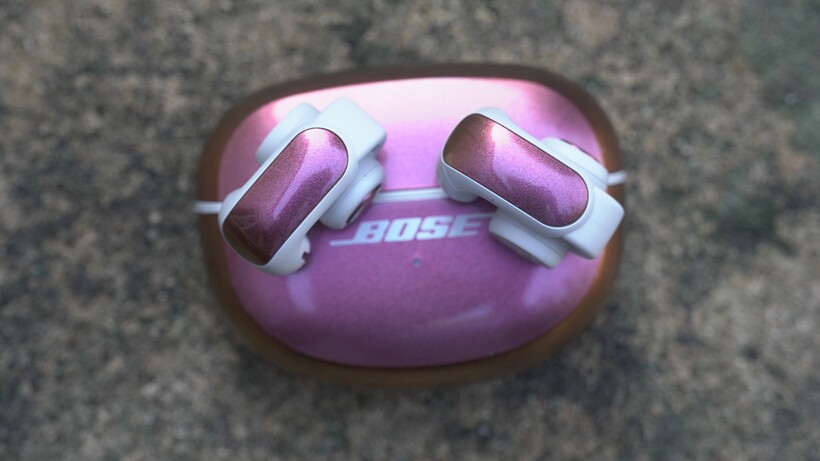
The brushed metallic finish is distinct, and more colours have launched since the original choice of black and white, with – take a deep breath – Colour Sunset Iridescent (the sample you see here): Violet, Plum, Gold, Lilac, Grey, Blue, Driftwood Sand, and Moonstone Blue.

Bose Ultra Open earbuds on top
Image Credit (Trusted Reviews)

I always moan about headphone brands never taking advantage of colours and bringing some personality to its headphones, but that’s not a complaint I can level at Bose here.

Advertisement

Comfort and a secure fit are the priorities, with the earphones fastening around the earlobe in a “cuff design”.

There are three parts: the driver section along with the battery barrel, which connect via a silicon coated flex arm. Unlike a traditional wireless earbud, these buds don’t block the ear canal but allow sounds to pass through.

Bose Ultra Open Earbuds controls
Image Credit (Trusted Reviews)

On top of the battery barrel is a physical button which when it’s depressed emits a helpful click. I tend to hold the top and bottom in a pincer, that way the earbuds don’t move. You can control playback, volume, the Immersive Audio feature, as well as any shortcuts through the buttons on each earphone.

After a while it becomes incredibly easy to clip them on, even with my predominantly weaker hand. And once they’re attached they don’t pinch or cause irritation. They’re very comfortable to wear and after a few minutes I forget that they’re even there.

The weigh little, and you can shift them up and down your ear for the best comfort or position to play audio – it’s a rather clever design. Wearing the earbuds with music playing, there’s little audio leakage even at high volumes.

Advertisement

Bose Ultra Open Earbuds earbuds
Image Credit (Trusted Reviews)

If you’re someone who dislikes the presence of true wireless earbuds, you’ll appreciate the lengths Bose has gone to here.

They’re rated IPX4 to guard against water and moisture. The charging case is compact, and the earbuds magnetically fasten. There’s a Bluetooth pairing button on the case with a USB-C port for charging on the underside.

Features

  • aptX Adaptive Bluetooth
  • Bose Immersive Audio
  • Bose app

Bluetooth support equals v5.3 with support for SBC, AAC, and aptX Adaptive (for Android devices). There’s also Snapdragon Sound support for those who want a higher quality sound and lower latency Bluetooth performance with compatible devices. That seems like overkill for a pair of headphones like these, but does help with maintaining a secure connection.

There’s Google Fast Pair for Android devices, while Bluetooth multipoint was added in an update back in 2024. Wireless connectivity has been solid – weak connections have been few and far between.

Advertisement

Bose Ultra Open Earbuds app
Image Credit (Trusted Reviews)

The Bose app is where you can monitor battery life, volume control, adjust EQ settings and switch modes – Stereo or Immersion. The app has a tendency to be flaky with connection issues or unresponsiveness par for the course. Sometimes I’ve had to restart my smartphone or put the earbuds in the case to get the app working again.

Immersive Audio turns stereo audio into 3D. It requires (a very brief) calibration to set up. If you find that Immersive Audio doesn’t sound right, it can always be re-calibrated.

There’s a choice of modes in Still and Motion. The former keeps 3D audio fixed, so if you move your head to the right, music doesn’t travel with you. With Motion, music travels as you move your head, keeping the listener in that immersive space as you walk about.

Bose Ultra Open Earbuds app customisation
Image Credit (Trusted Reviews)

The buds have been updated with the Auto Volume feature that adapts the volume in accordance with how loud the environment is; while voice pickup has been tweaked though it doesn’t seem to have yielded a positive effect.

Advertisement

The call quality of these earphones is still rough. They have a trend of not picking up noise when I’m not speaking, but as soon as I open my mouth allowing a cascade of noise to flood in. While voice pickup seems reliable enough when it’s quiet, the person on the other end found it hard to hear what I was saying and divorce it from the loud environments or blustery conditions.

On my side I found it hard to hear what they were saying even with the volume turned up to the max. Any continuous loud sound (basically being outside) made it difficult to have a conversation. If you’re going to use these earphones for calls, make sure you’re in a very quiet place.

Battery Life

  • 28 hours battery total
  • Optional wireless charging case

In general Bose expects 7.5 hours from the Ultra Open Earbuds, which is more than the Sony LinkBuds 5.5 hours but less than the Shokz OpenFit Pro’s 10. With Immersive Audio that figure drops to 4.5 hours.

Bose Ultra Open Earbuds charging case
Image Credit (Trusted Reviews)

There’s another 19.5 hours from the charging case (12 with Immersive Audio on), which makes for about 28 hours in total. In the battery drains I carried out, the Open Ultra lost 30% battery in two hours, which puts them around the 7+ hour mark, in line with Bose’s claims.

Advertisement

Fast charging is supported with two minutes providing two hours, and there is wireless charging support though it requires a slip-on accessory. For a £299 pair of headphones, it’s odd it’s not included as standard. Even £70 wireless earbuds are know to include the feature.

Sound Quality

  • Clear audio
  • Lacks bass extension

Wireless earphones such as these live or die on sound quality. There are obvious compromises due to the form factor, and as these headphones lack any form of noise reduction that Apple and Shokz pairs have included, I would not recommend them on public transport or anywhere else loud as you’ll struggle to hear anything.

But in the right environment, these are one of the better-sounding open earphones I’ve tested, even in 2026. They sound better than Sony’s original LinkBuds, and where they edge those earphones is in the clarity they afford mids and highs; and they’re better than the warm sound of the Shokz OpenFit Pro, though where the Bose are found wanting is in the bass department.

A listen to Esperanza Spalding’s I Know You Know sees the Bose offer a crisper, more defined midrange to the Sony’s smoother and warmer performance. The LinkBuds don’t carry as much detail, and sound softer as a result.

Bose Ultra Open Earbuds in case
Image Credit (Trusted Reviews)

Advertisement

With Bill Evans’ All Of You, the Bose are clearer and brighter in describing the tinkling of the ivories. The Ultra Open Earbuds show a more capable and assured hand as far as reproducing high frequencies are concerned.

They’re also capable of going louder than the Sony, useful enough in loud environments but just better in terms of the default volume. Ultimately though, the louder they are, the thinner and more hollow they sound.

Where the Bose Ultra Open Earbuds most obviously falter is in the bass. While there’s some bass presence, there’s a flatness with tracks such as Katy B’s Katy on a Mission where the Shokz finds more warmth and presence with the lows. The Bose aren’t the most energetic sounding pair of open-ear headphones I’ve tested.

Bose Ultra Open Earbuds on top of case
Image Credit (Trusted Reviews)

The soundstage is not the widest but the Immersive Audio works does open the sound up not just in front of you and to the sides as well. Having tested all the Bose headphones over the past four years, the Open Ultra Earbuds struggle to convey Immersive Audio at its best.

Turning on Immersive Audio on thins out music and makes it sound softer. Worse is the lack of noise isolation. When I used them on a train, they sounded so faint against the noise of the carriage that I wasn’t even sure I could hear anything. If there’s a second version on the way, they’d benefit from having some form of noise reduction, if the design allows for it.

Advertisement

Should you buy it?

Awareness of what’s around you

If you want awareness of what’s around you, the Bose hit the mark with good comfort levels too

The price makes you blink

These are the most expensive open earbuds I’ve tested, and even in 2026, they’re still among the most expensive pairs

Final Thoughts

The Bose Ultra Open Earbuds are one of the best examples of the open-headphone concept so far, even in 2026, two years after they launched.
 
They sound better than I expected though there’s still a struggle with external noises and reproducing bass. If you’re in a loud environment it’s hard to hear what’s playing without turning the volume up to full.
 
They’re very comfortable to wear and will satisfy those after a headphone that’s also a fashion item. The feature set is solid, although call quality isn’t great, especially in loud places.
 
They still command a premium price but you can find them discounted by up to £100 (which would suggest that s sequel is in the offing). In light of the limitations of open-ears provide, Bose’s first attempt is a very accomplished one.

How We Test

The Bose Open Ultra Earbuds were tested over the course of a month with real world testing.

  • Tested for a month
  • Tested with real world use
  • Battery drain carried out

FAQs

Do the Bose Ultra Open Earbuds support Bluetooth multipoint?

At launch they didn’t, but an update in July 2024 added the feature to the earphones.

Full Specs

  Bose Ultra Open Earbuds Review
UK RRP £299
USA RRP $299
EU RRP €349
AUD RRP AU$449
Manufacturer Bose
IP rating IPX4
Battery Hours 27
Fast Charging Yes
Size (Dimensions) x x INCHES
ASIN B0CPFV77W4
Release Date 2024
Audio Resolution SBC, AAC, aptX Adaptive
Connectivity Bluetooth 5.3
Colours Black, White
Frequency Range – Hz
Headphone Type In-ear

Advertisement


Source link