This Vacuum Brand Ranks The Highest For Customer Satisfaction


We may receive a commission on purchases made from links.

Although all vacuums share the same core function, their features, designs, and price points are very diverse. The best handheld vacuums on the market are lightweight and portable, but generally aren’t as powerful as larger cordless stick vacuums. Likewise, a cordless stick vacuum might cost more to buy upfront than a corded vacuum, particularly if you need to buy a set of expensive battery packs on top of buying the tool itself.

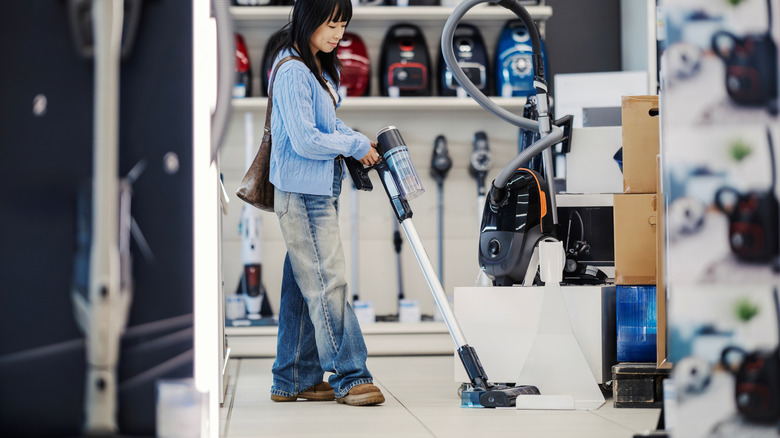
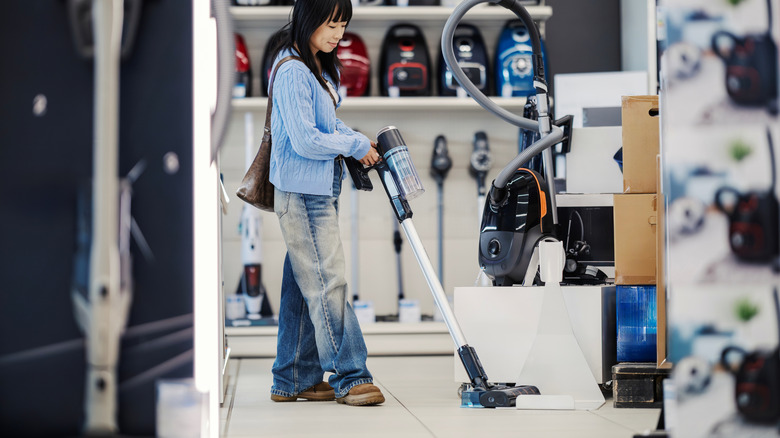
There’s no one definitive answer to which type of vacuum is best, nor which vacuum brand is best. It simply depends on the needs of an individual buyer. However, some brands receive consistently higher customer satisfaction ratings than others. According to the American Customer Satisfaction Index (ACSI), Samsung received the highest ratings of any major vacuum brand for its lineup in 2025. Respondents in the survey particularly liked how easy the best vacuums were to operate and empty. They also awarded high marks for the quality and reliability of the vacuums’ associated smartphone apps and were won over by the perceived durability of their purchases.

While the Korean brand took the top spot, there are a few competitors that were very close behind. Samsung’s score of 82 in the survey was only a single point ahead of Shark, which in turn was a point ahead of Dyson and Bissell. At the other end of the table, Hoover and Electrolux were the lowest scoring brands in the survey.

Samsung’s current vacuum lineup is varied but expensive

Although the brand scored the highest in the ACSI survey, Samsung’s current vacuum range is far from the largest on the market. The brand had just six different models listed in its U.S. offerings at the time of writing. Despite its lineup being small, however, it is varied. The cheapest option is the Jet 60 stick vacuum, which includes a removable, rechargeable battery that Samsung claims is good for up to 40 minutes of runtime. Although it was out of stock on Samsung’s website at the time of writing, it was available at Walmart for $299.99.

The brand also offers several pricier cordless stick vacuums with additional features. The Bespoke AI Jet Ultra is the priciest of this category, retailing for $1,099.99. This certainly makes it a major investment, albeit not quite as big of an investment as Samsung’s most expensive vacuum, the Bespoke AI Jet Bot robot vacuum. This gadget has an MSRP of $1,399.99, far exceeding what many vacuum buyers are likely willing to spend.

There are several key things worth considering before buying a robot vacuum of any kind, and it’s worth noting that the AI models have some of the lower ratings on Samsung’s website. Samsung’s vacuums may have gotten a top customer satisfaction rating on this survey, but the price of certain models can be a dealbreaker for some. Those prices may even be high enough to persuade some buyers to opt for a cheaper alternative from a rival well-liked brand such as Shark instead.


Source link

Leave a Reply

Subscribe to Our Newsletter

Get our latest articles delivered straight to your inbox. No spam, we promise.

Recent Reviews


In the ever-shifting geopolitical sphere, China’s growing military presence and the ongoing tensions over Taiwan and the South China Sea continue to be a closely watched topic — particularly in regard to China’s ambition for naval power. In recent years, much speculation has been made over the country’s rapid military development, including the capabilities of the newest Chinese amphibious assault ships.

While there’s no denying its military advancements and buildup, much has been made about the logistical and military difficulties that China’s People’s Liberation Army (PLA) would face if it launched an amphibious invasion of Taiwan. However, there’s growing concern that if a Taiwan invasion were to happen, it wouldn’t just be military vessels taking part in the action, but a fleet of commercial vessels, too — including a massive new car ferries that could quickly be repurposed into valuable military transports.

While the possibility of the PLA using commercial vessels for military operations has always been on the table for a potential Taiwan invasion, the scale with which China has been expanding its commercial shipbuilding industry has become a big factor in the PLA’s projection of logistical and military power across the Taiwan Strait. It’s also raised ethical concerns over the idea of putting merchant-marked ships into combat use.

From car ferry to military transport

The rapid growth of modern Chinese industrial capacity is well known, with Chinese electric vehicle factories now able to build a new car every 60 seconds. Likewise, China has developed a massive shipbuilding industry over the last 25 years, with the country now making up more than half of the world’s shipbuilding output. It’s from those two sectors where China’s latest vehicle-carrying super vessels are emerging. 

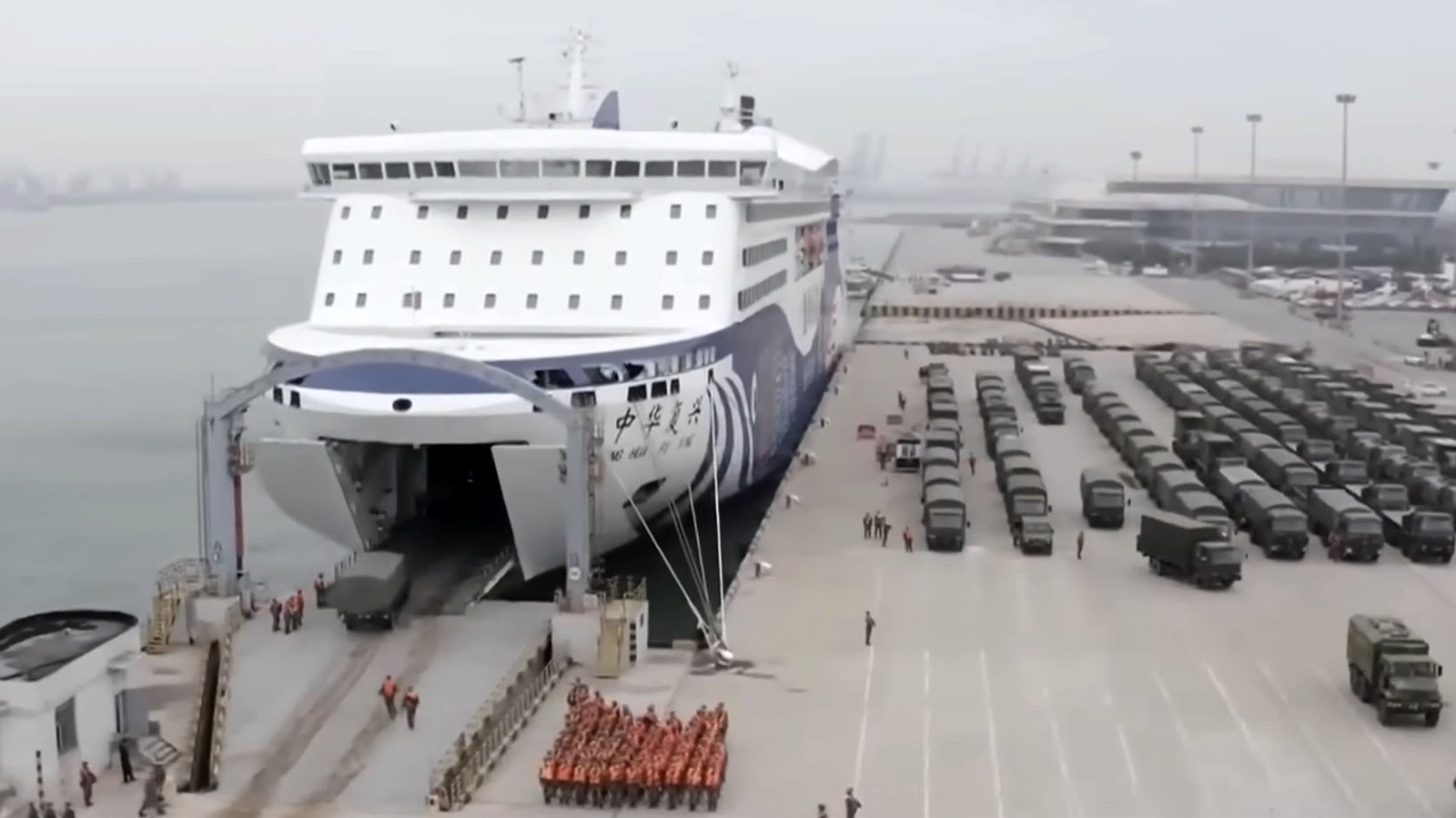
With a capacity to carry over 10,000 new vehicles for transport from factories in Asia to destinations around the world, these ships, known as roll-on/roll-off (Ro-Ro) ferries, are now the biggest of their type in the world. The concept of the PLA putting civilian ferries into military use is not a new one, or even an idea China is trying to hide. Back in 2021, China held a public military exercise where a civilian ferry was used to transport both troops and a whole arsenal of military vehicles, including main battle tanks.

The relatively limited conventional naval lift capacity of the PLA is something that’s been pointed out while game-planning a Chinese amphibious move on Taiwan, and it’s widely expected that the PLA would lean on repurposed civilian vessels to boost its ability to move soldiers and vehicles across the Taiwan Strait. With these newer, high-capacity Ro-Ro ferries added to the fleet, the PLA’s amphibious capacity and reach could grow significantly.

A makeshift amphibious assault ship

However, even with the added capacity of these massive ferries, military analysts have pointed out that Ro-Ro ships would not be able to deploy vehicles and soliders directly onto a beach the way a purpose-built military amphibious assault ship can. Traditionally, to deploy vehicles from these ships, the PLA would first need to capture and then repurpose Taiwan’s existing commercial port facilities into unloading bases for military vehicles and equipment.

However, maybe most alarming is that satellite imagery and U.S. Intelligence reports show that, along with increasing ferry production output, the PLA is also working on a system of barges and floating dock structures to help turn these civilian ferries into more efficient military transports. With this supporting equipment in place, ferries may not need to use existing port infrastructure to bring their equipment on shore.

Beyond the general military concern over China’s growing amphibious capability, there are also ethical concerns if China is planning to rapidly put a fleet of civilian merchant vessels into military service. If the PLA were to deploy these dual-purpose vessels into direct military operations, the United States and its allies would likely be forced to treat civilian-presenting ships as enemy combatants. On top of all the other strategic challenges a Taiwan invasion would bring, the U.S. having to navigate the blurred legal lines between military and merchant vessels could potentially give China a strategic advantage amidst the fog of war.


Source link