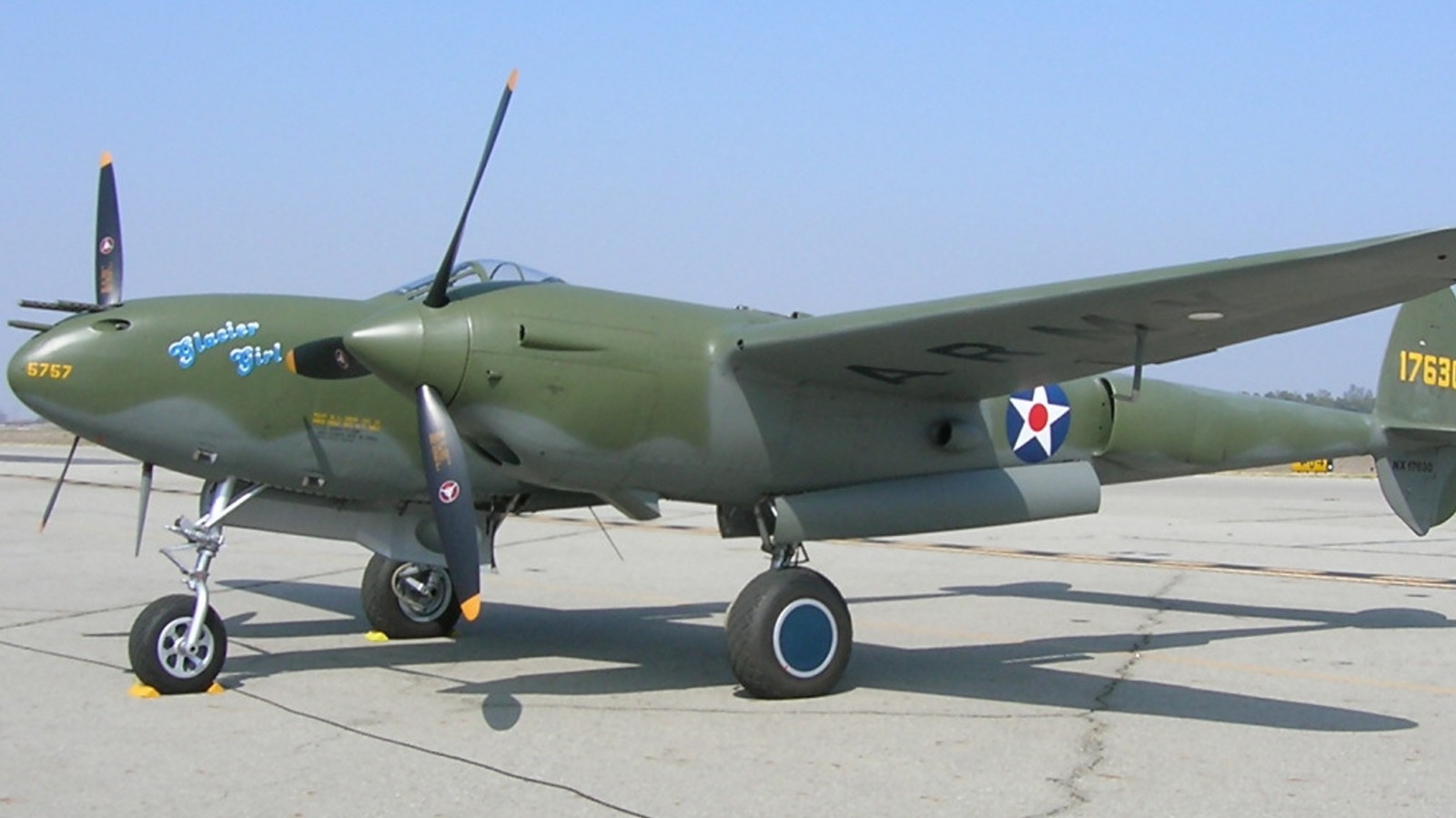
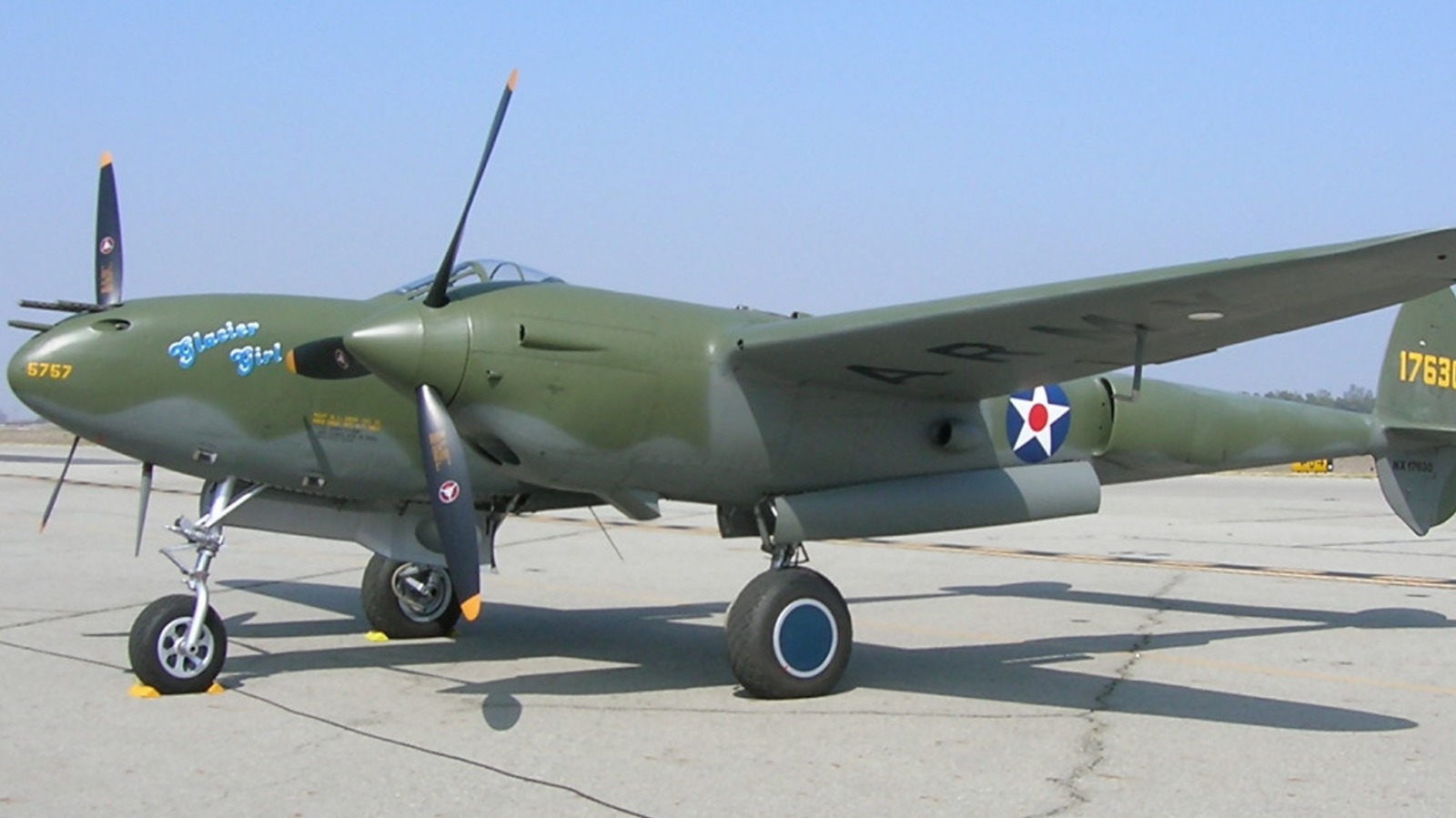
This WWII Plane Is Still Flying After Being Found Under 268 Feet Of Ice


World War II saw the development of all manner of aircraft, some of which have become iconic. One such plane was the bizarre-looking Lockheed P-38 Lightning, which was a single-seat aircraft with a twin-boom design. Throughout the war, P-38s flew all kinds of missions, including escort, fighter-bomber, and night fighter operations; they were heavily used. There are some well-known P-38s from the war, but one of the most fascinating is known as Glacier Girl.

That’s because the plane, which flew for the 94th Fighter Squadron, First Fighter Group, had to make an emergency landing in Greenland on July 15, 1942. The aircraft, along with two B-17 Flying Fortress bombers and five other P-38s, were all lost to the ice, which covered them as time passed. The aircraft remained buried under 268 feet of ice for decades. Then, in 1992, the Greenland Expedition Society excavated the P-38F, which was in inoperable condition after half a century under the ice.

It had to be removed and brought to the surface in pieces. Over time, every piece of Glacier Girl made it. The P-38F was moved to Middlesboro, Kentucky, where a great deal of time and effort made it flightworthy once more. Restoring the aircraft to flightworthy status was a big deal, as only 24 of the 10,113 built by the U.S. during the war survive today, and only six are flightworthy. That makes any operational P-38 a hot item as a Warbird, which is a restored military aircraft flown by enthusiasts.

Glacier Girl took to the skies after 60 years

It took four months to bring the plane up to the surface at a cost of $638,000, and all told, the entire project ran closer to $3 million. Despite where Glacier Girl was found and how long it remained buried, much of the aircraft was in surprisingly good condition. Initially, the project to fully restore the fighter to flightworthy status was thought to take two years. It ended up taking a decade, and it was made possible with around 80% of Glacier Girl’s recovered original parts. 

Once Glacier Girl was fully restored, the next thing to do was take it up into the air, so pilot Steve Hinton climbed into the cockpit and flew the restored Glacier Girl for 30 minutes in October 2002. Hinton is a name that many in the Warbird community know well, as he’s dedicated his life to flying restored military aircraft, having spent years doing so for the Planes of Fame Air Museum in Chino, California.

Glacier Girl continued flying for many years, transferring from one owner to another until it landed as the centerpiece of the Air Legends Foundation collection. It was later loaned to the Lone Star Flight Museum in Houston, Texas, and has continued flying and wowing onlookers for years. The P-38 was one of the best American planes of World War II, and it’s a testament to the craftsmanship and drive of U.S. war production in the 1940s that a plane buried for decades under the ice could be made to fly once more.


Source link

Leave a Reply

Subscribe to Our Newsletter

Get our latest articles delivered straight to your inbox. No spam, we promise.

Recent Reviews


Researchers in South Korea developed a wearable system that uses seven smart rings to read finger and hand motions to translate American Sign Language and International Sign Language into text. The purpose is to make communicating easier between those who sign and nonsigners without needing a separate human interpreter. 

AI Atlas

According to the study, published Friday in the journal Science Advances, the system reliably recognized 100 ASL and ISL words during testing. It also performed well with users the system had not seen before, and it didn’t require recalibration for each person. Because the system detects words in sequence, it can produce sentence-level translations without extra training on grammar. 

ASL and ISL are the everyday languages of more than 72 million deaf and hard-of-hearing people. However, most hearing people do not know any words in these languages or have a very basic understanding. That gap makes certain tasks, like ordering at a restaurant or asking for help, much more difficult. 

A graphic shows two illustrated people talking in sign language, ASL and ISL. The graphic also shows the different components of the ring as well as pictures of hands modeling the rings.

A concept of how the rings work in the real world. 

American Association for the Advancement of Science (AAAS)

Existing sign language translator prototypes often rely on bulky gloves that can distract from or block natural hand movement or feel uncomfortable for the wearer, which limits real word adaption. Camera-based technologies can work well in controlled environments but are often limited to those places where a camera can be set up with a clear line of sight, the researchers wrote. 

To solve these problems, the researchers designed sensing rings for each finger that can capture precise motion and finger position while letting the hands move naturally. The rings can detect both signs that involve movement, like the words for “dance,” “fly” and “sun,” and signs that are held still, like “I” and “you.”

“These advances suggest that [the device could enable] barrier-free public translation systems for unseen users and unrestricted daily assistive interfaces,” the authors wrote in the study. 

The authors are affiliated with Yonsei University, Hankuk University of Foreign Studies and the Korea Institute of Science and Technology, among others. While the technology is still experimental, the authors wrote that the technology has the potential to ease communication difficulties. The underlying idea could also help improve controls for other systems, like virtual or augmented reality.

“Beyond sign language translation, the ring-type, wireless, and modular architecture of (wirelessly connected, ring-type sign language translators) may also be extended to other gesture-driven applications such as virtual or augmented reality control, touchless device interfaces, or rehabilitation monitoring systems where fine-grained hand movement tracking is essential,” they wrote.


Source link