
Studies show that speed humps really do slow drivers down, and while that’s a good thing for the safety of pedestrians and cyclists, it does have some less desirable side effects. Emergency vehicles can also be impeded by speed humps, with one California study showing that fire trucks can be delayed by up to 15 seconds per section of humps. A larger number of humps can make a significant difference to a fire truck’s response time, which is why some fire departments opposed the implementation of speed humps when they first started to become widely used.
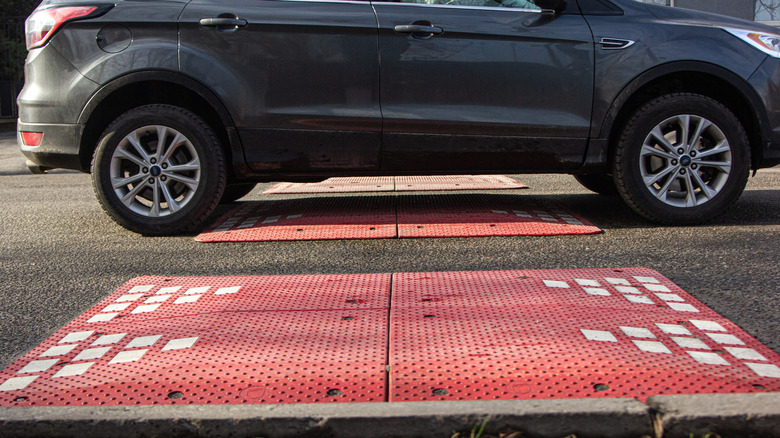
In response to those concerns, road safety planners began to build speed cushions in areas that emergency vehicles frequently needed to pass through. A speed cushion is designed differently from the conventional speed hump, and it allows fire trucks to pass over it with minimal delay. While a hump stretches all of the way across a road at a fixed height, a speed cushion features a raised section in the middle of the road with gaps at the sides. These gaps are designed to match the track width of an American fire truck, allowing trucks to pass over the cushion without needing to significantly slow down.
Further studies comparing the two types of traffic calming measures confirmed that speed cushions cause significantly less delay to fire trucks and other kinds of emergency vehicles than humps. At the same time, they still help cut the average speeds of passenger vehicles traveling on the road.
Some cities also design speed bump gaps for cyclists
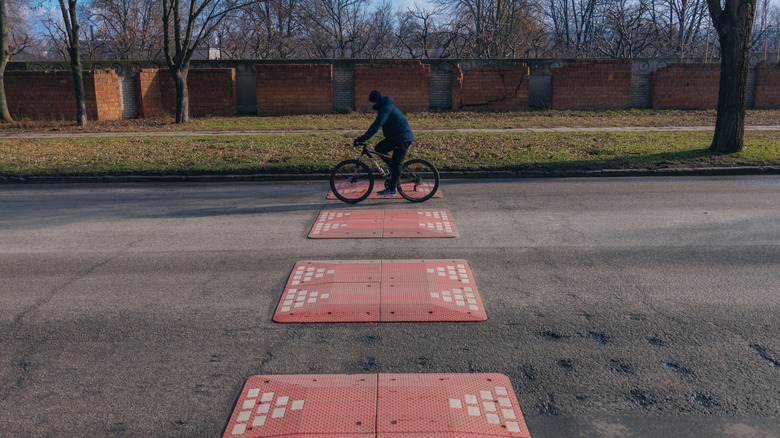
Although the gaps in speed cushions were originally designed to reduce the impact on emergency vehicles, some cities have also tweaked their design to serve a second use. City planners confirmed to BikePortland that recent speed cushions in Portland have been designed to be friendly to cyclists, allowing them to aim for the gap and avoid riding over the vertical part of the cushion.
These bike-friendly bumps have been implemented in areas where planners are encouraging cycling, even if they aren’t always needed for frequent emergency vehicle access. Avoiding bumps is particularly appealing for anyone riding e-bikes, with speeds of the fastest e-bikes being able to match or even exceed some posted speed limits on residential roads.
It seems the design change is working. A 2024 report by Portland city officials found that more than three-quarters of cyclists were observed riding through gaps in speed cushions rather than riding over them at locations where bike-friendly speed cushions had been installed. In the survey, 80% of respondents said they preferred cycling through speed bumps with gaps. It’s important for planners to design speed cushions to benefit as many groups as possible, since the same report noted that they can be around 20% more expensive to install on average than fixed-height speed humps.

Stephan is the sports journalist for the Maple Grove Report.