
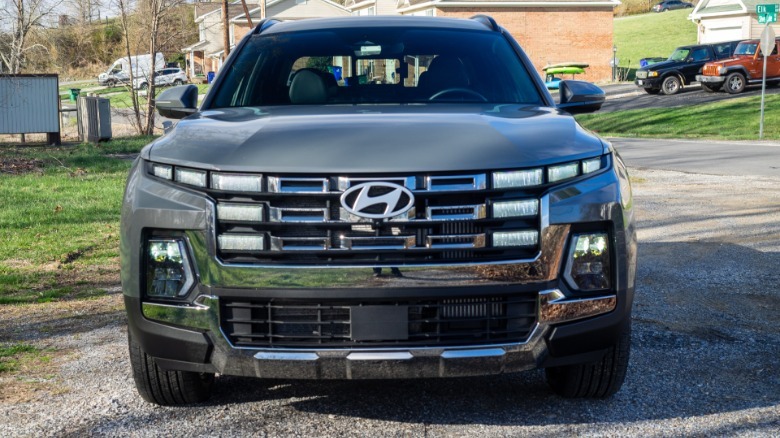

So, why then is Hyundai moving on from the Santa Cruz, leaving the very compact compact truck market to Ford and the Maverick?
Because the Maverick killed it from the start.
When it arrived in 2021 for the 2022 model year, the Maverick was marketed as the little Ford that could do it all, similar to (just smaller than) the Ranger and the F-Series. Looking more like a truck than the Hyundai certainly helped its case, not to mention all those QR codes for DIY projects scattered throughout to encourage owners to truly make the Maverick their own. Meanwhile, the Santa Cruz was positioned as more of a weekend ride, spending time cruising the farmer’s markets, cute antique shops, and heading out to the beach for some fun in the sun. Nothing wrong there, but few saw any potential beyond the lifestyle aspirations this Hyundai presented.
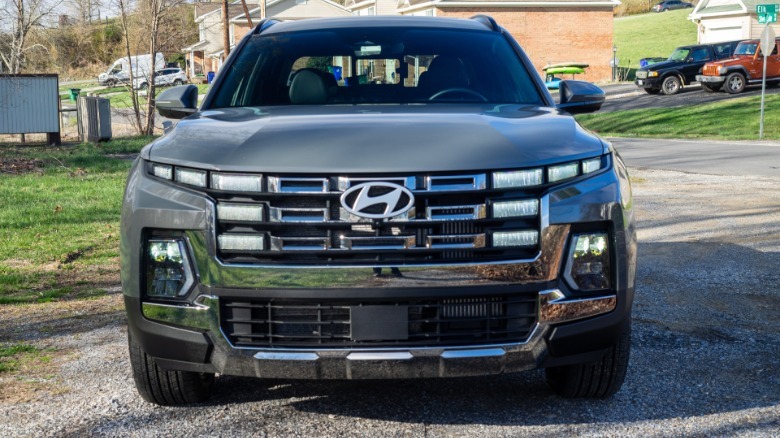 Cameron Aubernon/SlashGear
Then, there was the pricing. Coming out of the dark days of the pandemic, money was tight. Hyundai offered the Santa Cruz for a starting MSRP of $24,440 to $40,170. However, Ford delivered its Maverick for anywhere from $20,995 for the XL to $26,860 for the Lariat. To add more value, the automaker also offered its compact ute with a hybrid powertrain, something Hyundai, again, never got around to.
Finally, Ford was able to bring in new fans to the Blue Oval with the Maverick, with some 60% of that ute’s buyers in Q2 2025 being fresh to the brand overall. The Santa Cruz, on the other hand, didn’t have the same pull. Instead, more Hyundai fans opted to buy the Tucson.
In the end, the numbers don’t lie. The Ford Maverick closed 2021 with 13,259 units sold in the United States alone. By the end of 2025, over 155,000 units left the lot, with no peak in sight thus far. The Hyundai Santa Cruz, by comparison, sold just over 10,000 units in 2021, peaked at 36,675 units in 2023, then cruised down to 25,499 in 2025.

Stephan is the sports journalist for the Maple Grove Report.




