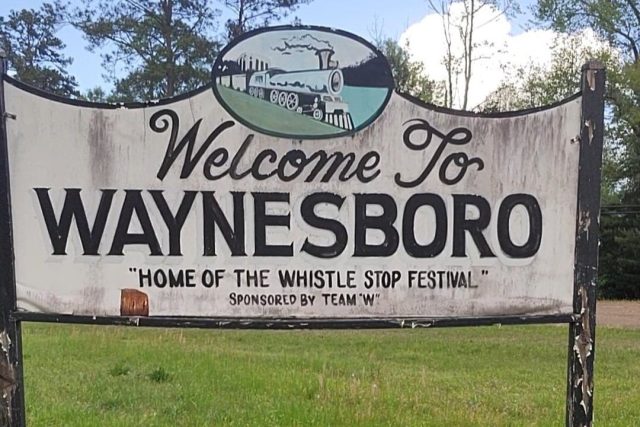
WAYNESBORO, Miss. — Wayne County, Mississippi, in a quiet southeast corner of the state, is home to about 20,000 people surrounded by forest and farmland.
But Wayne distinguishes itself in two ways: it is home to a Sipcam Agro plant that processes the toxic herbicide paraquat. Within the U.S., the plant is the largest single emitter of paraquat.
Wayne County also sees high rates of Parkinson’s disease deaths, in the top 7% of all U.S. counties that reported Parkinson’s deaths between 2018 and 2024.
Troves of evidence have long linked paraquat to Parkinson’s, the world’s fastest-growing – and incurable – neurodegenerative disease.
Due to safety concerns, paraquat is banned in over 70 countries, including China, Brazil, and throughout the European Union. The Environmental Protection Agency warns that “one sip can kill.” It is often used in suicides, since it’s cheap and fatal (for decades, 70% of suicides in Samoa were committed using paraquat). Even wearing PPE does not fully protect applicators from exposure.
Related: North Dakota’s Red River Valley an herbicide and cancer hotspot
Yet despite decades of campaigns, paraquat – a synthetic chemical also known as paraquat dichloride and marketed most commonly as Gramoxone – is still sprayed on millions of acres of farmland every year in the U.S., and its use continues to grow. About 35% of large commercial farms in the U.S. now use paraquat to kill weeds and dry up crops for harvest, often soybean, corn and cotton. It can quickly clear large tracts of lands without having to pay laborers to till. Use of the cheap, broad-spectrum herbicide has more than tripled between 2006 and 2017, a surge the EPA has attributed to a rise in resistance to another popular herbicide called glyphosate, also known as Roundup.
Paraquat was first brought to market in the 1960s by a predecessor of Syngenta, which today imports millions of pounds of paraquat concentrate, primarily from a facility in the U.K., through the Port of New Orleans. The paraquat is then trucked up along the Mississippi River, reformulated and packaged at a facility in the small town of St. Gabriel, in Iberville Parish, Louisiana, in the center of the highly polluted stretch along the Mississippi River known as “Cancer Alley.”
In March, Syngenta announced it would stop producing paraquat.
The company said the herbicide was no longer a significant part of their business due to competition from generic formulas.
But Syngenta’s exit doesn’t mean paraquat will stop entering the U.S. Instead, other companies and other facilities – like the one in Wayne County – will fill the gap, likely increasing the amount of paraquat they handle.
Paraquat is considered a toxic chemical, but not a federally regulated air pollutant – states have the authority to regulate it but generally do not set maximum emissions standards. The Mississippi plant already, as allowed by law, emits tens of thousands of pounds of paraquat into the air, exposing workers and nearby residents. In Waynesboro, hundreds of households, most of them Black, sit within a mile of the plant.
A Mississippi Department of Environmental Quality staffperson, who asked not to be named as he did not have permission to speak to media, confirmed that the Waynesboro plant is currently applying for a permit for increased emissions of federally-regulated air pollutants, such as lead and ozone.
“There is absolutely no doubt in my mind that we’re all victims of our environment,” said Ashton Pearson Sr., a life-long Mississippi resident who was first diagnosed with Parkinson’s disease in 2013, at 58 years old. Pearson now runs a support group for Parkinson’s disease patients and caregivers.
A retired mechanical engineer, Pearson grew up surrounded by agricultural fields in south Mississippi. He spent his youth helping out on his friends’ family farms, during which he sprayed herbicides with a spray rig.
Pearson can’t confirm, decades later, whether he and his childhood friends were exposed to paraquat. What he does know is that, decades later, “we’re all dying off.” He acknowledges he can never be sure what caused his Parkinson’s, but he wants to see products that cause the disease “immediately be taken off the market.”
Pearson was surprised to hear the Waynesboro plant emits a large amount of paraquat. “They ought to have scrubbers in their equipment that prevent that,” he said, comparing it to the controls required for fly ash produced by some coal-fired power plants. When he helped build those plants, he noted, “we weren’t allowed to just run that up the chimney and disperse it into the environment.”

Paraquat production shifting to other places
Syngenta made its announcement while facing thousands of lawsuits, primarily by farmers and farmworkers, who say Syngenta failed to warn people of the links between paraquat and Parkinson’s disease. Researchers from Imperial Chemical Industries, one of the corporate predecessors to Syngenta, found as far back as the 1950s that paraquat had adverse effects on brain tissue and the nervous system. Today’s paraquat producers, led by Syngenta, stringently deny that paraquat causes the disease. Regulators at the EPA have also maintained that the evidence is too weak to ban the chemical.
But a mass of research, including a rigorous 2024 study published in the International Journal of Epidemiology, has repeatedly affirmed the dangers of paraquat. When a person inhales paraquat, it travels into the brain, killing the neurons which produce dopamine, which in some people can lead to Parkinson’s. Long-term exposure to paraquat is also linked to thyroid cancer and childhood leukemia. Farmworkers who mix or apply paraquat are 2.5 times more likely to develop Parkinson’s than farmers who’ve never used it. Even people who live near fields where paraquat is sprayed have increased risks of Parkinson’s and thyroid cancer.
Syngenta has announced it will stop producing paraquat by the end of June.
But nearly 400 companies globally are registered to produce paraquat, and they have many distributors in the U.S. If the Louisiana paraquat facility closes, others, mainly in the South and Midwest, are poised to increase their production.
The Waynesboro facility is supplied by Red Sun, which also sends paraquat concentrate to a chemical manufacturing facility in Ennis, Texas. Other facilitiesformulating or storing paraquat are sited in Leavenworth, Kansas; Tunica, Mississippi; St. Joseph, Missouri; and Middlesex, North Carolina. Two sites each are in Cordele, Georgia and in Memphis, Tennessee.
There are no more paraquat producers in the U.S., since manufacturing costs are lower elsewhere. So whoever sells it, it will be imported – and likely brought through Louisiana. The majority of paraquat entering the U.S. between 2017 and 2024 – 398 million out of 583 million pounds – came through the Port of New Orleans. Huge container ships dock at the port and unload multi-ton tanks of paraquat concentrate, which are then loaded onto freight trucks. The number of shipments has also been increasing. In 2006, the Port of New Orleans imported 14 shipments of paraquat. By 2016, it was 144 shipments, and in 2025, 449, averaging more than one a day, according to data provided by Coming Clean, a nonprofit environmental health collaborative. Most of those shipments were by Syngenta.
Communities near production facilities face health risks
Since 2018, three facilities across the country have reported releasing paraquat into the air to the EPA: the Sipcam plant in Mississippi, a Syngenta subsidiary in Georgia, and a hazardous waste facility in East Chicago, Indiana.
The Georgia plant, which is owned by Syngenta subsidiary Adama in Tifton, released 10 pounds into the air in 2020. The Indiana waste site, which has been penalized for improper storage, reported releasing one pound of paraquat into the air in 2023.
The Mississippi plant was previously owned by Odom Industries, which also formulated herbicides and fungicides. Under Odom, paraquat air emissions hovered around 500 pounds per year, growing to 1,500 pounds in 2022. But they spiked massively in 2023, when Sipcam Agro took over the facility and announced plans to expand – thanks in part to tax credits provided by the Mississippi Development Authority.
By 2024, under Sipcam Agro, airborne emissions soared to over 47,000 pounds: enough paraquat to treat a tract of land larger than the city of Atlanta. The plant released a combined 81,667 pounds of the toxic herbicide into the air in 2023 and 2024. They were reported as fugitive emissions, likely meaning they unintentionally leaked during the industrial processes.
The Lens reached out to Sipcam Agro Solutions for comment, but the company did not respond before publication.
The Director of Communications for MDEQ, Jan Schaefer, said that “MDEQ is aware of the facility and has an open enforcement action related to alleged air violations. While MDEQ cannot elaborate further on an open enforcement action, please know that MDEQ regulates air emissions from the formulation of herbicides” of ingredients classified as ‘hazardous air pollutants.’ Paraquat is not considered a hazardous air pollutant. Leaks of toxic chemicals “would be evaluated as additional information is obtained.”
The amount of paraquat emitted by the Waynesboro plant in 2024 approaches the amount used by California’s largest paraquat user, the farming giant J. G. Boswell Co., across the entire state. Boswell is the largest producer of cotton in the US.
The Lens asked multiple scientists and advocates about the emissions, but none were able to give a precise assessment of what effect 47,000 pounds of airborne paraquat would have on surrounding residents. Little research has been done on paraquat production’s effects on surrounding communities.
But research has been done on communities close to paraquat use and it suggests that far lower levels of exposure have negative effects.
A recent study found that people who live within 1,600 feet of a paraquat application site have 91% higher odds of developing Parkinson’s. And a study last year found that people living on the same water service system as a golf course had double the odds of developing Parkinson’s than those on different water systems.
“That level of paraquat emissions are far above what’s considered to be a major source” for toxic air pollution, said Kimberly Terrell, a research scientist with the Environmental Integrity Project, a nonprofit environmental watchdog. “They are significant.”
Robert Gunier, an environmental health scientist with UC Berkeley’s research institution The Center for Environmental Research and Community Health, echoed Terrell’s concerns: “I can say that is a lot of paraquat, especially if those are air emissions,” he said. He added that they are estimates, so the actual emissions could be higher or lower.
Facilities must report any releases of chemicals considered to have adverse health or environmental effects to the EPA. But neither the EPA nor states set release limits on many of those toxic chemicals. There is no maximum threshold for paraquat emissions.
Gunier added that the paraquat released in Waynesboro would likely be transported in the air and eventually deposited on the ground. Paraquat, which is usually sold in liquid form and used as a spray, isn’t considered to be a chemical that turns into vapor easily, but in 2024, Syngenta submitted new data to the EPA that suggested it might vaporize more readily than previously thought.
In Mississippi, from 2018 to 2024, the mortality rate for Parkinson’s was 12.2 per 100,000 people. Nationwide, the average was 11.5. In Wayne County, Mississippi, the Parkinson’s mortality rate averaged 21.5.
The real rate of people who suffer from Parkinson’s near industrial facilities could be even higher. Terrell, who recently resigned from Tulane University over what she called the school’s “gag order” on her research on pollution-burdened communities in Cancer Alley, noted that county-wide data is often too broad to show the effects of point-source emissions. And Parkinson’s caused by environmental exposure can take years or even decades to show up. The Rust Belt today has some of the highest rates of Parkinson’s, which researchers suspect is a result of the now-defunct industries – like steel mills – that thrived there years ago.
Steel mills once used the solvent trichloroethylene (TCE), mostly used for metal degreasing, and also linked to Parkinson’s.
Facilities are also often built in areas that already disproportionately bear the brunt of industrial pollution, and face worse health outcomes. That can mask rates of Parkinson’s, which is usually only diagnosed after 65 years of age.
The life expectancy for Black residents of Iberville Parish is 69 years, well below the U.S. average of 78. In Crisp County, Georgia, where both Drexel Chemical and Helena Industries have paraquat facilities, the life expectancy for Black residents is just 66 years – so young that symptoms may not yet have become noticeable in a person with Parkinson’s.
Jannette Holifield lives less than a mile from the Sipcam Agro plant that opened in 2015. Her husband, Martin Montelongo, worked at the plant mixing chemicals for years. He died in September 2025. While his death was attributed to a heart attack, Holifield believes a contributing cause was a cough Montelongo had, which came and went and then got worse until he died. Long-term paraquat exposure has been linked to lung scarring. Montelongo was 63.
Organizing and legislation to stop it
“The most important thing is pushing the EPA to ban paraquat,” said Andi Fristedt, executive vice president with the Parkinson’s Foundation. “They could end paraquat use tomorrow.”
In January, the EPA declared it would “reassess” the safety of paraquat. EPA Administrator Lee Zeldin called it “more MAHA [Make America Healthy Again] progress.” Though the EPA is really only continuing reviews begun under the Biden administration, Fristedt believes Zeldin’s statement signals growing popular support for paraquat’s ban.
“The MAHA movement has been really clear that it is well past time to end the kind of chemical threats that we see from compounds like paraquat,” said Fristedt. “It’s just another example of the fact that there’s folks across the political spectrum, at the federal and state level, who are saying, ‘Enough is enough.’”
Fristedt adds that paraquat is not needed for agriculture. A 2023 study found that ending paraquat use “will save lives without reducing agricultural productivity.”
Related: EPA’s move to greenlight controversial dicamba herbicide sparks outrage
As the evidence against paraquat continues to mount, campaigners have turned to the state level. This year, 13 states introduced bills to ban or restrict the herbicide’s use. Bills to ban it remain active in eight states: Illinois, Iowa, Missouri, Minnesota, New York, New Jersey, Vermont, and Pennsylvania. The Vermont House approved its bill in March, but in most other states the bills are still stuck in committees.
Meanwhile, the revolving door between industry and the Trump administration threatens to undermine action. Kelsey Barnes, current senior advisor to U.S. Department of Agriculture Secretary Brooke Rollins, is a former manager of federal government relations for Syngenta. Language introduced in the Farm Bill would pre-empt state bills and prevent state and local bodies from regulating chemicals like paraquat. Organizers’ efforts to remove the language earlier this year were unsuccessful.
“We’re very concerned,” said Fristedt, that the House farm bill is set to strip states of their ability to adopt stronger protections for pesticide use. Such restraints on state-level regulation are extra concerning when the federal government has continued to resist taking action, he added.
“There are so many public health risks that we don’t understand, or that require really complicated solutions,” said Fristedt. “This isn’t one of those.”
This story is a product of the Mississippi River Basin Ag & Water Desk, an independent reporting network based at the University of Missouri in partnership with Report for America, with major funding from the Walton Family Foundation.
Related