Verdict

The Tapo C660 Kit is an affordable, but still impressively capable solar-powered pan and tilt camera that delivers strong 4K footage, genuinely useful tracking, and flexible local storage without forcing a subscription. It is not the prettiest thing you will bolt to a wall, and motion zones still struggle to keep up with a camera that never stops moving, but in everyday use it proves reliable and surprisingly polished. If you want full coverage from a single camera, proper solar performance, and a sensible app that does not fight you at every turn, this is one of TP-Link’s strongest smart security efforts yet.

  • Excellent solar performance

  • Sharp 4K video quality

  • Subscription-free local storage

  • Smart pan and tilt coverage

  • Bulky design

  • Motion zones feel clumsy

  • No Apple Home support

  • Needs mounting high up

Key Features

Introduction

TP-Link has been steadily expanding its Tapo smart home lineup, moving beyond plugs and bulbs into genuinely competitive security cameras, such as this one, the TP-Link Tapo C660 Kit.

In the US it goes by the name Tapo VistaCam 360 Solar, but the premise is the same: one camera, full pan and tilt coverage, 4K video, AI detection handled on the device, and no subscription required unless you actively want cloud storage.

I have had the Tapo C660 Kit watching over my garden for the past few weeks, mounted outdoors and running entirely on solar power. 

Advertisement

Find out how it holds up in the real world in my full Tapo C660 Kit review.

Design and installation

The C660 Kit is certainly not subtle. It is fairly chunky and more utilitarian than stylish, looking closer to something like the Reolink Altas PT Ultra than the sleeker cams from Eufy or Arlo. That said, it feels solid and purpose-built rather than cheap.

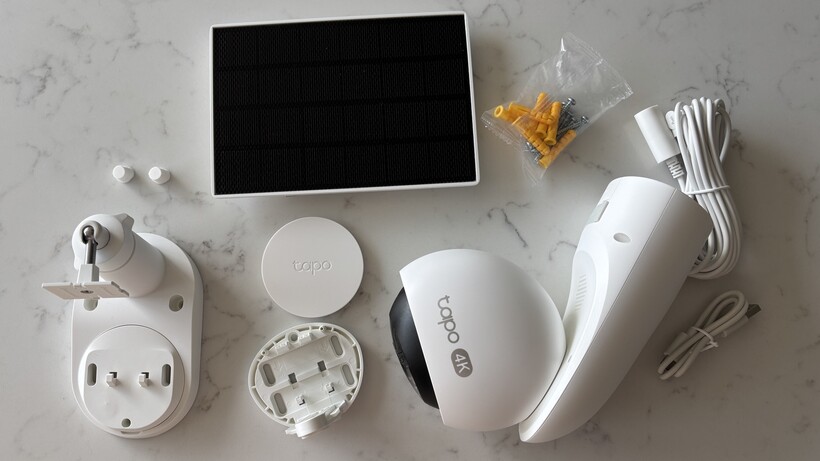
TP-Link Tapo C660 Kit parts

The camera and solar panel both attach to a shared base plate, which you screw into a wall or ceiling.

Advertisement

TP-Link Tapo C660 Kit solar panel
Image Credit (Trusted Reviews)

Once that plate is in place, the camera slots on and the solar panel screws into its own mount. It feels like a single system rather than a camera with an accessory bolted on later, which is something the likes of Reolink are often guilty of.

On the underside of the camera unit itself is a well-sealed rubber flap hiding the microSD card slot, reset button, and power button. Everything is nicely protected and rated IP65, so it is happy living outside year-round.

TP-Link Tapo C660 Kit card slot
Image Credit (Trusted Reviews)

TP-Link recommends mounting the camera at least eight feet up, and that advice matters. The camera cannot tilt up or down very far, so it is designed to look down from a height.

I initially mounted it closer to six feet for convenience and quickly noticed it cropping the heads of anyone standing too close. When mounted higher, coverage is much more natural.

Advertisement

TP-Link Tapo C660 Kit mounting bracket
Image Credit (Trusted Reviews)

Installation itself is quick. You’re obviously supposed to use all four screw holes but, for the purpose of this review, I was just putting it up temporarily for a few weeks on a wooden fence and it held up okay with just the two screws. 

TP-Link Tapo C660 Kit USB-C cable connected for solar
Image Credit (Trusted Reviews)

Plugging the solar panel into the USB-C port underneath the camera completes the physical setup.

Setup, features and the app

  • Records locally or to hub
  • Pan and tilt

Pairing the C660 Kit with the Tapo app is straightforward, although I did hit a small hiccup initially.

Advertisement

Despite a strong Wi-Fi signal in my garden, the camera refused to sync until I moved it closer to my outdoor access point. Once paired, I moved it back to its original position and have had no connection issues since.

TP-Link Tapo C660 Kit app pairing
Image Credit (Trusted Reviews)

A Tapo account is required, which may put off some privacy purists, but the upside is that the app experience is one of the more approachable ones in this category. 

The entire install and setup process took around fifteen minutes, with the app guiding you through storage setup, Wi-Fi testing, mounting advice with clear diagrams, and even a detection range test so you can dial in sensitivity.

TP-Link Tapo C660 Kit setup
Image Credit (Trusted Reviews)

The C660 supports local recording via a microSD card, sold separately, or recording to TP-Link’s HomeBase at no extra cost.

Advertisement

The HomeBase is a hub for Tapo’s sub-gig sensors and supports Matter-over-Wi-Fi devices, allowing it to act as a Matter controller. This means it can connect and control both Tapo smart home devices and Matter-compatible devices from other brands. 

It comes with 16GB of local storage, expandable with an external hard drive to 16TB. It supports Ethernet and 5GHz Wi-Fi, and can manage up to 16 Tapo cameras as well as support ONVIF-compatible camera. I tested the C660 without the HomeBase, but it is an option if you want to built out a bigger system.

Cloud storage is optional via Tapo Care. Crucially, AI detection for people, pets, and vehicles is processed on the device and works without a subscription.

The Tapo Care plan costs $3.49 per month. If you pay yearly, you’ll get a bit of a discount and there are also bulk offers too, if you want more than one Tapo cam keeping tabs on your home.

TP-Link Tapo C660 Kit app
Image Credit (Trusted Reviews)

The Tapp app is pretty good, and not overly confusing, with a nice tiles layout and plenty of easy to understand icons. It’s the same Tapo account as you’d use for  plugs and other devices so you can also include the C660 in native Tapo routines and automations. 

Advertisement

The C660’s pan and tilt is a major strength. The camera offers wide horizontal rotation and generous vertical movement, which combined with the 105-degree lens gives near complete coverage of a typical yard. Motion tracking works well, following people or animals smoothly before returning to a preset home position.

TP-Link Tapo C660 Kit side view
Image Credit (Trusted Reviews)

You can manually pan and tilt – by 326 degrees and by 45 degrees – but the real win is the Viewpoints system. This lets you save up to eight preset angles and jump between them instantly. 

These presets can also be tied into routines, or used as part of a patrol mode that cycles through views automatically. It is genuinely useful, although TP-Link does warn that constant movement could wear the motor over time.

TP-Link Tapo C660 Kit motion detection
Image Credit (Trusted Reviews)

Where things fall down slightly is motion zones. Detection zones are locked to the camera frame, not the physical space. When the camera moves, those zones move with it, often ending up pointed at nothing useful. For a camera designed to move this much, it feels like a missed opportunity.

Advertisement

Performance

TP-Link Tapo C660 Kit lights
Image Credit (Trusted Reviews)

Daytime footage from the C660 Kit looks excellent. Recorded at 4K with up to 20 frames per second (the default is 15fps, so you’ll want to up it in the app), video is crisp and detailed, with enough clarity to pick out fine details at a distance.

TP-Link Tapo C660 Kit day sample
Image Credit (Trusted Reviews)

The 18x digital zoom is predictably soft at the extreme end, but still usable for identifying activity.

There is no HDR, but colours are punchy without looking artificial. You can also tweak image settings like saturation and warmth, which is a nice touch for dialing in the look you prefer.

Advertisement

TP-Link Tapo C660 Kit night sample
Image Credit (Trusted Reviews)

Low light performance is solid. With enough ambient lighting, the camera can deliver colour night vision, helped by its built-in spotlights. If conditions are darker, it falls back to infrared, giving you more flexibility than colour-only systems.

You can adjust spotlight brightness and behavior in the app, or disable them entirely if you prefer a more discreet setup.

Two-way audio is okay, which is about as good as it gets in this category, and the built-in siren and flashing light can be scheduled or triggered on motion if you want a more aggressive deterrent.

One unusual extra is a timed panoramic capture feature, where the camera automatically takes a wide snapshot at a set time of day. It is a little odd, but potentially useful for keeping an eye on changing conditions in a large space.

Solar performance from the included panel is one of the C660 Kit’s biggest strengths. During testing, even after a full week of overcast weather, the battery only dropped to around 79%. A couple of brighter days were enough to bring it straight back to 100%.

Advertisement

TP-Link Tapo C660 Kit solar panel
Image Credit (Trusted Reviews)

Results will vary depending on how busy the monitored area is and how sensitive you set motion detection, but for a typical outdoor setup, manual charging feels like something you will rarely need to think about. 

Continuous recording is also available, with the camera dropping to a low frame rate when idle and ramping up when motion is detected, all while running on battery and solar alone.

Should you buy it?

You want a powerful all-in-one security camera

Great video, pan-and-tilt, solar charging and no subscription fees make this a great choice.

You can’t mount it high enough

This camera needs height to work properly, otherwise it can crop heads out of video footage.

Final Thoughts

The Tapo C660 Kit gets a lot right. It combines reliable solar power, sharp 4K video, and genuinely useful pan and tilt coverage in a package that does not nickel-and-dime you for basic features.

The app is approachable without being dumbed down, and local storage is properly supported rather than treated as an afterthought.

It is not flawless. The design is on the chunky side, and motion zones still feel undercooked for a camera that moves this much. Apple Home users are also out of luck for now although future Matter support could arrive and change this.

Still, if you want a single camera that can watch an entire outdoor space, stay powered without intervention, and avoid ongoing fees, the C660 Kit is an easy recommendation.

Advertisement

How We Test

We test every security camera we review thoroughly over an extended period of time. We use industry standard tests to compare features properly. We’ll always tell you what we find. We never, ever, accept money to review a product.

Find out more about how we test in our ethics policy.

  • Used as our main security camera for the review period
  • We test compatibility with the main smart systems (HomeKit, Alexa, Google Assistant, SmartThings, IFTTT and more) to see how easy each camera is to automate
  • We take samples during the day and night to see how clear each camera’s video is

FAQs

Do you have to pay subscription fees for the TP-Link Tapo C660 Kit?

No, this camera can record to a microSD card or to a hub.

Full Specs

  TP-Link Tapo C660 Kit Review
Manufacturer TP-Link
Size (Dimensions) 185 x 147 x 75 MM
Release Date 2026
First Reviewed Date 28/04/2026
Model Number TP-Link Tapo C660 Kit
Resolution 3840 x 2160
Battery Length hrs
Smart assistants Yes
App Control Yes
Camera Type Outdoor pan-and-tilt
Mounting option Wall
View Field 105 degrees
Recording option SD Card or hub
Two-way audio Yes
Night vision Yes (full colour)
Light Spotlight
Motion detection Yes
Activity zones Yes
Power source Battery (charged via solar or manually)


Source link

Leave a Reply

Subscribe to Our Newsletter

Get our latest articles delivered straight to your inbox. No spam, we promise.

Recent Reviews


Deer Valley’s new terrain expansion is one of the most ambitious projects in modern skiing. The resort plans to nearly double its skiable terrain while maintaining the industry-leading standards it’s known for. We spent an extended trip in early 2026 skiing the new footprint alongside Deer Valley representatives and Olympic skier Fuzz Feddersen to see how it all came together.

Construction is still ongoing, and this season marked the worst snow year in Deer Valley’s history. Even so, we found the new terrain diverse and distinct, yet seamlessly integrated into the legacy Deer Valley experience.

This guide introduces the terrain, lifts, and base-area amenities in Deer Valley’s East Village so you can make the most of the Expanded Excellence initiative.

East Village: A Second Front Door

Keetley Express Opening Day
Photo Credit: Deer Valley Resort.

Deer Valley East Village is seamlessly connected on the slopes, but geographically separate from the main resort, and that separation works in its favor. Accessed via US-189, it bypasses Park City traffic entirely.

Yes, it’s still a work in progress. You’ll see active construction throughout the base area. But the core infrastructure is already in place, and it functions like a fully supported ski base. What’s here now works and what’s coming will only enhance it.

The East Village base area delivers the Deer Valley essentials: free parking, rental shop, ski valet, and East Village Restaurant, where a bowl of the resort’s signature chili tastes especially good on a cold afternoon.

Where to Stay in East Village (25/26 Season)

High hot chocolate at Grand Hyatt Deer Valley Utah
Photo Credit: Jenn Coleman.

For the 25/26 season, the clear lodging choice is the newly completed Grand Hyatt. It offers a signature restaurant, on-site Ski Butlers rentals, a full spa, and shuttle service to Park City and Snow Park. There’s no ski-in/ski-out access yet, but a short shuttle brings you directly to the East Village base.

Additional hotels are expected to open for 26/27, which will further transform East Village into a true walkable ski hub.

We found the Grand Hyatt welcoming and highly functional, particularly with Ski Butlers on-site and a massive locker room that makes gearing up painless. Their High Hot Chocolate service, modeled after high tea but featuring locally processed cocoa, may become a new tradition for us. It’s indulgent enough to stand in for a light meal or serve as a sweet reset between Park City’s famously rich dinners.

The only logistical wrinkle is shuttle coverage. Service does not extend to Empire Canyon (Fireside Dining) or Silver Lake (Stein Eriksen Lodge, Mariposa), so a bit of planning is required. Still, between Snow Park (St. Regis, Cast & Cut) and downtown Park City, dining options are abundant. With new hotels opening next season, you may soon be able to walk to a different restaurant every night and still not try them all.

Snow Science: The Engine Behind the Expansion

Expanded Terrain snowmaking gun
Photo Credit: Deer Valley Resort.

Deer Valley’s reputation has always been built on snow quality, from immaculate corduroy to sophisticated snowmaking. The expansion continues that legacy in a serious way.

The new terrain draws most of its water from Jordanelle Reservoir. Roughly 80 miles of new snowmaking pipe now support more than 1,200 high-efficiency snow guns. The reservoir isn’t just scenic, it’s foundational.

What’s more impressive is the sustainability loop. Deer Valley is allocated just 1% of the reservoir’s available water. Through dedicated irrigation channels, approximately 80% of that allotment is returned by season’s end. Combined with an expanded grooming fleet, that system allowed the resort to open a record number of runs during a historically hot and dry winter.

If you’re wondering how the terrain skied so well in a lean year, this is your answer.

East Village Gondola: The Spine of the New Terrain

East Village Gondola
Photo Credit: Deer Valley Resort.

The 10-passenger high-speed East Village Gondola is one of the two primary lifts out of the base area. It’s a 15-minute, 3,000-vertical-foot ride to Park Peak (9,350’), with a mid-station at Big Dutch Peak (8,170’).

From Park Peak, you access some of Utah’s longest runs along with terrain served by Pinyon Express and the Vulcan Express / Revelator Express lifts.

Green Monster is the headline act: a 4.85-mile green descent between Park Peak and Baldy Mountain, nearly 40% longer than Park City Mountain’s Home Run. It weaves between two blues: Carbonite, which drops along the ridge, and Age of Reason, which follows the valley floor.

Deer Valley partnered with longtime Mountain Host Michael O’Malley to name the new terrain in ways that honor both local mining history and the resort’s evolving identity. “Green Monster” references a Wasatch County copper mine, though you’ll never convince me there isn’t a double entendre for the 37-foot-tall wall in Fenway Park that has foiled many home runs. Common sense tells us that “Age of Reason” is an homage to Thomas Paine, and I could imagine cruising down the exposed ridge would freeze you like the compound that imprisoned Han Solo. However, “Carbonite” is a nod to Park City’s silver mining legacy. 

Names aside, the terrain progression is smart. Carbonite offers a manageable ridge experience before committing to Redemption Ridge. And if confidence wavers, Green Monster provides a bailout.

Another thoughtful touch is Corduroy Lunch. Select freshly groomed terrain off the gondola’s mid-station remains roped until noon. Carving fresh tracks midday is a true afternoon delight. 

Keetley Express: The Connector

Keetley Express lift Deer Valley Ski Resort Utah
Photo Credit: Deer Valley Resort.

Keetley Express is the other primary East Village lift and likely the fastest gateway back to legacy Deer Valley terrain. After the 1.25-mile ride up, a short ski down Road to Sultan brings you to Sultan Express.

Of course, you have to take Sultan up the mountain before you get back to skiing. That sets you up for over 5 continuous miles of green runs if you combine Homeward Bound with McHenry, or take a run on the classic black Stein’s Way. You could also use connectors to access the lower half of Green Monster or McHenry directly, or try the plethora of intermediate runs off Keetley Point.

Advanced skiers should keep Keetley on their radar as well. When conditions align, it’s a sneaky access point to Mayflower Bowl and its quiet pocket of expert terrain.

Aurora: Small but Essential

McHenry / Aurora area Deer Valley Ski Resort Utah
Photo Credit: Jenn Coleman.

Aurora is easy to underestimate. It’s only about 700 feet long and takes two minutes to ride, but it plays a crucial role.

It’s the return lift from McHenry, which connects directly to Silver Lake Lodge, and it services Keetley Point terrain. There’s also a confusing sign near the top of Aurora on Green Monster directing skiers left toward East Village. If you follow it, you’ll earn a short Aurora ride, and remember to hang right next time if you want to return directly to Keetley and the gondola.

Tiny lift. Big utility.

Vulcan Express & Revelator Express: Commitment Terrain

Woman carving Ridgeline at Deer Valley
Photo Credit: Deer Valley Resort.

These lifts rise from one of the steepest valleys in the Deer Valley footprint, so steep that lift towers had to be installed by helicopter.

Redemption Ridge is the signature descent, often described as Stein’s Way on steroids. At roughly twice the length of Stein’s, it drops 2,700 vertical feet over 2.5 miles. Once you commit, you’re in it, with steeper, more technical lines breaking off the ridgeline into the valley.

If that feels ambitious, start on Stein’s to calibrate. Carbonite also offers a similar exposed-ridge experience that’s much more forgiving. But If the snow is right and you can hang, Redemption could be your saving grace from the Bambi Basin blues.

Pinyon Express: High-Alpine Access for Everyone

Pinyon Express Chairlift
Photo Credit: Deer Valley Resort.

Pinyon Express and Revelator both reach Park Peak, but their personalities diverge from there.

Pinyon serves a beginner-friendly zone on the north side of Park Peak, allowing newer skiers to experience high-mountain terrain without intimidation. Clipper stands out because it also connects the East Village Gondola back into legacy Deer Valley terrain, but there are multiple easy route options.

Because Pinyon sits right at the boundary between old and new terrain, it functions as a seamless crossover point. Novice skiers and ski classes can access this alpine playground from either side of the resort.

The Future of Deer Valley Is Already Underfoot

Fuzz_Ski_with_a_Champion
Photo Credit: Deer Valley Resort.

It would be easy to judge an expansion like this on acreage alone. Nearly doubling skiable terrain is headline material in any snow year, let alone the driest season in resort history. But what impressed us most wasn’t the scale; it was the intention.

Expanded Excellence doesn’t feel bolted on. It feels studied. Deliberate. The lift placements make sense. The terrain progression makes sense. Even the names tell a story. You can ski a 4.85-mile green down Green Monster, test your mettle on Redemption Ridge, duck into legacy terrain off Keetley, and end the day with corduroy that rivals anything Deer Valley has ever groomed, all without feeling like you’ve left the original footprint of the resort.

That’s no small feat.

Skiing with Olympic veteran Fuzz Feddersen gave us an insider’s lens, but even without that access, the throughline is obvious: Deer Valley isn’t chasing growth for growth’s sake. They’re building a second front door that will eventually feel as iconic as Snow Park or Silver Lake, and they’re doing it with the same snow science, guest service, and meticulous grooming that built their reputation in the first place.

East Village still hums with construction equipment. You’ll see cranes on the skyline and fresh dirt where hotels will soon rise. But beneath that temporary noise is something permanent: infrastructure that works, terrain that skis well in lean years, and a blueprint that positions Deer Valley for the next several decades.

If this was Expanded Excellence in the worst snow year on record, it’s hard to imagine what it will feel like in a banner winter.

One thing is certain: the future of Deer Valley isn’t coming. It’s already here!

Ready to Book Your Trip? These Links Will Make It Easy:

Airfare:

Insurance:

  • Protect your trip and yourself with Squaremouth and Medjet


  • Safeguard your digital information by using a VPN. We love NordVPN as it is superfast for streaming Netflix


  • Stay safe on the go and stay connected with an eSim card through AloSIM

Our Packing Favs:

  • We LOVE Matador Equipment for their innovative products and sustainability focus. Their SEG45 is a game changer when you need large capacity while packing light.
  • Travel in style with a suitcase, carry-on, backpack, or handbag from Knack Bags
  • Packing cubes make organized packing a breeze! We love these from Eagle Creek

Disclosure: A big thank you to Deer Valley Resort for hosting us, setting up a fantastic itinerary, and usage of some of the images throughout (image credit in hover text ).

For more travel inspiration, check out Deer Valley Resort’s InstagramFacebookTwitter, and YouTube accounts.

As always, the views and opinions expressed are entirely our own, and we only recommend brands and destinations that we 100% stand behind.

Like it? Pin it for later on Pinterest!


Hi! We are Jenn and Ed Coleman aka Coleman Concierge. In a nutshell, we are a Huntsville-based Gen X couple sharing our stories of amazing adventures through activity-driven transformational and experiential travel.


Source link


