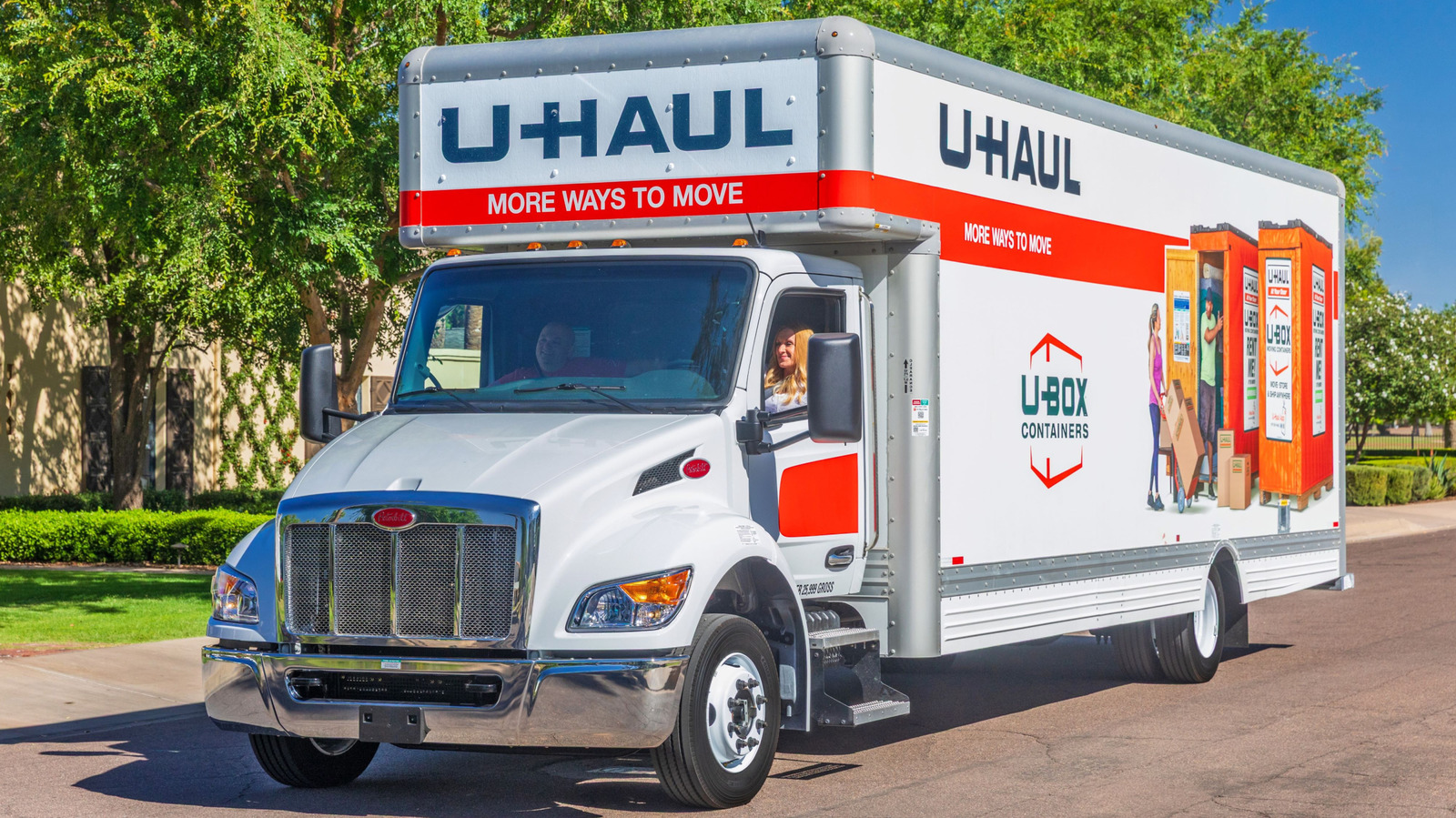
U-Haul’s 36-Foot Peterbilt Is Basically A Semi Truck You Can Rent Without A CDL


Summer is moving season, whether it’s for college students leaving their dorms and apartments for the final time or empty-nesters downsizing to a smaller space in preparation for their golden years. And sure enough, the classic white-and-orange U-Haul trucks and trailers are out and about, helping do-it-yourselfers save as much cash as possible while doing so, a much-needed solution as prices for everything climb ever higher these days.

Those with really large homes (around four to six bedrooms) previously didn’t have much choice, though. Until recently, the biggest U-Haul truck size available was a 26-foot truck combined with a 6-foot by 12-foot cargo trailer, a combo that, while doable, likely wasn’t ideal (especially on the pocketbook). That all changes this year, however. On May 20, 2026, U-Haul revealed its newest (and biggest) beast of burden, the Easy Mover “EM” 29-foot box moving truck — and you can rent it even with a standard driver’s license.

U-Haul’s Easy Mover is Peterbilt to make everyone’s move a breeze

Built in collaboration with Peterbilt at U-Haul’s plants in Pomona, California, and Warrington, Pennsylvania, this big daddy of the moving scene is one you won’t need a commercial driver’s license (CDL) to drive down the open road to your new home. The new truck is one pound under the max gross weight limit of 26,000 pounds; unladen, it weighs 14,000 pounds.

Despite its size, this truck should be easy to drive. For one, the nose of this heavyweight, which houses a turbocharged Cummins B6.7 Octane engine that produces 300 hp and 660 lb-ft of torque, is short enough not to impede maneuverability in tight urban streets. The extra-large windshield and sloped hood help, too, by offering better visibility. Plus, you won’t need to know how to row your own gears thanks to the eight-speed automatic moving those draft horses to the dually axle out back.

Other familiar features include cruise control, power windows and locks, low steps for ease of entry and exit, and a quiet cab that seats three across. Sure, it’s not your usual Ford F-350 Super Duty or even a Toyota Tundra, but this U-Haul Peterbilt offers the big truck experience while making you and your fellow drivers feel right at home.

Size does matter when it comes to making the big move

Of course, it wouldn’t really be a U-Haul if this 36-foot Peterbilt didn’t have the U-Haul cargo box to back up its immense size. The overall box measures 29 feet, with a 3-foot “Mom’s Attic” over-cab storage area and a 26-foot load floor; the total cargo area is 2,057 square feet. The air-bag suspension lowers the box down to 30 inches, complementing the 16.8-degree loading ramp angle for easy loading and unloading of your family’s treasured belongings. If you still need to haul something behind this big truck, it can tow up to 10,000 pounds.

Now, for the rough news: U-Haul says to expect around 8 mpg, two fewer than its Ford F-650 moving trucks. The Peterbilt drinks from a 60-gallon fuel tank, which works out to around 480 miles before you’ll have to stop for fuel. It’ll be an expensive stop, especially after gas prices hit a four-year high in early May 2026. According to the AAA, the national average currently sits at around $4.52/gallon for regular, which is what this truck, like all of U-Haul’s powered fleet, uses.

It’s also available for rent only in Los Angeles and Philadelphia for now, with in-town moves beginning at $49.95; one-way rates vary based on origin, destination, and other fees. Either way, the highways and neighborhoods are about to see a new player in the moving game this summer. Just mind those turns when driving through the neighborhood to your new home; this isn’t your usual moving truck, after all.


Source link

Leave a Reply

Subscribe to Our Newsletter

Get our latest articles delivered straight to your inbox. No spam, we promise.

Recent Reviews


Flip phones are making a comeback, but most US adults aren’t convinced enough to upgrade. 

Smartphone brands are trying new phone concepts, like flip and foldable phones, to give us a bigger screen when we want it, while still maintaining the same functionality as the smartphones we’re used to. There’s the Samsung Galaxy Z Fold 7, for instance, and there’s even a rumor that Apple plans to release its first foldable phone

And if you remember the popular 2000s Motorola Razr, now there are rumors about the Motorola Razr 2026 — it reminds me of my old pink phone. But gone are the days of a basic keypad and a few ringtones. Smartphone brands are adding AI features, such as creating custom emoji, removing background objects from photos, and live translation. 

Yet a recent CNET survey says smartphone users aren’t sufficiently impressed by new features and concepts to consider upgrading their phones. Only 12% are motivated by AI integrations and 13% by new phone designs. Instead, price (55%) and longer battery life (52%) are the biggest drivers of their decision to get a new phone. 

If most US adults aren’t sold, why are tech brands so adamant? Let’s dive into CNET’s findings and what they mean for the future of smartphones.

  • The top three motivations for US adult smartphone owners to consider upgrading their devices are price (55%), longer battery life (52%) and more storage (38%). That’s the same top three as last year: In 2025, price was the top motivator (62%), followed by longer battery life (54%) and storage capacity (39%). 
  • Despite AI’s growing presence, only 12% of smartphone owners say AI integrations would motivate them to consider upgrading. 
  • Only 13% of smartphone owners would be motivated to consider upgrading to a new phone concept, such as a foldable or flip phone. 
  • Over half of smartphone owners (58%) experience frustration with their phone’s battery life, and 31% say their phone’s battery doesn’t hold a charge as well as it did when it was new.  

Most US adults aren’t motivated by new smartphone features and designs

Smartphone brands, like Samsung and Apple, are building in convenient features, such as a tool to remove unwanted objects from pictures, AI call screening and the ability to draft a message from a prompt. However, CNET found that US adults would consider upgrading for more practical reasons. Over half (55%) of US smartphone users are motivated by price, including 53% of Apple users and 56% of Samsung users. 

Yet brands are still exploring new concepts and features, like Apple Intelligence, a built-in AI feature. Then there’s the rumor of a book-style iPhone, potentially followed by a clamshell foldable design. But that’s not what most smartphone owners are after. 

Smartphone owners are more convinced by other design and feature factors when deciding on a new phone, such as camera features (27%) and the phone’s display or screen size (22%). Here are the top motivators to consider upgrading for all smartphone users.

Zain Awais / CNET

You’ve probably noticed the price of a basic smartphone has increased drastically over the years. Take the iPhone, for example. It was originally $600 for 4GB. But advanced features, the RAM shortage, inflation and tariffs are pushing prices even higher. Now, the baseline iPhone 17 (256 GB) is $800, and the Samsung Galaxy S26 (256 GB) starts at $900. 

There’s no way of knowing for sure, but these may be the lowest prices we’ll see on new models for a while, especially as features advance and designs become more complex. So if you’re already in the market for a new phone, you might want to think seriously about pulling the trigger now if you find a good deal.

The top upgrading motivators haven’t changed much over the years

Looking back at CNET’s survey data from 2024 and 2025, and now, people’s motivators for upgrading their phones haven’t changed much. Price, longer battery life and more storage have been top drivers in the past, and despite small dips this year, they’re still key upgrading factors.

Despite design upgrades and new features, smartphone owners are still focused on how much they’re paying and how long they can use their devices without needing a charger. Consumer sentiment about AI integrations dropped hard from 2024 to 2025, but it has edged up slightly in 2026. And smartphone owners aren’t as easily persuaded by phone color or the phone being thinner, either. 

Even with these nice-to-have capabilities, smartphone owners are looking at the basics. That includes practical features like battery life and more storage to hold their many important files, photos and apps. 

Most smartphone owners want better battery life

Taking a closer look at smartphone users’ hope for longer battery life in a new phone, over half (58%) are frustrated with their current phone’s battery life. Roughly one in three (31%) say their phone doesn’t hold a charge. 

The reality is, battery life will decline the longer you have your phone, so you may find your phone’s battery charge doesn’t last as long as it used to. Even though you can replace your phone’s battery, most phone batteries have a lifespan of two to three years before they start degrading. 

CNET Director of Editorial Content Patrick Holland examined battery life tests on over 35 current smartphones. And it’s not just iPhones that pack impressive batteries.

Based on CNET’s lab testing, the $1,200 iPhone 17 Pro Max had the best overall battery life, with a 5,088-mAh capacity. Another top performer was the $900 OnePlus 15, with a 7,300-mAh battery. 

If you’re looking for a phone with better battery life, consider one with a silicon-carbon battery to increase capacity without requiring a larger phone. The OnePlus 15, Poco F7 Ultra, OnePlus 13R and OnePlus 15R all feature silicon-carbon batteries with large capacities and all performed well in Holland’s testing. Keep in mind that other factors can impact your battery life, like your carrier’s signal, software efficiency and processor. 

Methodology

CNET commissioned YouGov Plc to conduct the survey. All figures, unless otherwise stated, are from YouGov Plc. The total sample comprised 2,486 adults, of whom 2,407 owned a smartphone. Fieldwork was undertaken from April 29 to May 1, 2026. The survey was carried out online. The figures have been weighted and are representative of all US adults (aged 18 plus). 


Source link