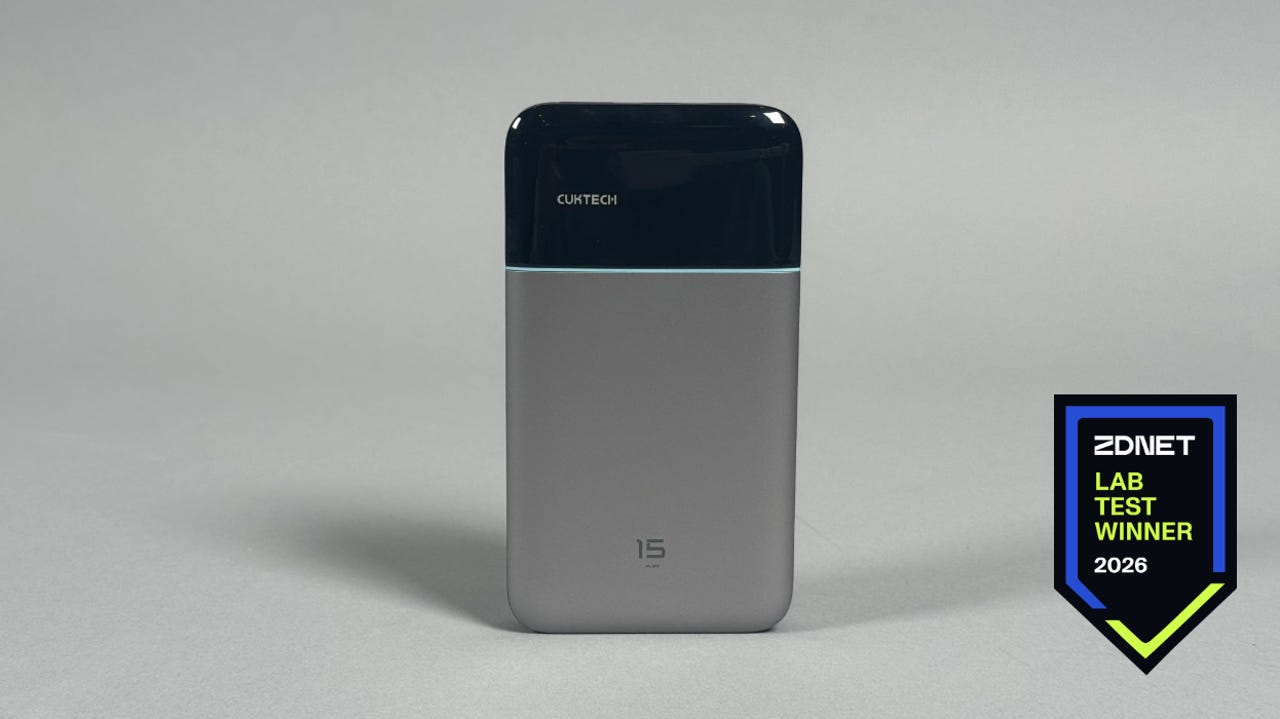
We tested 10 power banks in our lab – and this one had the fastest charge


ZDNET power bank lab award badge

Gianmarco Chumbe/ZDNET

Follow ZDNET: Add us as a preferred source on Google.


The hidden hero behind all our favorite tech devices is the power bank. Power banks charge our devices while on the go, whether you’re camping, traveling, or just away from a power source for a few hours. While some have handy features like different port options, or a slimmer or more durable build, or safety precautions, the thing that really matters most is how fast a power bank charges. 

Also: The best power banks you can buy

We compared 10 power banks from popular brands like Anker, Baseus, and UGREEN, based on our gadget reviewer Adrian Kingsley-Hughes‘ recommendations from his real-world testing, as well as the products we’ve tested in our Louisville-based lab. Our goal was to measure power banks’ energy data rather than manufacturer specifications or onboard charge indicators to determine the approximate charge-completion times. 

Based on our data-driven comparison process of how quickly each unit reached charge milestones of 50%, 80%, and 100%, the power bank that charged the fastest was the Cuktech 15 Air

How we tested these power banks

To test these power banks, we used a HOBOware plug load logger to measure the energy (Wh) drawn from the wall to charge each power bank from 0% to 100% battery. All units were charged using a 70W USB-C power adapter. The logger recorded energy consumption at one-minute intervals, and we then summed these per-minute readings to obtain the total cumulative energy used over the charge cycle. 

power bank charging

Gianmarco Chumbe/ZDNET

Using the cumulative energy curve and its timestamps, we interpolate the elapsed time at which each unit reaches the 50% and 80% points, as well as full charge, and report these as charge-milestone times. In our testing, the shorter the time span, the faster the unit charged. 

Gianmarco Chumbe, the ZDNET lab’s product testing manager, noted a few caveats to the testing. “Charge milestones are based on cumulative input energy measured at the wall, providing a consistent reference point across all units tested,” he said. “Because input energy includes normal charging overhead, reported figures reflect energy delivered to the charger rather than energy stored in the cells.”

The results

Based on our test results for how long each power bank took to charge to 100% (Fig. 1), the Cuktech 15 Air was the fastest, charging in only 54 minutes. It also took only about 26 minutes to charge to 50% (Fig. 2), which is great for those who want a quick top-up. 

In our hands-on testing, Hughes also noted that the Cuktech 15 Air also supports pass-through charging, so it can be charged itself while powering other devices. 

Review: Cuktech 15 Air

An honorable mention goes to the Anker Prime power bank: Despite it having a significantly higher capacity (250Wh) than the Cuktech 15 Air, it fully charges in just 100.2 minutes (1.67 hours).

Another interesting result we found was the Baseus EnerGeek GX11 4G MiFi — it was by far the quickest power bank to charge to 50% in just above 13 minutes; however, it took more than 3 hours to charge fully to 100%. This, of course, could be attributed to the fact that this unit also doubles as a hotspot that can charge up to 10 devices at once. 

Our test results might differ from your own experience with power banks, depending on the power source you’re using to charge a device, as well as other factors. However, as a baseline, our testing provides expert analysis of how quickly flagship power banks from top brands charge. 

  • Battery size: Power banks range from giving your device a single charge to several charges, and may increase in size and price accordingly. Anything with a battery capacity below 7,500 mAh can be considered a small power bank, while 7,500 to 20,000 mAh are medium power banks, and anything above 20,000 mAh are large power banks better suited to those wanting to charge laptops and such or who are going to be away from a power outlet for a few days.
  • Portability: Some people want giant power banks for multi-day adventures, while others want something small they can hold in their pocket or purse for daily charging or emergencies. 
  • Design: Some want something stylish and sleek, while others want something more like a charging computer than a simple power bank.
  • Weight: Big power banks can really pull on your pocket or bag, so choose wisely if you intend to carry it around with you.
  • Ports: Do you want one or two or more ports? Do you need USB-A or will USB-C be fine? These are points to consider before making a purchase.
  • Passthrough: Do you want to be able to charge the power bank while it is charging other devices? This is a handy feature when traveling because you can use the power bank as a charger for multiple devices.


Show more

Lithium-ion batteries — the batteries found in most power banks — are good for about 800 recharge cycles.  This means if you used a power bank daily, and each day you ran it empty before recharging it for the next day, you’d get more than two years of life.

In reality, people easily get 5 years from a power bank, and normally, it’s technology moving forward and making the power bank obsolete that kills it, not usage.



Show more


Source link

Leave a Reply

Subscribe to Our Newsletter

Get our latest articles delivered straight to your inbox. No spam, we promise.

Recent Reviews


When you envision a tropical getaway in the Philippines, Bohol is often associated with the Chocolate Hills and the large, lively beaches of Panglao Island. For most tourists, the adventure begins the moment they step off the Cebu to Bohol ferry, eager to immerse themselves in the island’s legendary beach lifestyle. 

However, there is a secret that only experienced island-hoppers and natives know: the best beach in Bohol is actually not where all the action is.

Have you ever been to Bohol and found yourself dodging selfie sticks or competing for a square inch of sand? Then you know that the magic doesn’t happen where the crowds are, but when you get off the beaten path. But what is it about these less-visited shores that are stealing the hearts of those who know where to look? Let’s find out. 

The Psychology of Paradise: Why Less is Truly More?

There is a particular type of peace that can only be achieved when the loudest sound you can hear is the retreat of the tide over broken coral. In the more popular areas of the island, the beach experience is almost like a show with music from bars, street vendors selling sunglasses, and the ever-present sound of motorized boats. While this is exciting for a night out, it does not have the heart of a real island vacation.

The best beach is more than just the brightness of the sand and the clarity of the water; it is about the sense of being a part of something small and special. 

When you discover a beach that is not on every Top 10 list, you are not just a visitor; you are a guest of the land. You get to witness the local fishermen unloading their morning catch instead of a jet ski line. You get to witness the stars without the neon lights of a bar. 

This is the main reason why travelers are now beginning to seek out something new, something different from the popular Alona Beach.

The Problem with Popularity

Let’s not forget that beaches like Alona are popular for a reason. They are stunning. However, with popularity comes development, and development can lead to the degradation of the very thing that drew visitors in the first place. Overcrowded beaches deal with problems like light pollution (which affects sea turtles), noise that chases away native birds, and the inevitable tourist tax on everything from coconuts to cocktails.

On the other hand, quiet and secluded beaches boast of finer sand and more vibrant reefs because they have not faced the same level of foot traffic and boat anchors. 

So, Where are These Hidden Gems?

If you’re ready to trade the crowds for a bit of solitude, here are the beaches that truly define the beauty of Bohol:

1. Dumaluan Beach

Technically still on Panglao Island but lightyears away from the hustle and bustle of Alona, Dumaluan has a much wider shoreline and shallower waters. It’s a favorite among locals, which makes it have a much more down-to-earth and authentic feel. The resorts are also not as packed, which means you get to breathe.

2. Anda White Beach (Quinale Beach)

Anda is situated on the eastern tip of the island and is also known as the next Boracay, minus the high-rise buildings. The beach is famous for its white and fine sand, which stretches for kilometers. It is also a peaceful haven since it is a few hours away from the nearest port. It is one of those places where you can walk for twenty minutes without seeing anyone.

3. Doljo Beach

Hidden away in the northwest corner of Panglao, Doljo is the best spot to watch the sunset. It is renowned for its untouched coral reefs and historic coconut trees that stretch towards the water. There are hardly any commercial developments in this area, which makes it ideal for a long walk while the sun sets.

4. Pamilacan Island

Although you have to take a short boat ride to get there, the beaches of Pamilacan are famous. This small island used to be a whaling ground but is now a protected marine sanctuary. The water is so clear that it is like glass, and the sand is soft white sand and sun-bleached shells. It is the epitome of an off-the-beaten-path paradise.

5. Momo Beach

If you are looking for a rustic experience, Momo is the place to be. It is a shallow beach that is largely occupied by locals, so it is a peaceful and unpretentious destination that is free from all the usual tourist trappings. It is a good place to sit back and watch the colors of the sky change or to read a book under a palm tree.

How to Get to Your Slice of Quiet?

Does it require more work to reach these destinations? A little bit. But that is the filter that makes these destinations unique. The majority of tourists go with the flow. They alight from the ferry, ride a tricycle to the closest resort, and stay there.

If you want a better experience, you have to plan ahead. Come to Bohol via the Cebu to Bohol ferry, which docks in Tagbilaran City. From there, instead of going with the majority to the southwest, you can rent a scooter or a private car to go east to Anda or north to the less crowded areas of Panglao.

The Verdict: Is it Worth the Journey?

Ask anyone who has ever spent a morning alone on the deserted shores of Anda or a sunset alone at Doljo, and the answer is always a resounding yes.

The best beach in Bohol is not a destination where you go to be noticed. It’s a destination where you go to be forgotten for a little while. It’s all about the indulgence of emptiness, the richness of local culture, and the possibility of reconnecting with nature without the filter. When you move away from the masses, you’re not just viewing a beach; you’re living the essence of the island.

The next time you find yourself planning a trip to the Visayas, remember that the most beautiful sights are sometimes only a few miles beyond where everyone else stops. Are you ready to discover your own hidden shore?

Hi! We are Jenn and Ed Coleman aka Coleman Concierge. In a nutshell, we are a Huntsville-based Gen X couple sharing our stories of amazing adventures through activity-driven transformational and experiential travel.


Source link