What Does 2CT Mean On Michelin’s Motorcycle Tires?


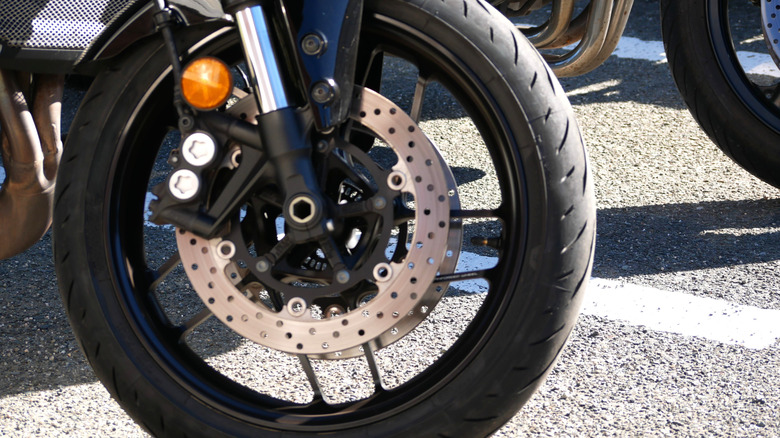
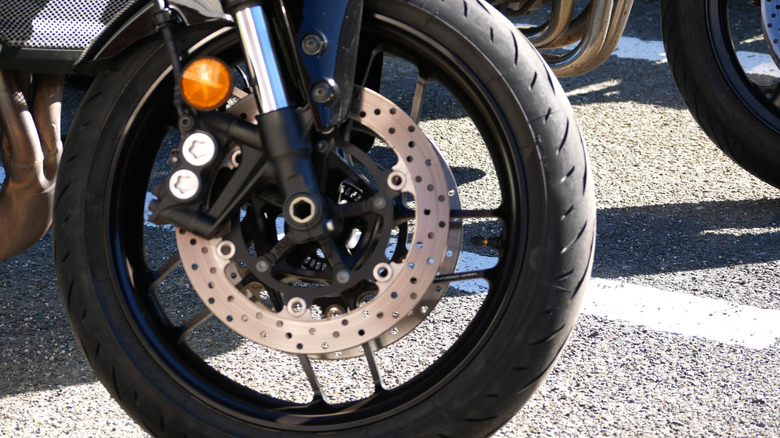
Many Michelin tires built for sports bikes today have 2CT stamped onto the sidewall. And if you’ve ever wondered what that means, it actually does stand for something — it isn’t one of those machine-generated model codes. 2CT stands for Two Compound Technology, and it’s Michelin’s exclusive shorthand that conveys the tire is made up of two different rubber recipes. This is not the only useful feature on a Michelin tire, but it’s one of the more telling ones.

It’s not like these two compounds are ground into paste and distributed equally around the tire, though. One of them is actually limited to just the middle strip, while the other takes up the rest. The middle of a motorcycle tire takes the brunt of regular riding, since bikes obviously spend most of their time rolling in straight lines. But when you lean into a corner, especially at high speeds, that’s when the shoulders come into play. Because of this, both sections end up wearing at very different rates, so it makes sense to build them out of different materials to match the different conditions they are subject to.

That’s exactly what Michelin did. They tossed a harder compound into the middle, one that favors longevity and high wear resistance. Meanwhile, the shoulders got a more supple compound, reportedly 20% softer than the center, with the goal of maximizing mechanical grip around corners. The exact differences in materials between the two hasn’t been officially revealed, though the tire in its entirety uses silica-infused rubber, aramid fibers, and radial construction.

How 2CT came to be

2CT tires get a lot more interesting for racing enthusiasts once you dig into their history. These were initially designed for Michelin’s racing program way back in 1994. At the time, they weren’t officially labeled 2CT yet, and were simply referred to as dual-compound tires. From there, the tire took a good decade to filter down into road-legal designs consumers could buy. The first consumer-oriented model, the Power Race, was launched in 2005, and was the first tire to wear the 2CT badge. But even then, it was strictly track-focused.

Four years later, motorcyclists were finall treated to the first proper road-going tire to use the 2CT badge. This was the Pilot Power 2CT, which dropped in 2009 and is still in production today.

One quirk worth flagging about this line is that while the Pilot Power 2CT was the first to feature the 2CT branding, the meaning of 2CT has since expanded. Today, it’s evolved from a specific model identifier into a universal label for all tires from the company using the same technology. So 2CT now also shows up on scooter rubber and ADV tires, like is the Anakee Adventure 2, an 80/20 adventure-touring tire built for riders who also go off-road occassionally.

There’s another newer and upgraded version worth mentioning called 2CT+, which was first introduced on the Power RS tire back in early 2017. It packs a harder layer of rubber underneath the soft shoulder compound, in order to offer a firmer ride for the everyday street rider. Today, Michelin Pilot Power 2CT tires typically cost between $147 and $195 per tire and can be picked up both individually and in sets. Beyond Michelin, most major motorcycle tire brands offer their own dual-compound options now, although Michelin will forever be recognized for getting there first.


Source link

Leave a Reply

Subscribe to Our Newsletter

Get our latest articles delivered straight to your inbox. No spam, we promise.

Recent Reviews


Flip phones are making a comeback, but most US adults aren’t convinced enough to upgrade. 

Smartphone brands are trying new phone concepts, like flip and foldable phones, to give us a bigger screen when we want it, while still maintaining the same functionality as the smartphones we’re used to. There’s the Samsung Galaxy Z Fold 7, for instance, and there’s even a rumor that Apple plans to release its first foldable phone

And if you remember the popular 2000s Motorola Razr, now there are rumors about the Motorola Razr 2026 — it reminds me of my old pink phone. But gone are the days of a basic keypad and a few ringtones. Smartphone brands are adding AI features, such as creating custom emoji, removing background objects from photos, and live translation. 

Yet a recent CNET survey says smartphone users aren’t sufficiently impressed by new features and concepts to consider upgrading their phones. Only 12% are motivated by AI integrations and 13% by new phone designs. Instead, price (55%) and longer battery life (52%) are the biggest drivers of their decision to get a new phone. 

If most US adults aren’t sold, why are tech brands so adamant? Let’s dive into CNET’s findings and what they mean for the future of smartphones.

  • The top three motivations for US adult smartphone owners to consider upgrading their devices are price (55%), longer battery life (52%) and more storage (38%). That’s the same top three as last year: In 2025, price was the top motivator (62%), followed by longer battery life (54%) and storage capacity (39%). 
  • Despite AI’s growing presence, only 12% of smartphone owners say AI integrations would motivate them to consider upgrading. 
  • Only 13% of smartphone owners would be motivated to consider upgrading to a new phone concept, such as a foldable or flip phone. 
  • Over half of smartphone owners (58%) experience frustration with their phone’s battery life, and 31% say their phone’s battery doesn’t hold a charge as well as it did when it was new.  

Most US adults aren’t motivated by new smartphone features and designs

Smartphone brands, like Samsung and Apple, are building in convenient features, such as a tool to remove unwanted objects from pictures, AI call screening and the ability to draft a message from a prompt. However, CNET found that US adults would consider upgrading for more practical reasons. Over half (55%) of US smartphone users are motivated by price, including 53% of Apple users and 56% of Samsung users. 

Yet brands are still exploring new concepts and features, like Apple Intelligence, a built-in AI feature. Then there’s the rumor of a book-style iPhone, potentially followed by a clamshell foldable design. But that’s not what most smartphone owners are after. 

Smartphone owners are more convinced by other design and feature factors when deciding on a new phone, such as camera features (27%) and the phone’s display or screen size (22%). Here are the top motivators to consider upgrading for all smartphone users.

Zain Awais / CNET

You’ve probably noticed the price of a basic smartphone has increased drastically over the years. Take the iPhone, for example. It was originally $600 for 4GB. But advanced features, the RAM shortage, inflation and tariffs are pushing prices even higher. Now, the baseline iPhone 17 (256 GB) is $800, and the Samsung Galaxy S26 (256 GB) starts at $900. 

There’s no way of knowing for sure, but these may be the lowest prices we’ll see on new models for a while, especially as features advance and designs become more complex. So if you’re already in the market for a new phone, you might want to think seriously about pulling the trigger now if you find a good deal.

The top upgrading motivators haven’t changed much over the years

Looking back at CNET’s survey data from 2024 and 2025, and now, people’s motivators for upgrading their phones haven’t changed much. Price, longer battery life and more storage have been top drivers in the past, and despite small dips this year, they’re still key upgrading factors.

Despite design upgrades and new features, smartphone owners are still focused on how much they’re paying and how long they can use their devices without needing a charger. Consumer sentiment about AI integrations dropped hard from 2024 to 2025, but it has edged up slightly in 2026. And smartphone owners aren’t as easily persuaded by phone color or the phone being thinner, either. 

Even with these nice-to-have capabilities, smartphone owners are looking at the basics. That includes practical features like battery life and more storage to hold their many important files, photos and apps. 

Most smartphone owners want better battery life

Taking a closer look at smartphone users’ hope for longer battery life in a new phone, over half (58%) are frustrated with their current phone’s battery life. Roughly one in three (31%) say their phone doesn’t hold a charge. 

The reality is, battery life will decline the longer you have your phone, so you may find your phone’s battery charge doesn’t last as long as it used to. Even though you can replace your phone’s battery, most phone batteries have a lifespan of two to three years before they start degrading. 

CNET Director of Editorial Content Patrick Holland examined battery life tests on over 35 current smartphones. And it’s not just iPhones that pack impressive batteries.

Based on CNET’s lab testing, the $1,200 iPhone 17 Pro Max had the best overall battery life, with a 5,088-mAh capacity. Another top performer was the $900 OnePlus 15, with a 7,300-mAh battery. 

If you’re looking for a phone with better battery life, consider one with a silicon-carbon battery to increase capacity without requiring a larger phone. The OnePlus 15, Poco F7 Ultra, OnePlus 13R and OnePlus 15R all feature silicon-carbon batteries with large capacities and all performed well in Holland’s testing. Keep in mind that other factors can impact your battery life, like your carrier’s signal, software efficiency and processor. 

Methodology

CNET commissioned YouGov Plc to conduct the survey. All figures, unless otherwise stated, are from YouGov Plc. The total sample comprised 2,486 adults, of whom 2,407 owned a smartphone. Fieldwork was undertaken from April 29 to May 1, 2026. The survey was carried out online. The figures have been weighted and are representative of all US adults (aged 18 plus). 


Source link