What Is The Difference Between Fuel Economy And Fuel Efficiency?


Fuel economy and fuel efficiency get used interchangeably all the time, but they’re not actually the same thing. One is a specific measurement, and the other’s more of a broader concept. Knowing which is which can make all the difference, both for a vehicle’s performance and estimating its fuel costs. It’s all about looking beyond the traditional mpg figure to see the big picture.

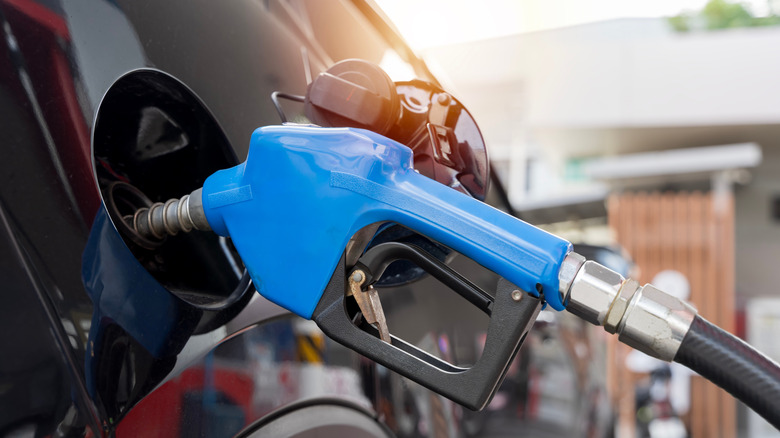
In the simplest of terms, fuel economy is miles per gallon (MPG). It gives you an estimate of how far a vehicle can travel using one gallon of fuel. On paper, a sedan rated at 30 mpg can travel 30 miles on a gallon of gasoline. But fuel efficiency will tell you how effectively that sedan actually converts that fuel into motion. If it’s too big, too heavy, or driving too fast, fuel economy can take a hit. For that reason, a vehicle can have an efficient engine, but poor fuel economy.

A different way to measure fuel consumption
This nuance between fuel economy and fuel efficiency is why some are pushing to measure fuel consumption by gallons used over a fixed distance rather than miles traveled per gallon. The argument is that gallons per 100 miles gives drivers a more accurate description of how much fuel a vehicle burns, not unlike the calculation to find MPGe.

Automotive researcher Edmunds says it best. In its example, an SUV with a fuel economy of 12.5 mpg uses eight gallons to travel 100 miles, but a sedan with a fuel economy of 25 mpg uses four gallons over the same distance. Likewise, a 50-mpg hybrid would need two gallons. By thinking of it this way, Edmunds explains, you can see both fuel economy and fuel efficiency in one metric… revealing “how much gas is saved in each case.” 

Sticking with Edmunds’ exercise, think about a 25-mpg sedan and a 50-mpg hybrid. Fuel economy would make you think the hybrid is more efficient than the sedan because the mpg figure doubles. But in reality, the difference is only two gallons saved per 100 miles. Meanwhile, a 25-mpg sedan saves four gallons over a 12.5-mpg SUV using eight. That’s better fuel efficiency.

Here’s what to take away from all this math: Fuel economy measures distance traveled per gallon, while fuel efficiency tells you how effectively a vehicle uses fuel overall. To get the best picture, think in terms of fuel consumption rather than fuel economy alone.


Source link

Leave a Reply

Subscribe to Our Newsletter

Get our latest articles delivered straight to your inbox. No spam, we promise.

Recent Reviews


Google is experimenting with a new policy restricting the amount of free storage provided to some accounts. New Google accounts (including new Gmail accounts) created in certain regions will be limited to 5GB of free storage when they’re first set up. That’s only one-third of the amount of storage that has been typically offered. There is a way of increasing the amount of free storage you get when setting up a new account, though: you can unlock it by linking your phone number.

When approached for comment by Android Authority, a Google spokesperson confirmed that the new policy was being tested to “help us continue to provide a high-quality storage service to our users, while encouraging users to improve their account security and data recovery.” The statement didn’t clarify which regions the policy is being tested in, nor for how long the testing period will last.

Notably, a Google One Help support page about account storage has been updated to state that each Google account contains “up to 15 GB of storage”, as noted by 9to5Google. Previously, the page didn’t say “up to”; it simply stated that accounts come with 15 GB of storage. So far, the experiment doesn’t appear to stretch to pre-existing accounts.

Per a screenshot shared by Reddit user Sungusungu on R/DeGoogle (a subreddit dedicated to finding alternatives to Google services and products) Google is collecting phone numbers to make sure that the full 15 GB of storage is only redeemed once per person. Of course, that’s easily evaded by using a burner phone to set up multiple accounts, should you want to. The pop-up directs users to a webpage to learn more about storage management. However, at the time of writing, the link redirects to the help center landing page instead.

How to link your Google account with a phone number

If you’re in the process of setting up a new Google account in an impacted region, then you might be prompted with the option of unlocking an extra 10 GB of storage using your phone number via a simple pop-up menu. If so, you can go ahead and follow those steps. However, if you want to link your phone number with a pre-existing Google account, then here’s what you need to do. Using your computer, you need to:

  1. Open your browser and head to myaccount.google.com, then navigate to “Security and sign in” on the left-hand toolbar. This should open a list of security options.

  2. Select “Use your phone to sign in” and then “Set it up”. 

  3. Add a phone number using the “Recovery phone” option.

  4. Follow the on-screen steps to verify your number and finish linking it to your account.

Your options might look a little different if you already have a recovery number set up with your account.

Alternatively, you can connect a phone number to your Google account from your Android device, iPhone, or iPad. Much like on a computer, you connect your number by adding it as a recovery phone. First, head over to myaccount.google.com. Then select “Personal info”, followed by “Phone”. From there, you should be able to add or edit your phone number by navigating to the “Recovery phone” section.


Source link