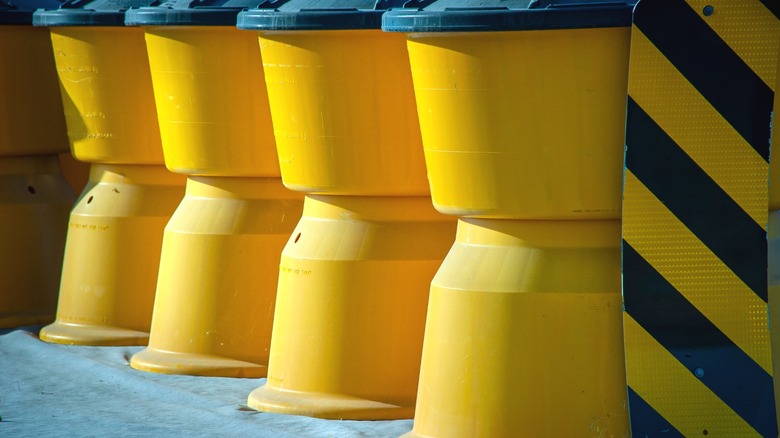

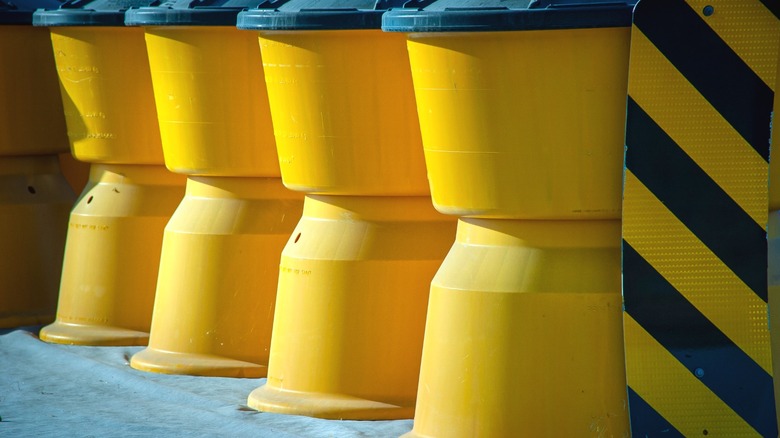
You’ve likely noticed yellow barrels alongside a highway, sometimes in temporary construction zones and other times placed in more permanent locations. Given their bright color, it’s obvious that drivers are supposed to notice them, but exactly what purpose do these barrels serve? Are they simply larger versions of traffic cones to alert drivers of objects in the road, or are they doing something different?
Like those tall concrete walls that line highways, these yellow barrels have a distinct purpose — and no, it’s not just to catch the eye of drivers or warn them of something. The main purpose of these barrels is to act as a cushion that limits damage if a car veers off the road toward exposed walls, pillars, and other rigid obstacles.
Crash barrels are one of several styles of cushioning systems used by highway departments. Though they may sometimes look like they’ve just been placed along the road haphazardly, there’s actually a lot of physics involved in their deployment – and a history that’s closely related to the world of auto racing. And, despite their relatively simple nature, they’ve long been shown to improve safety in the event of a crash.
From the race track to the highway
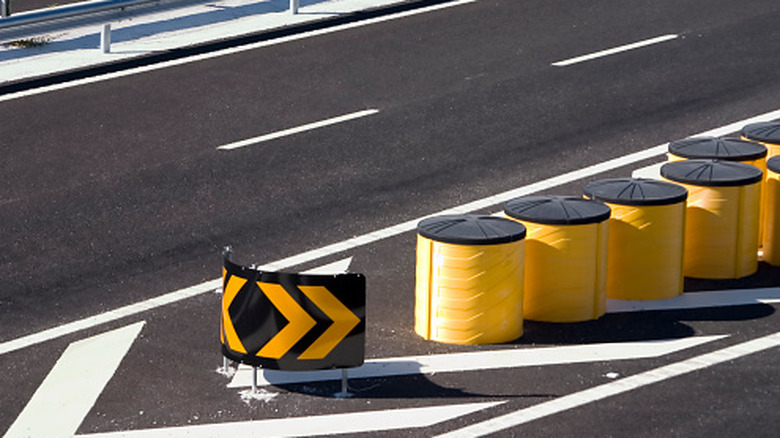
Like other distinctly colored objects you’ll see along the highway, these yellow barrels, formally known as impact attenuators, but also called crash barrels or crash cushions, are there for an important reason. Yes, the yellow color is intended to make them easily visible, but if they cannot be avoided, their job shifts to absorbing the energy from a crash — not unlike how tire walls are used at racetracks.
In fact, the history of these yellow barrels is heavily tied to motorsport, namely to former racer John Cooper Fitch. Fitch is known for inventing several types of guardrails and barrier systems designed to save lives on both racing circuits and highways. He is, however, probably best known for the Fitch Inertial Barrier. This consists of an array of filled barrels that can dramatically reduce both speed and deceleration force during vehicle impacts.
As for what’s inside the barrels themselves, that varies depending on how and where they are placed. Some are filled with sand, and at their heaviest, can weigh as much as 2,100 pounds each. Other barrels are filled with water to absorb crashes with liquid energy. Typically, that water will be mixed with magnesium chloride to prevent it from turning into ice during the winter, because a hard block of ice is just about the last thing you’d want to crash into.
The science of crashing
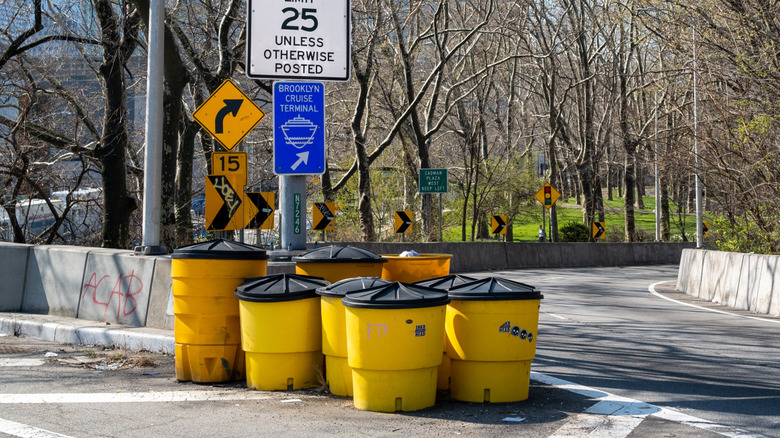
In most cases, these barrels will be arranged with the shortest, lightest barrels closest to the road, and then widen out with taller, heavier barrels placed closer to the rigid obstacle. The goal is to have each part of the barrier absorb energy at a different rate and, ideally, prevent the vehicle from ever hitting the edge of a concrete barrier or an exposed pillar.
Other types of modern impact attenuators in use include movable plastic extensions, barriers that redirect crashing cars away from hazards, and attenuators attached to the back of slow-moving highway work trucks that protect them from being rear-ended. While their designs and implementations may vary, they’re all there to soften impacts and turn what could have been an extremely serious crash into a glancing blow.
Highway safety is always evolving, and whether it’s proven inventions like yellow crash barrels or newer techniques like reflective stripes on road barriers, they all aim to save lives on the road. Hopefully, a driver won’t ever have to experience first-hand what it feels like to hit these barrels at speed, but passing motorists can rest assured that there’s a lot of science behind their presence.

Stephan is the sports journalist for the Maple Grove Report.