What’s The Difference Between These Fuel Types?


As gas prices increase, you may be wondering what level of premium fuel you actually need. Some car manufacturers recommend or require premium gasoline, but with the national average reaching $5 a gallon, it’s tempting to just stick with the lowest grade. Is premium gas actually necessary? Before you forgo the higher octane gas, it helps to know the difference between octane levels. 

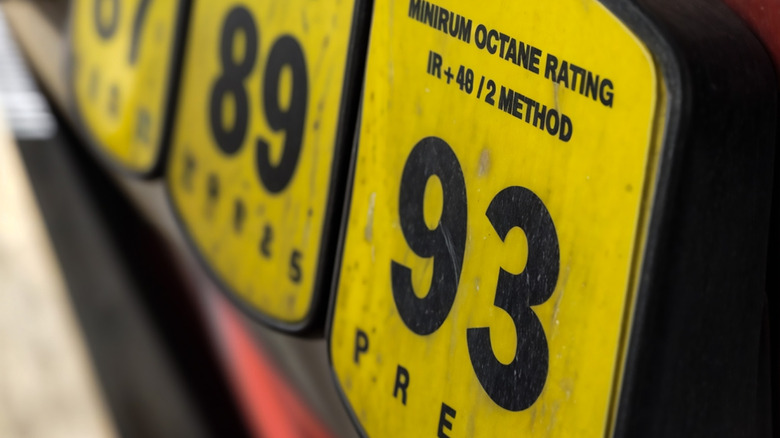
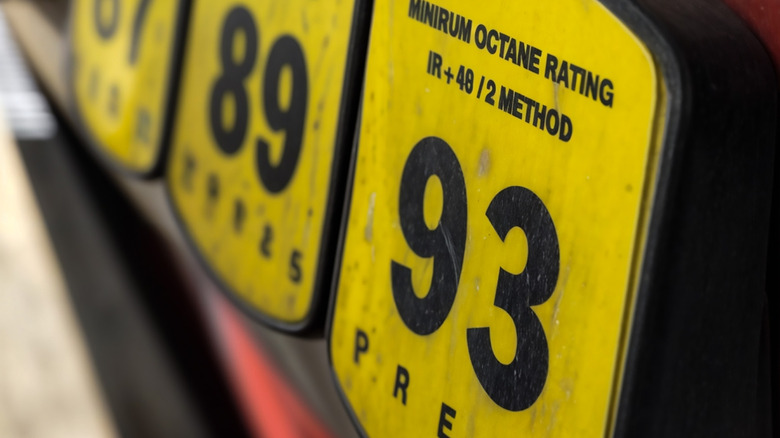
Gas’ octane rating measures fuel stability. The higher the rating, the higher the pressure at which the fuel will ignite in the engine. This means that higher octane fuel is more stable. Gas stations in the United States have three grades of gasoline — regular (lowest octane, usually 87), mid-grade (usually 89 to 90), and premium (highest octane, usually 91 to 94). However, the exact octane level will vary based on the state. Generally, the western half of the country carries 91 octane fuel, while the eastern half carries 93 octane fuel. 

If you are just commuting to work, you may not notice the difference between 91 and 93 octane. However, drivers looking to track their car may want to use 93 if it’s available — the same engine can make more horsepower with 93, since it can handle more pressure before it combusts. There may be a slight boost in the car’s performance. 

Can you use 87 octane in a performance car?
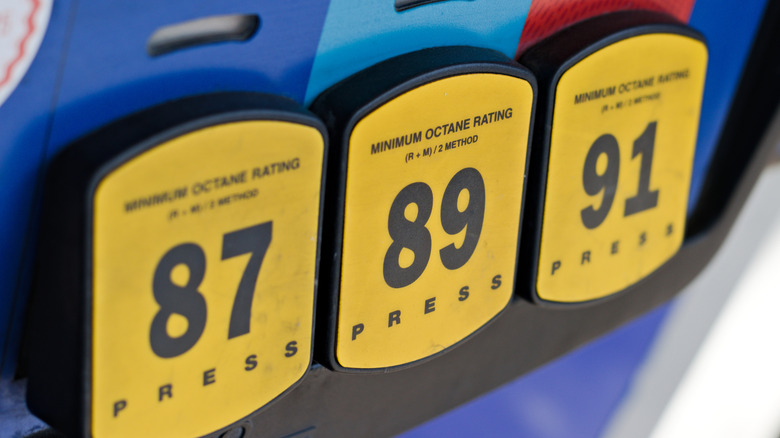
The debate over 91 versus 93 octane doesn’t have a clear answer in the car community, largely due to the various availabilities across the country and the minimal difference that it provides for many drivers — unless your car engine is tuned for 93 octane. However, most car enthusiasts are aligned on one thing: avoid 87 octane if you are driving a performance car. 

Using regular fuel instead of premium will reduce your horsepower output and efficiency, which is clearly not ideal for anyone wanting the most out of their performance car. You’re not going to see car enthusiasts jump at the chance to reduce their horsepower, even if the price is a bit cheaper at the pump. You’ll lose efficiency anyway, so it may not even save you the money you hoped for. 

On the bright side, it will likely not damage your engine if that was your concern. Modern vehicles have computers that can adjust the engine’s performance when lower octane fuel is detected. If you hear a knocking sound however, that could mean the lower octane fuel is causing premature combustion — although there are a few other possibilities


Source link

Leave a Reply

Subscribe to Our Newsletter

Get our latest articles delivered straight to your inbox. No spam, we promise.

Recent Reviews


Testing desks is something of a subjective game. Much like office chairs, the tests are based on comfort, reliability and ease of setup rather than things you can test in electronics such as wattage and battery usage. I still tested each one rigorously and will continue to test them for longevity in the coming months.

I tested these desks by asking three people to try each one. Each of them used the desk for at least 16 hours and then gave me their impressions. The three people were 6 feet, 1 inch tall; 5 feet, 8 inches tall; and 5 feet, 4 inches tall respectively, to give me a good cross-section of average user height.

A busted up box containing a desk

James Bricknell/CNET

Setup time and package quality

Building desks can often be difficult and time-consuming. For each desk, I timed how long it took to unpack and assemble, and I noted whether the manual was easy to follow. I followed the instructions as closely as possible so that each build was performed as if I had never built one before. I also thoroughly checked the packaging, to make sure it wasn’t damaged, and if it was secure enough to carry the desk it had in it. Any damage was noted, and images were sent to the manufacturers for review.

Structural integrity

Modern desks need to be able to hold a good amount of weight. If you’re at a writing desk you might only have a small laptop, but if you’re using a gaming desk, it likely has two monitors and a giant gaming PC as well. For each desk, I checked the maximum load specification, and I tried to match that with the materials we actually use on our desks.

I used:

  • A heavy gaming PC tower
  • Two 27-inch gaming monitors on a dual monitor arm
  • A MacBook Pro
  • Two different keyboards and assorted mice and trackpads
  • My Oculus Quest 2
  • My phone stand and USB hub
  • A podcasting mic and headphones

Depending on the length and weight capacity of the desk, I mix and match these items, then check for any bowing of the top or inconsistencies in how the desk felt as I worked.

Giant black standing desk with rainbow lights

James Bricknell/CNET

The wibble-wobbles

This is a bit of a throwback from when my dad used to make furniture. Anything my dad built would be critiqued by my mum, and if it didn’t pass muster, she would say, “It’s a bit wibbly-wobbly, isn’t it, dear?” Once I’ve built each desk and loaded it for normal use, I would check it for the wibble-wobbles. This means rocking it from side to side and forward and backward to check that all the screws, bolts and fixtures kept everything rigid.


Source link