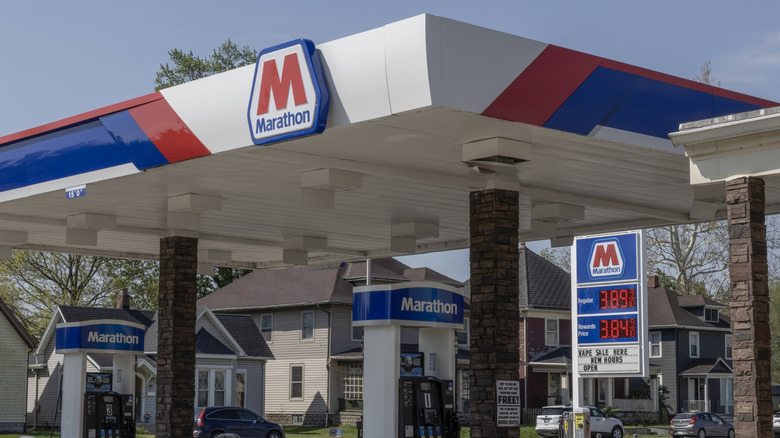
Marathon Petroleum has more than 7,000 locations across the United States, a long way since it was the Ohio Oil Company, founded back in 1887. Marathon Petroleum is currently an independent company, but it has a pretty complex ownership history. 

Ohio Oil was purchased by Standard Oil Trust two years after it was founded. In 1906, the company forged its first pipeline from Illinois to Indiana. However, the U.S. Supreme Court broke up Standard Oil in 1911, making Ohio Oil independent again. 

In 1924, Ohio Oil purchased Lincoln Oil Refining Company and then Transcontinental Oil Company in 1930. This is when it came across the Marathon brand name. For decades, the Ohio Oil focused on supporting the defense industry during the World War II and then post-war development after. 

In 1962, Ohio Oil changed its name to Marathon Oil Company. It was purchased by U.S. Steel in the 1980s. In 2001, Marathon Oil broke off from the steel company to become independent once more. In 2011, Marathon Oil split off from even more assets — including transportation and sales — to become Marathon Petroleum Corporation. 

Marathon Petroleum’s pivot to renewable natural gas
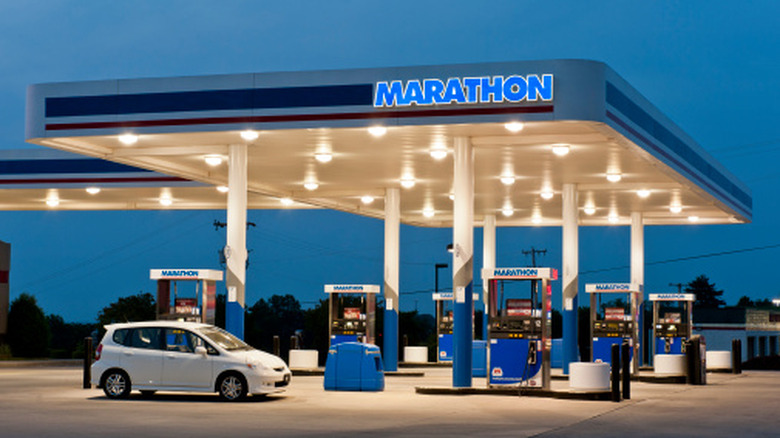
In 2018, Marathon Petroleum acquired Andeavor, creating the largest refiner in the United States. After acquiring ten more refineries and more than 3,000 retail gas stations, Marathon was popping up all over the states. This includes El Paso, Texas, Los Angeles, California, and Salt Lake City, Utah. By the mid-2020s, Marathon Petroleum controlled interest in about 20,000 miles of oil and natural gas pipelines. 

In 2021, Marathon sold its Speedway markets to 7-Eleven for $21 billion. While Marathon Oil was purchased by ConocoPhillips in 2024, Marathon Petroleum continued as an independent operator. It did, however, acquire just under 50% of LF Bioenergy in 2023, a company focused on renewable natural gas. Marathon started operating the Green Bison Soy Processing Facility — soybean oil as a form of renewable diesel, part of Marathon’s renewable energy initiatives. 

This may have been partially in response to the company’s history of pollution-related fines and an attempt to reduce greenhouse gases. In 2023, Marathon’s refinery in Louisiana caught fire, with naphtha burning for hours, toxins spreading into the air. This forced schools and businesses in the area to evacuate, and Marathon found itself getting sued. “This was an entirely preventable event,” New Orleans attorney Kerry James Miller told USA Today, pointing to Marathon’s poorly maintained electrical equipment, which was close to its storage tanks.


Source link

Leave a Reply

Subscribe to Our Newsletter

Get our latest articles delivered straight to your inbox. No spam, we promise.

Recent Reviews


Payments are at the heart of any accounting and bookkeeping firm. But what happens when your clients don’t pay on time? The cost isn’t just financial. There’s often an emotional toll, a drain on time, and a real barrier to growth.

We surveyed 800 small-to-medium business (SMB) decision-makers across Australia and New Zealand to better understand the state of late payments today, and the findings are powerful.

The GoCardless Pursuing Payments 2025 report uncovers the true impact of late payments and what you can do to break the cycle.

1. The pursuit of payments is still a time drain for many businesses

Over a quarter of small businesses report spending up to an hour every single week just chasing down late payments.

Think about that – a full hour of every work week, gone. That’s an hour that could be spent onboarding new clients, innovating, or simply focusing on what you do best. Instead, it’s lost to the frustrating and awkward task of debt collection.

Unfortunately, the problem isn’t getting any better. Nearly half of SMBs are waiting longer for payments now than they were just 12 months ago (48% in Australia and 51% in New Zealand). And with rising living costs, it’s no surprise that 59% are worried this trend will only get worse.

2. Late payments take a financial and emotional toll

While the time sink is bad enough, the financial and emotional impact can be far-reaching.

41% of Australian SMBs and 35% of New Zealand SMBs report that their payments are, on average, more than 14 days overdue. And these delayed payments inflict a substantial financial hit with 15% of SMBs in both countries losing up to $1,000 every month.

Our research also showed the heavy emotional cost. Chasing money creates tension with customers, causes stress, and makes business owners feel anxious and frustrated. It’s a vicious cycle that can distract from your day-to-day business and core purpose.

3. Bad cash flow is bad for growth

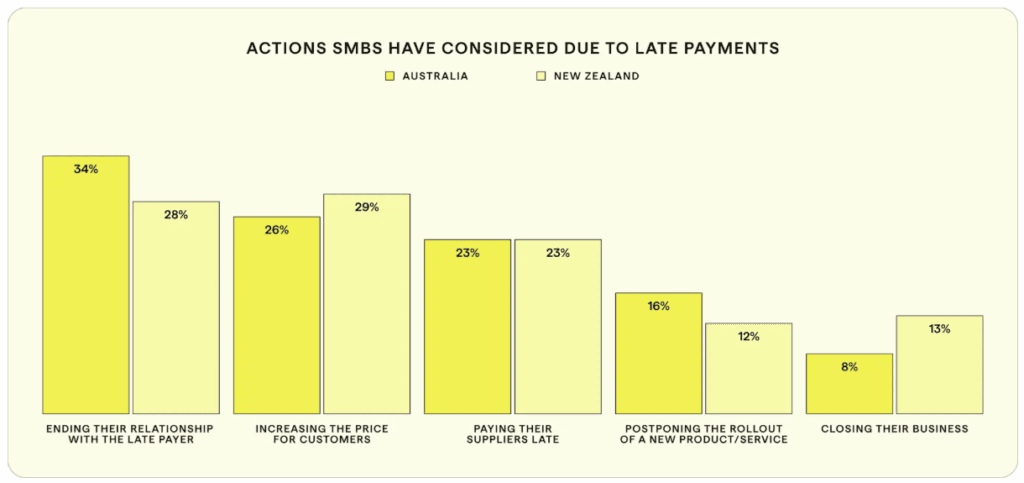
Delayed payments often mean poor cash flow and can result in businesses having to put a hold on future plans. Here are a few growth-stunting actions Australia and New Zealand SMBs have been forced to take due to late payments:

  • Ending their relationship with the late payer
  • Increasing the price for their customers
  • Being late paying their suppliers
  • Postponing the rollout of a new product or service
  • Closing their business

4. Late payments don’t have to be inevitable

So, what’s the solution? The good news is that SMBs are hungry for change. Two-thirds of the businesses we surveyed said they’re interested in using new technology to get a handle on late payments.

That’s where technology comes in. By adopting modern methods like bank payments with GoCardless (think, payments that are made from one bank account directly to another, including BECS Direct Debit and PayTo) you can create, schedule and collect payments for your client invoices on their due date – all from your existing Xero setup.

It’s time to put a stop to the endless admin, reduce costly payment failures, and get paid up to 47% faster. Connect GoCardless to Xero to automate invoice payments, and take back control of your business’s cash flow and growth. 

Was this article helpful?

YesNo


Source link