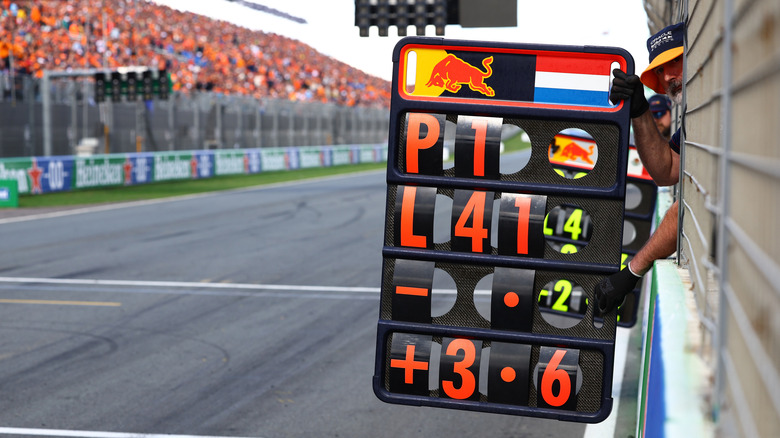

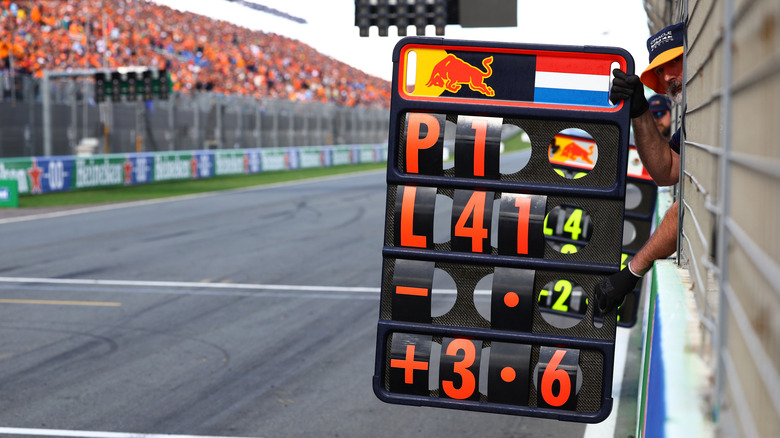
For all the things that Formula 1 has changed over the years, from the powertrains, drivers, and safety equipment, some aspects always stay the same. One of the most vital of these is communication. Bear in mind that, unlike in video games, drivers don’t have convenient heads-up displays telling them what position they’re in, where their opponents are in relation to them, and other vital pieces of information. That’s the job of the race team in the pits, which usually relay such information over the radio. But what if the radio fails, it’s difficult to understand, or any number of other scenarios occur? Then it’s time to go old school.
Enter the traditional pit board: A large, easy-to-read board filled with numbers and letters. There’s no specific set language, but everything is concise and carries specific meanings — it’s designed to be read as the driver passes the start-finish line at racing speeds, after all. It’s never going to be as involved as actual radio calls or presenting the information on a steering wheel display, of course. But it’s a system that will never break down due to electronic or mechanical failure, which is why it’s still just as valid today as it was yesteryear.
F1 teams use pit boards to eke out every last possible advantage in a championship race and to avoid losing time and position. When points are on the line, a team doesn’t want to be forced to retire because of something like a radio failure. Auto racing is a brutal and unpredictable sport; that’s why these redundancies exist. Much like an aircraft flying on one engine, it may not be the most efficient, but using pit boards to communicate can still get you across the finish line.
What do Formula 1 pit boards say?
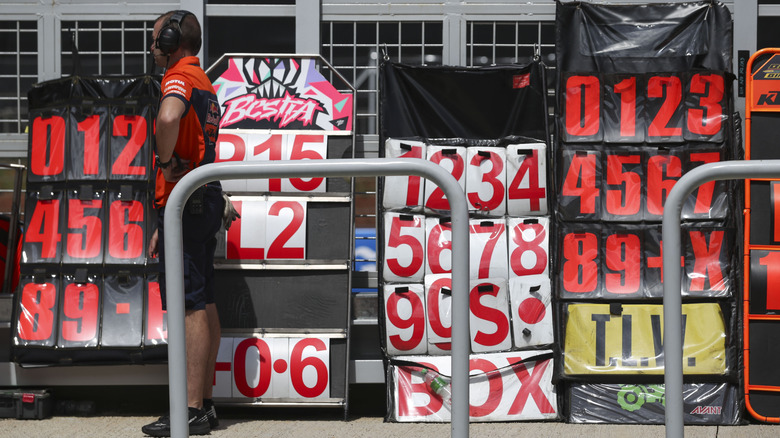
This is the biggest question for onlookers especially newbies just getting into F1, and the simplest answer is that it depends. Pit boards are designed to convey information, pure and simple — what that information precisely says varies depending on the team and what needs to be said. Generally, a pit board contains one or more of several points: Driver position, gap between cars, pit orders, sector cautions and other safety information, and general one or two-word commands can all be conveyed on a pit board.
There’s no real accepted “style,” per se. How many letters are used, what color the font is, what information is placed where on the board — it all varies. But you’ll often find that it’s usually based on common sense; you won’t place “BOX,” shorthand for “come in for a pit stop,” in the middle of two driver positions, for instance. Ultimately, it’s a form of coaching, and like the coaches themselves, there’s no set “right” or “wrong” way to convey the information as long as it’s clearly conveyed.
Let’s use an example. Imagine you’re leading on lap 10 and Verstappen is behind you by a little over 2 seconds. The pit board may say something like, “P1 – VER +2.1 – L10”, meaning you’re in Position 1, Verstappen is 2.1 seconds behind, and it’s Lap 10. Again, there’s no set language — different boards will have different formats. Sometimes they will spell out words like “LAP” or someone’s top message will be someone else’s bottom message. Because it has to be read at speed, presumably the order is committed to memory so it’s quickly legible at a glance. As a driver, it could potentially mess you up if your board’s format suddenly switches.
Other uses for pit and trackside message boards
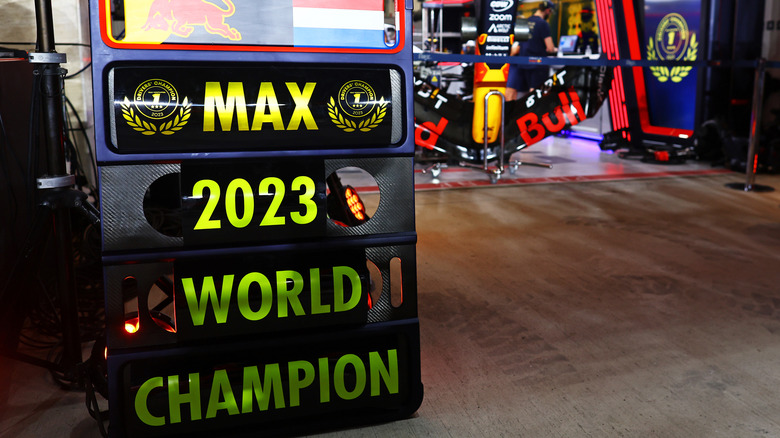
The biggest reason you’ll often see aside from track position and gap time is safety. Stewards use trackside boards to denote incidents, such as a large “SC” to indicate the presence of a safety car, or different colored boards to indicate flags; there’s a lot of racing flags, and their colors have their own standardized language.
As for the traditional pit board, it still has its uses outside of the radio or electronic equipment being broken. Sometimes it’s used because of personal preference or to keep from distracting the drivers. Bear in mind that top-level motorsport is incredibly demanding on drivers’ concentration, especially when racing in packs, which results in many compilations of drivers angrily shouting into their radios mid-race (much to our amusement). But let’s be honest — how many of us miss important pieces of information when we’re in high-stress environments? Something like a pit board might be more useful, even if just to repeat this sort of information.
In its purest sense, the pit board is a low-tech solution to the modern problem of information overload. With today’s F1 cars being faster than ever, coupled with the rising prevalence of automation and software on the racetrack, the sport has arguably become just as much a technical showcase as it is about the drivers’ skills. A pit board is a simple and effective method of getting information across to drivers without having to use words or other distractions, a point no less valid today, which is why it’s been crucial to motorsport since the dawn of the discipline.

Stephan is the sports journalist for the Maple Grove Report.