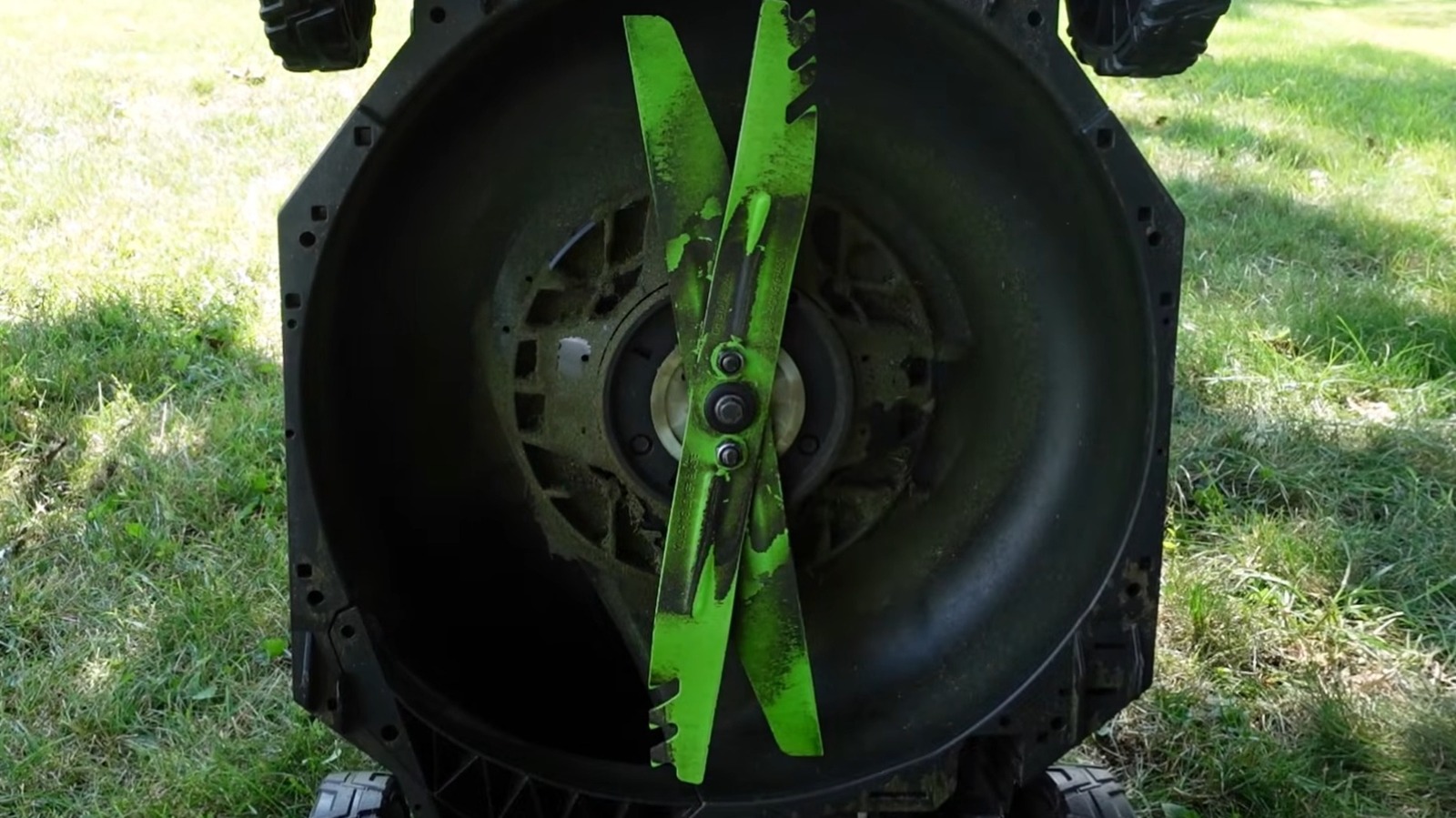

For the most part, regular push lawn mower blades aren’t all that complicated. They attach with a bolt that runs through the center hole, making removal easy for the process of safely sharpening your mower blades or replacing them. In the case of some blades, though, there are two additional holes, one on either side of the typical center hole, that don’t seem to serve a purpose. They’re actually crucial for mowers that use them, as they are intended to aid stability and the mower’s ability to cut grass as designed.
First and foremost is the matter of stability, since the incredibly fast rotation of mower blades can cause the central bolt to loosen and the blades to wobble or detach. Thus, some mowers feature pins on the underside of the deck that run through the two side holes to more evenly distribute torque and reduce stress at the center connection point. Meanwhile, mowers like the Ego 800 Series Power Plus 21-inch mower require more than one set of blades. In this case, the side holes are needed for a strong connection and safety, preventing either or both blades from becoming wobbly and colliding while spinning.
Evidently, side holes don’t exist on some mower blades for no reason. It’s crucial to consider their presence or absence when shopping for new mower blades, among other blade criteria.
Side holes are key in choosing the right mower blades
If a mower deck has a pin on either side of the center blade bolt, it shouldn’t be ignored or used with blades that don’t have pin holes. The mower is designed to distribute weight and torque across those three points. If the blades rely solely on the center connection, the rotational force will eventually loosen them to the point of dangerous disconnection while spinning. Conversely, using three-hole blades on a side hole-free mower isn’t a good idea either. These blades are designed for a three-point connection; using only one connection point inevitably leads to loosening and detachment. Not to mention, using any incorrect blade-mower pairing can damage the mower, from cutting up the mower deck to putting unnecessary strain on the engine.
Of course, choosing the correct lawn mower blades doesn’t begin and end with their number of mounting holes. Center holes can come in different shapes and sizes, so the blade hole needs to match the dimensions of the peg or screw on the mower. The blades’ length is key, too, since an excessively long blade leads to deck contact and damage, while a short set reduces cutting performance. You should also select the right blade design for your needs. For example, sand blades prevent debris lift in loose, dry soil, mulching blades finely chop grass clippings, and gator blades are ideal for leaf mulching.
There are mistakes everyone makes with their lawn mowers, and using the wrong blades can be one such issue. Always consult your mower’s manual to ensure your blades are the right length, the center hole is compatible, and the number of connection points matches what you see on the mower’s deck.

Stephan is the sports journalist for the Maple Grove Report.