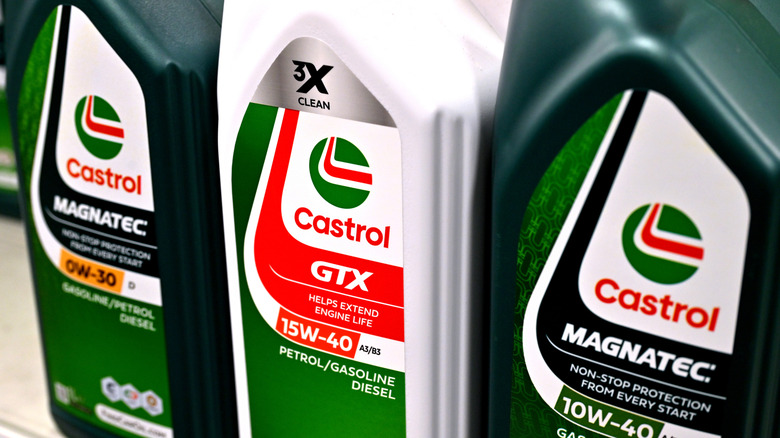
Fuel prices have been one of the hottest topics of 2026, and for good reason. Thanks to global fuel supply chain disruptions brought on by the Iran War, U.S. gas prices hit a four-year high in May 2026 and aren’t likely to come down for some time. This situation isn’t only impacting how much it costs to fill up your tank, though; oil changes may likely become more expensive too, as motor oil is another commodity that’s expected to be in short supply due to the war.
As reported by outlets such as The Drive, the automotive industry is preparing for motor oil shortages in 2026, and it’s down to two reasons. On the one hand, there’s the Strait of Hormuz blockade, which has impacted the global distribution of oil and other commodities. On top of this, damage to refineries and other essential infrastructure near the waterway has also limited oil production since the start of the war.
With a serious shortage on the horizon, the automotive industry is responding as best it can. In addition to passing higher costs onto consumers, it’s doing what it can to ensure folks willing to pay up can even get oil changes in the first place as supply begins to dwindle.
How the industry is reacting to the prospect of a shortage
John Keeble/Getty Images
Naturally, one of the first things those in the automotive and oil industries have done is consult the United States government. Unfortunately, talks with the Department of Energy haven’t yielded many concrete solutions. Speaking to CNN, Holly Alfano, CEO of the Independent Lubricant Manufacturers Association, said that while the department is trying, the factors behind the shortage are largely outside its control. The same CNN report also included a statement from Ben Dietderich, the DOE’s press secretary, who told the outlet that the DOE is “ready to take additional action, if needed, to help avoid supply disruptions.”
Oil manufacturers are also taking steps to limit the effect of any shortages. Some have suggested that drivers use higher-viscosity oil in some vehicles in place of thinner blends — a risky maneuver, since thicker oil than recommended could lower fuel economy and make cold starts harder.
The notion of adjusting oil service intervals has also been floated, with consumers encouraged to run their current motor oil for as long as possible before going in for a refresh. Regardless of whether you change your motor oil yourself or go somewhere to have it done, there’s no way to avoid the fact that the oil itself looks like it’s getting more expensive in 2026.
What Is an Impairment Rating in Workers’ Compensation Claims? (2026 Edition)
An impairment rating is a formal medical assessment that assigns a percentage to the permanent loss of function in a body part (or the whole body) after a workplace injury. It’s the number that ultimately drives how much compensation an injured worker receives once their condition stabilizes.
The stakes are enormous. According to the National Safety Council, the cost of work injuries reached $181.4 billion in 2024, including $36.8 billion in direct medical expenses and $54.9 billion in wage and productivity losses. The Bureau of Labor Statistics also reported 2.6 million nonfatal workplace injuries in 2023 alone. With numbers like these, standardized systems for evaluating and compensating permanent physical deficits aren’t just helpful; they’re essential.
Before any financial calculation is performed, a specific clinical threshold must be met. State statutes regulate the process, requiring objective medical evidence and standardized evaluation methods.
Reaching Maximum Medical Improvement (MMI)
An impairment rating can’t be assigned until a doctor formally declares Maximum Medical Improvement (MMI). In plain terms, MMI is the point at which your condition has stabilized, and further treatment isn’t expected to produce significant improvement.
Under workers’ comp law, rating a disability before MMI is considered both legally and medically premature. Why? Because the full extent of permanent loss simply can’t be measured accurately while the body is still healing.
How the AMA Guides Work
To keep evaluations consistent, physicians use the AMA Guides to the Evaluation of Permanent Impairment. This reference text lays out diagnostic criteria and calculation models for virtually every type of physical and psychological injury. And which edition your state requires matters more than you might think.
A study comparing AMA Guides editions, released in 2026 by the Texas Department of Insurance Division of Workers’ Compensation (TDI-DWC), found that 59% of cases received significantly lower ratings under the 6th edition compared to older guidelines. That’s a massive difference in benefits for the same injury.
The rating process isn’t limited to physical trauma. Throughout 2026, a nationwide expansion of PTSD Presumption Laws has overhauled workers’ compensation frameworks, changing the burden of proof for psychological injuries and widening the gate for mental health benefit eligibility.
How Impairment Ratings Translate to Money in 2026
Once a physician assigns a specific percentage, the claim shifts from clinical assessment to financial calculation. This is where the rating turns into an actual dollar amount.
Calculating Permanent Partial Disability (PPD)
Your impairment rating directly determines the value of a Permanent Partial Disability (PPD) award. PPD benefits compensate workers who’ve sustained a permanent reduction in functional capacity but aren’t completely unable to work.
The financial outcome depends heavily on injury severity. Strains and sprains are among the most common workplace injuries, making up roughly 23% of workers’ comp claims. Severe injuries like amputations, on the other hand, carry an average cost of $102,500 per claim, pushing the overall average per medically consulted work injury to $48,000.
Because converting a medical percentage into a dollar figure involves complex statutory formulas, many injured workers turn to dedicated tools for estimates. A workers compensation calculator that factors in state-specific limits, age, and wage data can help you project a realistic settlement range. But getting a solid estimate is only part of the equation; qualified legal representation is just as important to make sure the final award reflects your actual loss of earning capacity.
Impairment-Based vs. Wage-Loss Models
Different states use fundamentally different systems to turn an impairment rating into compensation. The two main approaches break down like this:
Approach Type
Primary Focus
Methodology
Impact on Award
Impairment-based
Physical/mental limitations
Converts a physician’s percentage into statutory benefit weeks
Standardized compensation regardless of post-injury earnings
Wage-loss
Economic impact
Measures the gap between pre-injury and post-injury earning capacity
Individualized; focuses on vocational impact, not just medical severity
Disputing an Impairment Rating
Given what’s at stake financially, disputes over impairment ratings happen all the time. It’s worth remembering that an impairment rating is a medical opinion, not an unassailable legal fact. If the methodology is flawed or key medical evidence was ignored, you can challenge it.
The Appeals Process
Not satisfied with your rating? You have the statutory right to contest the physician’s findings. Here’s how the process typically unfolds:
File a formal objection. You or your attorney notifies the state workers’ compensation board that you disagree with the treating physician’s rating.
Request an Independent Medical Examination (IME). A neutral, third-party physician evaluates you and may assign a different impairment rating using the appropriate AMA guidelines.
Submit vocational evidence. In wage-loss states, vocational rehabilitation experts can testify about how your specific medical limitations affect your long-term earning capacity.
Attend an administrative hearing. An Administrative Law Judge (ALJ) reviews the conflicting medical reports, weighs the credibility of each rating, and issues a final, binding compensation order.
Impairment ratings serve as the bridge between medical science and legal compensation. Whether your state uses the 4th or 6th edition of the AMA Guides, getting a precise medical evaluation is one of the most important steps you can take to protect your financial future after a permanent workplace injury.
To provide the best experiences, we use technologies like cookies to store and/or access device information. Consenting to these technologies will allow us to process data such as browsing behavior or unique IDs on this site. Not consenting or withdrawing consent, may adversely affect certain features and functions.
Functional
Always active
The technical storage or access is strictly necessary for the legitimate purpose of enabling the use of a specific service explicitly requested by the subscriber or user, or for the sole purpose of carrying out the transmission of a communication over an electronic communications network.
Preferences
The technical storage or access is necessary for the legitimate purpose of storing preferences that are not requested by the subscriber or user.
Statistics
The technical storage or access that is used exclusively for statistical purposes.The technical storage or access that is used exclusively for anonymous statistical purposes. Without a subpoena, voluntary compliance on the part of your Internet Service Provider, or additional records from a third party, information stored or retrieved for this purpose alone cannot usually be used to identify you.
Marketing
The technical storage or access is required to create user profiles to send advertising, or to track the user on a website or across several websites for similar marketing purposes.