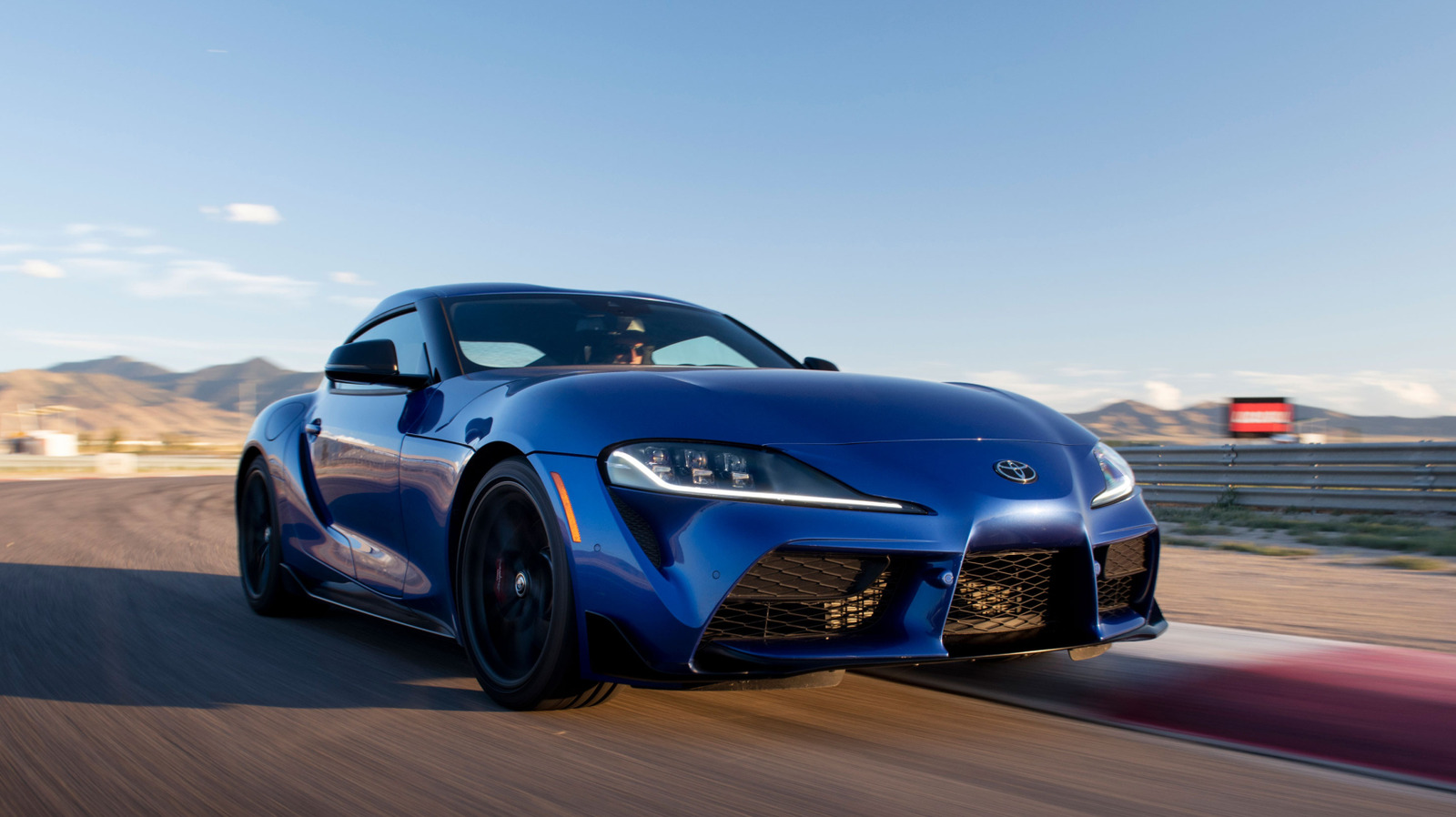

It’s the end of an era for Toyota; as many of us enthusiasts know (and lament), the Supra is officially on its way ou, at least for now. We have a few stunning-looking JDM cars coming out in the next couple years, granted. Cars like the Toyota GR GT and next-generation Nissan Skyline, for instance, but while I’m as excited as the next gearhead, I’m also a pragmatist; we don’t really know how well these cars will fill the Supra’s shoes, since we’ve not gotten our hands on them yet.
Instead, I’m going to consider the term “replacement” in a modern context, as opposed to a future one. It’s the end of 2026, and all the Supras have disappeared from the lot. What are my options for a solid rear-wheel drive mid-range sports car with a manual transmission? Sure, I could always buy used — for A90 Supra money (starting at near enough 60 large), I could import (another) one of my dream JDM cars and not break a sweat. Part of the reason why I’m hypothetically purchasing a new Supra is because I want a brand-new car, and with sports cars fading into the tall shadow cast by crossovers and SUVs in America, I’m not exactly spoiled for choice.
I’ve been into cars for the better part of three decades now; I know exactly what I want, and a modern Supra would check a lot of those boxes for me. Which raises the question: What else is out there? There’s a couple obvious answers, to be sure, but the more I looked (and the more out of the box I thought), the more surprises I found. Let’s have a look.
BMW M2 / M240i
I want to get the most obvious one out of the way first, and that’s because the Supra and BMW Z4 share the same platform. It’s sort of a meme that the Supra’s referred to as a BMW, though that’s not technically true; it’s more of a collaborative car than anything. Still, people often compare the two, and I can understand why, but the base Z4 is in a totally different class than the Supra, as Toyota itself openly admits. Unforunately, the Z4 is dead as well. That leaves just one option: the M2, along with its slightly less powerful sibling, the M240i.
The BMW M2 is the closest continuation we have to the Supra when you think about it, albeit with 91 more horsepower than the M240i that shares the Supra’s engine. Sadly, though, you can’t get a six-speed in an M240i anymore, meaning you and I would have to swallow an additional 17 grand for a third pedal. The world is a cruel place. Still, apart from the powertrain discrepancy, they’re both BMW M cars, and high-performance sports coupes at that. Both cars have received glowing praise, with the M240i seen as excellent performance for the money, and the M2 highlighted for its power, lighter weight, and driver-focused experience.
Out of these two, though, I’d go for the M2 (though I wouldn’t complain with an M240i, either). I do love me an involved driver’s car, especially as someone who dailies her classic cars. And consider this: the Mk V Final Edition costs an eye-watering $69,350, pretty much the same price as an M2. So, do I want a bit of bragging rights with that Final badge, or almost 100 more horsepower? Decisions, decisions.
Acura Integra Type S
Pretty much the only thing the Integra Type S doesn’t do is spin the rear wheels, but that doesn’t make this any less of a spirited vehicle. What I’m looking for is a sleek, handsome sports car with plenty of potential, excellent handling characteristics, a quality fit and finish, and an engaging driving experience, and Acura delivers on all counts here.
This sports sedan has been the bell of the ball at places like Car and Driver and Motor Trend, with journalists routinely praising its virtues as a superb driver’s car. That’s what matters here — power and drivetrain aside, is it fun to drive? As we found out, this applies even to the regular Integra.
I’ve taken a look at the full range of Hondas, and honestly, this seems like the best one for my money; it’s got a close-ratio six-speed, a rev-happy turbocharged four-cylinder making a healthy 320 horsepower at 6,500 RPM, 25.2 pounds of boost, and suspension that’s lauded for being planted and responsive. I have no doubt that with a decent tune and a good running gear setup, I could turn this car into an even more potent track-day weapon as well.
Of course, being a Honda product, there are alternatives here as well; the Civic Type R immediately comes to mind, but that has less power with roughly the same functionality and quality. The Prelude is a two-door compact, but Honda never made one with a stick-shift, and the hybrid powertrain only manages 200 horsepower for a car priced at $42,000. Therefore out of this lineup, I have to side with the Integra, assuming I had Supra money to splurge.
Ford Mustang Dark Horse
I just know I’m going to get hate for this; truthfully I struggled to pick it at first, too. But the more I looked at it, the more convinced I became, and I’ve never been a Mustang girl. Even I had to concede here, though; while yes, about $60k is a lot of money to drop on a Mustang, you are getting what you pay for in this case. What really sold me was the powertrain here — a 500-hp 5.4-liter V8 married to a Tremec close-ratio six-speed? Yes, please. Okay, it might not actually be 500 horsepower, more like 450, but the Supra only manages 382, and it doesn’t have a V8 growl.
Still not convinced? Neither was I, so I dug around some more, focusing my attention on fellow journalists who’ve driven these cars on-track. In the words of Raphael Orlove of Road & Track, “I was, as you could say, intimidated.” Everywhere I’ve read, from periodicals to blogs, they all say the same thing: This is a serious Mustang built for serious driving.
Moreover, at this price point, there’s hardly anything left in the true muscle car market; the closest thing we have nowadays is the 2026 Dodge Charger, which is hardly a contender after dropping the Hemi. Other pony cars like the Camaro and Challenger are gone as well, effectively leaving the Mustang in a one-horse race. Even so, it measures up to its European and Asian competitors thanks to its RWD layout, good power, and fair price point for what you get. The only other near-alternative is arguably the Corvette, but that’s out of the price range, and it’s pretty much a supercar at this point.
Audi RS 3
Here’s another controversial pick — originally I wanted to go with Porsche, but even a base-model Cayman was over $77,000 and that’s a hard sell when you have an RS 3 for $10 grand less. Okay, firstly, let’s address the elephant in the room — Audis are generally thought of as boring, but we’ve proven otherwise when reviewing this car. Also, luxury sedans are typically seen as boat anchors, with this car weighing a hearty 3,559 pounds. But the GR Supra actually isn’t all that much lighter, with Toyota claiming a curb weight of 3,400 pounds.
It’s relatively small, powerful, and various sources agree that the driving is superb — seems like a good recipe to me. Of course, it doesn’t have the same sort of involvement as a manual Supra, but I can forgive that fact because this thing will blow the doors off a Supra any day. Quattro AWD plus a potent 394-horsepower five-cylinder combine to launch this thing to 60 in a rated 3.6 seconds, though Car and Driver managed it in 3.2 seconds — it’s easily the fastest-accelerating car on this list. Plus it’s a sedan, and I’m all for more performance sedans and wagons on today’s roads.
Frankly, I never really liked Audi. Sure, I like some of their more characterful cars like the S1 Quattro and RS 2 Avant (what enthusiast doesn’t), but every one I’ve been in always felt as bland and uninvolved as a rolling office building. However, even I must give credit where it’s due; the specs don’t lie. The RS 3’s a certified sleeper, and yes, it’s not as exciting as the CT4-V Blackwing, but the CT4-V Blackwing is on its way out, too. Thanks, GM.
Nissan Z
I’m saving the best (and most obvious) for last, and not just because I daily a classic Skyline. Biases aside, in my research, Nissans have always held this weird reputation of either being terrible, boring, or absolutely stellar; guess which category we found the Nissan Z NISMO to fall into. But even the standard Z is still, in my opinion, genuinely superior to the Supra in all the ways that matter. It’s cheaper, has more power, it’s got the manual option (omitted on the NISMO because who knows why), and a more traditional body style evocative of the Z’s of old — the NISMO is actually almost identical performance-wise with the Supra.
The Nissan Z, continuing the long and storied lineage of the Z nameplate, maintains its reputation as one of Japan’s premiere 2+2s. It actually combines the concept of a sports car and a grand tourer quite elegantly, with Edmunds citing it as a fantastic road-tripper. Obviously you’re never, ever fitting more than two adults in one comfortably, but the same can be said for the Supra. In fact, most factors about the Z can also be said about the Supra. These cars were direct competitors for years, after all.
This arms race means that, with Toyota out of the picture, the Nissan Z effectively holds a monopoly as far as the U.S. is concerned. If you want a potent, driver-focused Japanese sports car that’s more powerful than a GR86, guess what you’ll likely look at. Not that that’s a bad thing; the Z is genuinely an excellent car, and it’s even outsold the Supra in 2024.
Methodology
I found a few different lists online which struck similar chords, but one thing that I personally wanted to emphasize was the term “replacement.” This implies that, because the Supra is being discontinued, we should look at cars that would serve in its stead when it’s gone. New cars, specifically — after all, you could just as easily buy a used Supra. So the criteria was simple: The cars had to be new, not discontinued for model year 2027, and already on the market and/or professionally reviewed.
As for which specific cars, I narrowed that down based on price, standard equipment, and performance. If I was buying a Supra, I’d buy it for the performance, so this was paramount to me. The cars had to be roughly similar in terms of power and function; while several are unquestionably slower, they’re all certainly within the sports category. Likewise, they all had to retain a driver-centric experience. A manual transmission certainly helped here, but it was not a requirement; rather, I looked for cars reviewed and tested by respected journalists and peers and frequently cited as excellent driver’s cars.
Lastly, the sources I used varied; power figures, pricing, and so on were all taken directly from the manufacturer when possible — all vehicles listed here have publicly-available configurators and MSRPs listed on their respective sites. Reviews and testimonials were primarily from established journals and long-running periodicals, such as Car and Driver, Road and Track, Edmunds, and Motor Trend.

Stephan is the sports journalist for the Maple Grove Report.