Android Auto has been the standard for integrating your Android smartphone’s capabilities into your vehicle’s dashboard for quite a while now. The combination of clear GPS visibility, music control, and call and messaging interface capability is at the core of what makes it so useful, but there are dozens of applications and several useful hidden features built in that take Android Auto’s utility to the next level. What’s more, the company is constantly refining this technology and adding even more features to keep it at the cutting edge. This is a big part of the reason that over 250 million cars now feature dash displays that host the software.
Senior Director of Product and User Experience Guemmy Kim recently announced that the company is making some big changes in 2026. Android Auto is undergoing a significant redesign, with a focus on improving personalization and screen efficiency while also integrating several new AI features. If you use Android Auto or are looking to start, then you might be curious about the details of these changes. What are they, and how will they affect your daily drive?
Visual redesign
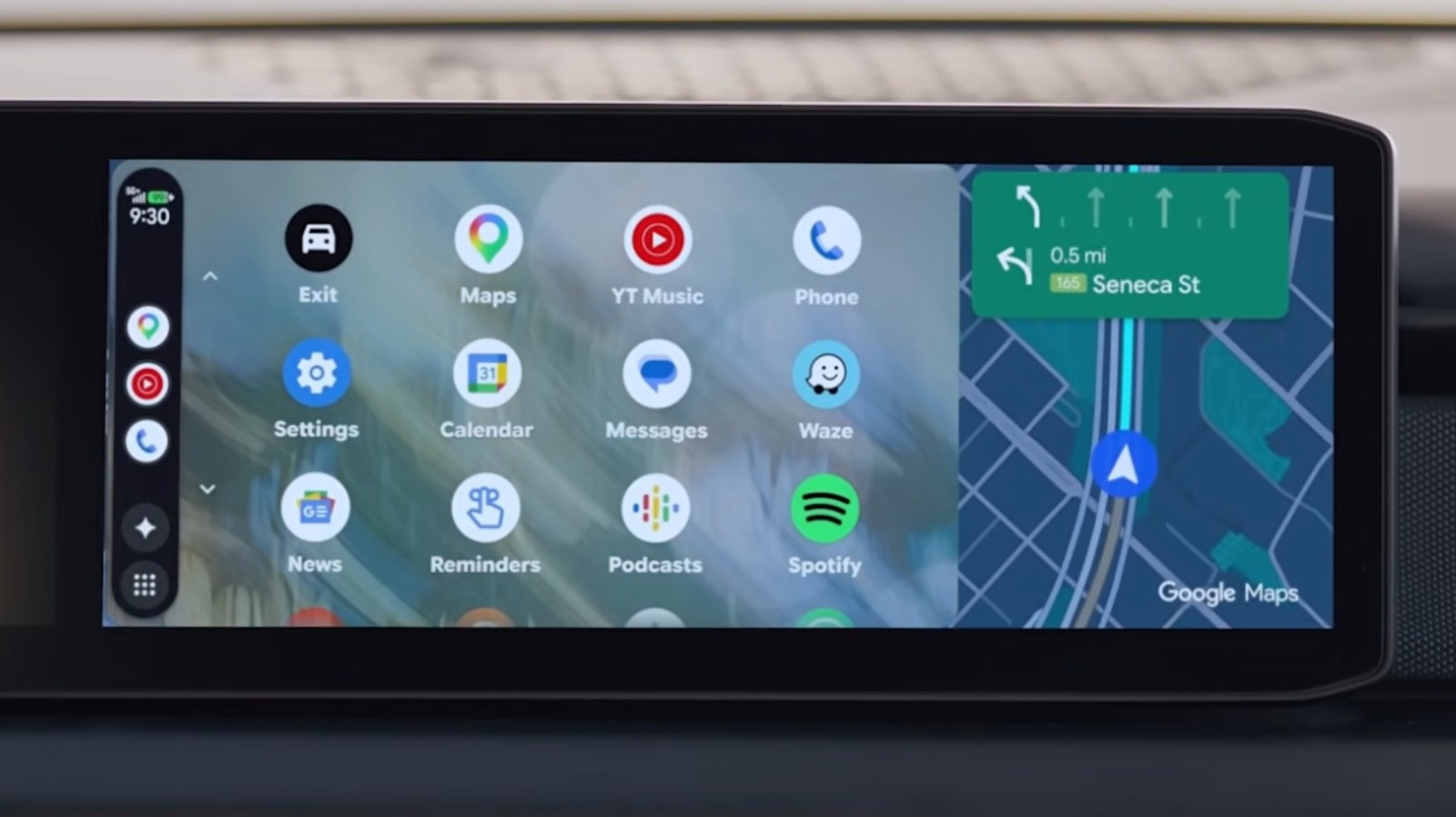
One of the biggest changes that is being made to Android Auto pertains to the way the interface looks on your screen. “Android Auto is getting a full refresh that brings personal design touches, widgets you can see at a glance, and edge-to-edge Google Maps to your dash,” says Kim. This is largely due to the integration of the Material 3 Expressive Google design system, which adds more expressive designs and animations to your phone, as well as specialized fonts and wallpapers, an expanded shape library, and new color schemes. This makes smart devices feel more responsive and customizable than past iterations. It uses a motion-physics system that emphasizes fluid feeling transitions and button activation. These elements will now also transfer to your Android Auto display, making it feel more ‘alive’ while also making it more personalized so that it feels like a natural extension of your smartphone.
The expansion of Maps is particularly interesting. Android Auto has sometimes struggled to adapt to the aspect ratios of certain screens and has left an abundance of unused, empty space around the interface window. This new modification promises a tailor-fit GPS design for any screen, including ultra-wide models, circular screens, and even uniquely shaped ones. Some aspects of the interface will still be confined to a sort of invisible box, but the expanded Google Maps background promises to give more visual navigation information while also making the screen look and feel more intentional.
Widget support
As Kim mentioned, widget support is coming to Android Auto as well. People have been able to add these miniature interactive applications to their home screens on their phones and tablets for a while, but they will now be able to add them to the dashboard display in their car. This serves as a useful way of providing shortcuts to the information and tools that you want to keep at the ready, but it’s also safer, as it will allow you to see and interact with these apps at a glance while driving rather than needing to navigate through a menu that might take your eyes off the road for an unsafe amount of time.
It’s unclear at this time if all the widgets that are on your phone will be supported by Android Auto or if it will be a limited selection. Kim specifically mentions that you can add shortcuts to your favorite contacts, garage door opening applications, and an overview of the weather. Google has also demonstrated a few other apps, including a clock, Google Home controls, and a photos widget. So, it seems like they already have a lot of the biggest utilities covered. These float at the top of the expanded map and can be organized in a scrollable stack (via 9To5Google).
Immersive Navigation
While having the map be able to stretch to the outer borders of your screen is certainly an improvement, it might not actually be the most exciting development for your car’s GPS. Android also announced that it would be integrating a new immersive navigation mode. Google Maps has a lot of great tricks hidden away, but this one is more than a little feature. Android claims that this is the company’s “biggest update to Google Maps in over a decade,” and it’s easy to see why.
Rather than viewing traditional 2-D maps from the top down, this gives you a 3-dimensional view with an isometric perspective. The screen displays buildings, overpasses, and bridges as 3-D structures that are shown in relation to ground roads, providing a more detailed visual of the terrain relative to the vehicle. This seems like it would be particularly useful for city driving, as it provides more nuanced information about complex environments.
Immersive Navigation also displays things like lanes, traffic lights, and stop signs so that the driver is aware of any stops, turns, and merges that they’ll need to make in advance and prepare accordingly. This appears to be much more intuitive than the standard top-down model, as it provides the driver with more information and a more practical perspective.
New audio and video features
If your car has a nice big screen and a decent sound system, then you might want to be able to use it to watch high-quality video. Adding this feature to Android Auto has been a struggle for a while now, as it can’t allow you to watch video while driving for obvious safety reasons. You used to need a third-party workaround to watch YouTube on Android Auto, but an official version of the feature is now finally on its way.
“For the first time in Android Auto, you’ll be able to sit back, relax, and watch videos on apps like YouTube,” says Kim. “Look for it in crisp 60fps full HD in supported cars later this year, starting with BMW, Ford, Genesis, Hyundai, Kia, Mahindra, Mercedes-Benz, Renault, Škoda, Tata and Volvo.” It’s unclear what this means in older or unsupported cars, however, and the announcement doesn’t clarify if the feature will simply be available at a lower resolution or if it won’t be available at all.
Android Auto tackles the safety issue in a unique way. Rather than shutting the video off altogether when the car is shifted out of Park, it instead transitions into an audio-only mode. This allows you to listen to things like video podcasts, news, and interviews, even when you need to keep your eyes on the road.
On top of this new feature, several media apps, including heavy-hitters like YouTube Music and Spotify, will be getting some visual updates that are designed to make them easier to see while driving.
Gemini Intelligence integration
Of course, it’s not a tech update in 2026 without a little AI thrown in there somewhere, and it looks like Android Auto is leaning further into Gemini integration. Those who have Gemini on their smartphones will now be able to access its adaptive and generative capabilities through their dash screens. This adds context recognition and suggested response capabilities that were not previously available.
One of the examples that Android provides is the Magic Cue system. “If you get a text from a friend asking for an address, Magic Cue will understand the context of the question, find the answer using information from your text messages, email or calendar, and offer to send a reply with the right information, all in a single tap.” Additionally, this can be used to verbally initiate tasks, such as ordering food from DoorDash without even needing to open the app.
Some newer cars also have Google built-in, and users will be able to use the Gemini interface in Android Auto to get information about the car itself, such as what dash symbols mean and how much storage space is in the trunk. It will also be able to use the cars cameras to provide lane guidance in Google Maps, and advise you when to change lanes or take an exit in real time.

Stephan is the sports journalist for the Maple Grove Report.