5 Reasons Why Someone Might Not Want To Wear A Smartwatch


If ever there was a good time to buy a smartwatch, it’s now. Great budget-friendly options are easy to find, and they offer a treasure trove of health metrics for your general well-being and workouts; wearing one could help you improve your sleep, get you moving more, and make you more conscious of other negative impacts on your health, like exposure to loud sounds. They further prove their worth when they save people’s lives with their fall and crash detection. As awesome as they might sound, though, they’re definitely not for everyone.

I’ve been wearing an Apple Watch daily for years now. While it’s one of the best tech purchases I’ve made, I think I have a pretty good idea of why you wouldn’t want to wear one. I’ll be using the Apple Watch as the baseline, although these arguments apply broadly to any smartwatch brand. Read this if you’re a person who is intrigued by the idea of a smartwatch — enough to maybe buy one — but isn’t fully convinced you truly need or want one. If any of the reasons below are dealbreakers, then a smartwatch might not be for you.

Increased digital distractions

One of my favorite studies continues to be the one that suggested merely having a smartphone nearby will ruin your focus. Proximity — not usage, just being close — is all it takes. That study was about smartphones. Some studies find smartwatches more distracting than phones, and I think it’s pretty obvious why: they are quite literally within arm’s reach at all times. And they have to stay there if you want your watch to provide long-term analyses of health metrics, such as hypertension. Meanwhile, it’s serving you notifications from your phone, vibrating on your wrist constantly unless you change the settings.

Even with a stringent focus mode that only lets your smartwatch vibrate for the most important things, you develop a reflexive habit of checking it a lot more frequently than a smartphone. Even in cases where you just want to check the time and date, your eyes will inevitably drift to that unread notification dot. There are also plenty of instances where it’s visible in your field of view (such as when you’re typing or reading a book), and all the while it’s goading you, silently, saying, “C’mon, look at me.”

There are ways to mitigate this. Theater Mode on the Apple Watch blanks the screen and creates some friction when viewing notifications. And of course, it doesn’t hurt to take it off during the hour or two when you want no distractions. Nonetheless, wearing a smartwatch presents a perpetual potential distraction, so if you can’t afford to have yet another device hogging your precious cognitive bandwidth, steer clear.

Superfluous biometric hardware

Modern smartwatches gather an impressive list of health metrics. Take the Apple Watch Series 11. It has heart rate monitoring, hypertension tracking, blood oxygen levels, ECG, accurate sleep tracking, sleep apnea warnings, respiratory rate, and temperature sensing. More are coming. There are whispers of blood glucose monitoring. Point is, the list of health-tracking capabilities is huge. That’s great, but there’s an unexpected issue: These metrics (I think) may be nice to have, but not essential.

Think about it. When you go to the gym, does it really matter what your heart rate is? As long as you get a sweat in and feel the endorphins afterwards, probably not. Even for an everyday gym rat like myself, I wouldn’t lose a wink of sleep if I never saw that data again. The same argument extends to a lot of other areas. Does it really matter knowing how many times you woke up at night as long as you feel rested? Does it really, really matter knowing how many flights of stairs you climbed? Some of the health metrics gathered by smartwatches can be hard to find any use for, even if you tried, like blood oxygen levels.

I’m not talking about people who have health concerns that a smartwatch could keep tabs on, by the way, just those who don’t have a strict need for most (or all) of the health-tracking features. Humans have lived without smartwatches quite contently for thousands of years, and today companies seem to gish gallop consumers with a list of health-tracking features because they recognize this is a completely optional, auxiliary device. Think real hard if you need that health information. Chances are, you don’t.

Battery anxiety

Battery anxiety is no joke. Some studies have estimated that as many as 90% of people get anxious when their smartphone battery is low. It’s a problem that seems to get compounded the more devices you add to the equation, like laptops, tablets, e-readers, and wireless earbuds, all of which take a little sliver of your cognitive pie as you mentally track what battery level they’re at and when they need a charge. Adding a smartwatch only exacerbates that problem.

Granted, smartwatches tend to have pretty long battery life. The Apple Watch Series 11 can squeeze out up to 38 hours on low power mode, and more expensive ones like the Apple Watch Ultra boast up to 72 hours. Other brands go even longer, lasting as long as months in some cases. Still, one day you’re going to have to charge it, and as we’ve explained, it’s in your best interest to keep a smartwatch topped up to see those long-term health metrics. If you were on the fence already, this might be reason enough to reconsider.

Privacy concerns

Privacy is perhaps the number one concern users have about the tech industry, and it’s a moving target that constantly forces you to evaluate what information you give to whom, what apps you use, and how you prepare for the fallout if a company breaks its promises or gets hacked. Smartphones already contain a ton of personal information that can be abused and exploited, but smartwatches take that to the next level.

Again, if it wasn’t already obvious, a smartwatch is a device that could have access to your most sensitive health information. It knows whether you have hypertension and when your period is, knows everywhere you go, and then at night it quite literally watches you while you sleep. No other consumer device gets that intimate. All you have protecting you is a company’s paper-thin privacy policy that — as the tech industry has demonstrated again and again and again — it might see only as a guideline. Considering your smartwatch will likely be running closed-source software, you simply cannot verify it’s doing only what it says it will, and even if it does behave, it could be hacked.

It’s probably impossible for us to completely eliminate privacy risks in the modern age without living off the grid. But if you’re trying to limit the reach tech companies have into your life, yeah, avoid a smartwatch.

Physical discomfort

As we’ve said, a smartwatch is a device that benefits from being worn for long periods of time, which makes it the ideal way to give yourself a rash. Sometimes it’s the watch’s fault. Remember when Fitbit’s fitness bands were giving people allergic reactions? Sometimes it’s not. Skin irritation may be something you’re more prone to than others, and you’d be miserable wearing one without some adjustments — and even then, it still might chafe and itch.

I personally haven’t had any skin irritation issues from the Apple Watch, but I have noticed that at times it can get extremely uncomfortable to wear. Throughout the day, I’ll find myself constantly adjusting it, occasionally getting so bothered by it that I just take it off for an hour or two so my wrist can breathe. It has to be at the perfect tightness setting, too, or it becomes too tight — even more uncomfortable — or too loose. Smartwatch sensors have to “maximize skin contact,” in Apple’s words, to work effectively.

This is coming from a person who likes having a smartwatch, mind. If you’re the sort of person who can’t sit still for long or gets annoyed wearing necklaces and wristbands, then a smartwatch could be torture to wear. These things are heavy, too. The Apple Watch Series 11 (the 42mm version) weighs 29.7 grams at its lightest, which could be a lot more than that cheap plastic Casio you’re replacing it with.


Source link

Leave a Reply

Subscribe to Our Newsletter

Get our latest articles delivered straight to your inbox. No spam, we promise.

Recent Reviews


Europe would like digital sovereignty to be a jurisdictional problem. It would be much easier for EU bureaucrats if the path to frontier AI ran through Brussels, could be secured by certification, and depended mainly on where a given cloud provider is incorporated. Unfortunately, the binding constraints are less cooperative: GPUs, chips, memory, power, capital, and the inconvenient fact that much of the relevant capacity is already spoken for.

On May 27, after repeated delays, the European Commission is expected to unveil the Cloud and AI Development Act (CAIDA), the centerpiece of its broader “Tech Sovereignty” package. In a new International Center for Law & Economics (ICLE) issue brief published today, I argue that the stricter versions of CAIDA favored by some stakeholders would impose most of their costs on European users, businesses, and public institutions. The package’s implied objective—legal immunity from non-European Union legal systems accessing EU data—is also unlikely to be achievable in practice.

The empirical backbone of the brief comes from SemiAnalysis’ research on the artificial-intelligence infrastructure market. Their numbers, more than the political messaging surrounding the package, make the clearest case against a categorical version of CAIDA.

This post puts those numbers front and center, while pointing readers to the full brief for the legal and policy analysis that follows from them.

The Market Did Not Wait for Europe

Three market realities all point to the same uncomfortable conclusion. None is something the EU can plausibly change fast enough to matter during this regulatory cycle.

Sovereignty Is Not a Compute Cluster

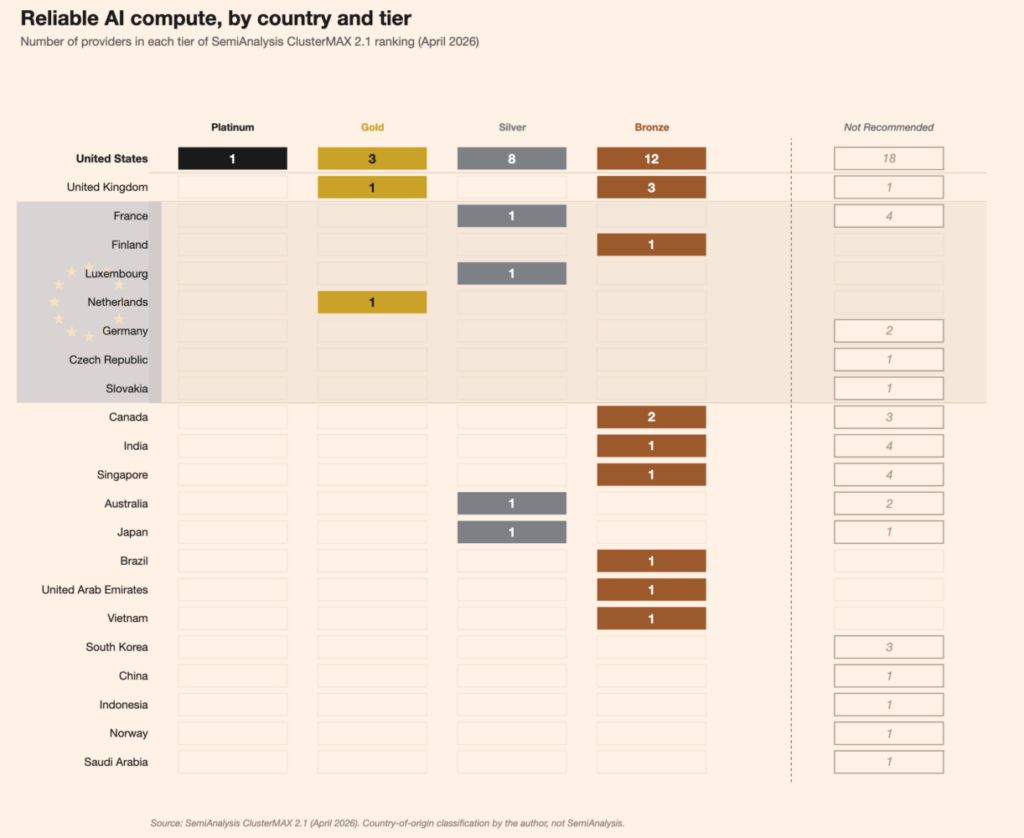
First, Europe does not host the top tier of rentable artificial-intelligence compute infrastructure. SemiAnalysis’ April 2026 “ClusterMAX 2.1” ranking evaluates graphics-processing-unit (GPU) cloud providers on the operational metrics that actually matter for frontier-AI development: how reliably a cluster performs useful work, and how quickly customers can deploy large-scale training jobs.

Across the entire Platinum-through-Silver range—the only tiers where serious frontier-model work happens consistently—the EU accounts for just three providers: Scaleway (France), Gcore (Luxembourg), and Nebius. Nebius, moreover, exists in its current form only because of the 2024 corporate split from Yandex, the Russian technology company.

GPU cloud providers in each tier of SemiAnalysis ClusterMAX 2.1 (April 2026), grouped by country of headquarters. The EU band (highlighted) contains one Gold-tier provider (Nebius, the post-Yandex Dutch entity), one Silver-tier provider in France (Scaleway) and one in Luxembourg (GCORE), and the rest in “Not Recommended.” Country-of-origin classification mine, not SemiAnalysis’s.

Cross-reference those rankings with the Cloud Sovereignty Framework procurement the European Commission completed last month: €180 million over six years, evaluated under the Commission’s Security and Eligibility Assurance Levels (SEAL) framework for legal and operational sovereignty. Only one of the four winning “sovereign” providers ranks in ClusterMAX’s top three tiers.

To be fair, SEAL and ClusterMAX are measuring different things. That is precisely the problem. A provider can score highly on legal sovereignty while performing poorly on the operational metrics that determine whether advanced AI systems can actually be trained and deployed effectively.

The Bottleneck Is a Cleanroom, Not a White Paper

Second, the semiconductor and memory supply chains are already effectively locked in. SemiAnalysis’ “Great AI Silicon Shortage” analysis finds that nearly every major AI-accelerator family has converged on Taiwan Semiconductor Manufacturing Co.’s (TSMC) N3 manufacturing process. AI demand is projected to consume 86% of N3 wafer output by 2027, with effective utilization exceeding 100% in the second half of 2026.

The bottleneck is not money. It is cleanroom capacity, which takes years to build.

The memory market tells a similar story through a different mechanism. SemiAnalysis describes a “once-in-four-decades” high-bandwidth-memory (HBM) supercycle, dominated by just three suppliers worldwide: Samsung, SK Hynix, and Micron. Customers are already signing long-term agreements backed by prepayments simply to secure future allocation.

None of these constraints responds, on any meaningful timeline, to directives from Brussels or the capitals of EU member states. Industrial policy cannot conjure advanced semiconductor fabs out of thin air—at least, not before this regulatory cycle ends.

You Are Not Outbidding Anthropic

Third, the rental market is already sold out, and frontier-AI customers are not about to be outbid. SemiAnalysis’ “Great GPU Shortage” analysis reports that on-demand GPU rental capacity is exhausted across both Nvidia’s Hopper and Blackwell architectures. Capacity scheduled to come online through August and September 2026 is already fully booked.

Prices reflect that scarcity. The H100 one-year contract-price index rose from $1.70 per GPU-hour in October 2025 to $2.35 by March 2026—a roughly 40% increase in just five months for what is now effectively a previous-generation chip.

Meanwhile, Hopper contracts originally due to expire this year are being renewed at the same rates customers agreed to two or three years ago, with terms extended through 2028.

Why are buyers willing to commit at that scale? Because the economics of frontier models have detached from the rest of the market. SemiAnalysis reports that Anthropic’s annualized revenue grew from roughly $9 billion at the end of 2025 to more than $44 billion by spring 2026. During the same period, inference gross margins rose from below 40% to above 70%.

A European entrant into this market—“sovereign” or otherwise—does not arrive as a market-maker. It arrives as a price-taker.

The Price of Sovereignty Is Paid by Users

If those three facts hold, then a version of CAIDA that pushes European users away from non-EU compute providers and application-programming interfaces (APIs) would not create meaningful European capability fast enough to matter during this regulatory cycle. It would, however, raise costs and reduce the quality of the AI systems European users can actually deploy.

Those costs vary by workload, which is worth unpacking separately.

SemiAnalysis’ “Cluster Total Cost of Ownership” methodology estimates that a Silver-tier cluster carries roughly 15% higher total cost of ownership than a Gold-tier cluster for a representative large-language-model (LLM) pretraining workload, even assuming identical GPU-hour pricing.

For any European lab trying to compete at the frontier, that translates into a research-velocity penalty measured in months of engineering time.

Inference workloads—the process by which trained AI models generate outputs for users—look somewhat different. There, the same methodology places the equal-priced Gold-versus-Silver gap below 1%. As the brief explains in greater detail, frontier-model training and frontier-model access through APIs bear sovereignty-related costs differently.

For European businesses and public institutions using Claude, GPT-5, or Gemini through an API, the binding sovereignty constraint is not where a request physically lands. It is whether users retain legal access to the API at all. That is the layer at which most European users actually encounter frontier AI.

The broader problem, developed at length in the brief, is that the categorical approach does not even deliver the legal immunity it implicitly promises.

The “immunity from non-EU law” standard embedded in the European Cybersecurity Certification Scheme for Cloud Services (EUCS) High+ framework assumes that EU headquarters and EU-based data processing sufficiently shield data from the reach of foreign legal systems. Canada’s King v. OVHcloud case is the live counterexample.

In September 2024, the Ontario Court of Justice issued a production order requiring OVHcloud to disclose subscriber data stored on servers in France, the United Kingdom, and Australia. The appeal remains pending.

That the most prominent extraterritorial production order of the past 18 months targeted Europe’s flagship sovereign-cloud provider, involving EU-hosted data, should weigh more heavily in this debate than it has so far.

Digital Sovereignty Is Not Autarky

At the EU level, CAIDA should take a risk-based rather than categorical approach, while preserving member-state subsidiarity for genuinely stricter public-administration requirements, instead of turning them into a single-market default. The genuinely narrow category of residual extraterritorial-risk concerns can already be addressed through Article 9 of the General Data Protection Regulation (GDPR), tailored national-security exceptions, and the proportionality principles that govern public-sector procurement more broadly.

The “build” side of the agenda—where European policymakers actually have leverage—looks very different. It runs through corporate-law reform, financial-single-market integration, and faster, harmonized permitting for data centers and electric-grid expansion.

The European Commission’s proposed “EU Inc.” framework belongs in that conversation, although its current drafting risks dilution through excessive deference to member-state legal autonomy—the same pattern I have criticized in earlier work.

The Commission’s own Joint Research Centre captured the core point with unusual bluntness for a JRC paper: “digital sovereignty cannot be equated with autarky.”

I will return to the package, the Council negotiations, and the EUCS High+ debate as the implementing acts come into view. For now, the key point is simpler than much of the rhetoric surrounding “AI sovereignty” suggests.

Europe’s binding constraints are silicon, capital, power generation, and its own hesitation to enact the corporate-law reforms its technology sector has requested for years—not jurisdiction.

A categorical CAIDA would not change those constraints. It would mostly change who pays for them.

The post You Can’t Regulate a GPU Into Existence appeared first on Truth on the Market.


Source link