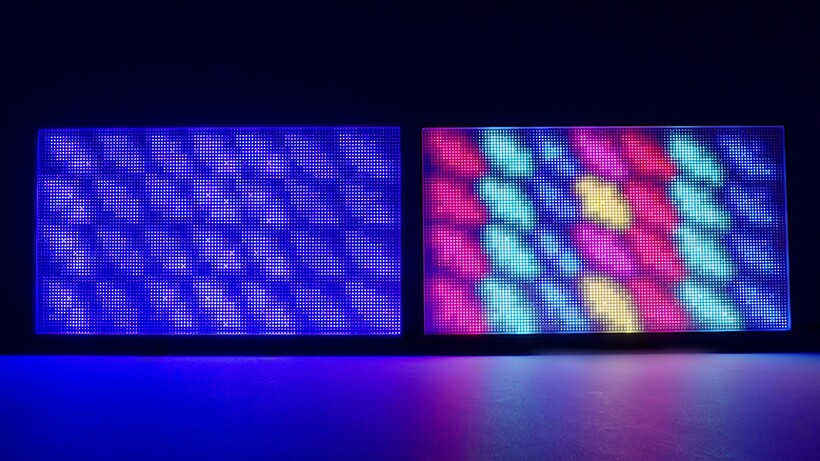

Depending on who you ask, a new era of TVs have arrived… or maybe it’s the same era as before, just more colourful and brighter. Either way, RGB TVs have arrived to challenge OLED TVs… or they’re here and not as good as OLED TVs.
The above introduction speaks to the mixed messaging from the TV market about its latest technology. Depending on the brand you ask, RGB TVs could change the home viewing experience, get closer to the performance of OLED and do so at sizes and prices that’d make similar OLED screens prohibitively expensive.
Or RGB TVs aren’t as good as OLED TVs. Their backlight control gets closer than anything previously developed to match their OLED cousins, but they’re still an LCD TV and arrive on the scene with the limitations of that technology.
From what I’ve gleaned, RGB TVs land somewhere in the middle of that discussion. A genuine alternative to OLED at affordable prices, but the performance will depend on how much can be extracted from the backlight, panel and colour performance. Not every RGB TV is born equal.
But what I wasn’t expecting to learn about RGB TVs is that, while it can offer this almost unparalleled combo of brightness and colour performance, there’s no real-world content available to truly take advantage of it.
Another 8K TV situation?

This notion I gleaned from editing one of your contributors’ (John Archer) review of the Samsung R95H. He mentions several times throughout the review that there’s “there’s no real content out there that can fully exploit such wide colour” that the R95H can produce, which is not an aspect about RGB TVs that I’ve heard mentioned before about the technology.
The onus has been on reproducing a wider range of colours for a more faithful experience, but what if, in the case of RGB TVs, it goes beyond current standards?
With the R95H hitting “nearly 150% of the DCI-P3 colour spectrum and nearly 95% of the most extreme BT2020 colour spectrum”, would we be watching content as it was meant to be watched, in the form that it was mastered in, or is it more likely there’s plenty of potential colour performance left on the table because there’s no content that’s been produced to the standard RGB TVs can reach?
As RGB TVs can hit colour extremes that OLED TVs can’t (at the moment), the answer is likely yes to the latter. With no content currently available, upcoming RGB TVs can consistently hit levels of brightness and colour range that are beyond previous versions of an LCD TV, but we’d be viewing an interpretation of what a TV thinks content should look like, rather than a broadcast, stream or 4K Blu-ray that’s informing the TV how its colours should be displayed.
It brings to mind the situation surrounding 8K TVs, a technology that had the cart before the horse, with the biggest issue being that there was nothing to see in the cart. 8K tried to push through standards that the industry had to catch up to, and eventually decided it was interested in pursuing. Might the same happen with RGB TVs?
Will we see RGB’s potential fulfilled?

I don’t think this is like what unfolded with 8K TV. 8K suffered with issues due to production, the scarcity of content to view on the screens, as well as problems with distributing 8K content. There simply wasn’t the will to bring the technology into being.
RGB TVs are an evolution of the Mini LEDs, Full Array Local Dimming TVs and LCD TVs that have come before it. We’ve seen brightness pushed to levels that I’d say aren’t really needed from a content point of view, but from a practical point of view, higher brightness has aided watching TV in a bright room.
Colour is a slightly different issue as that can be tweaked with processing. You would think that having a row of five TVs side-by-side in the same picture mode would result in the a similar performance, but I’ve seen on many occasions that it does not. Everyone has their own approach to colour, to what they believe is what their customers want to see and this will be tweaked over time as feedback comes in.
But it does sound as if content needs to catch up in order for RGB to fulfil its potential. We could be sailing into a glorious, bright and colourful future, or one that’s ruled by marketing speak or eye-catching specs. RGB TVs have opened the door, but who’s going to venture in and produce the content that unleashes all the potential that RGB TVs can offer?

Stephan is the sports journalist for the Maple Grove Report.