How Weight Loss Drugs Affect Demand


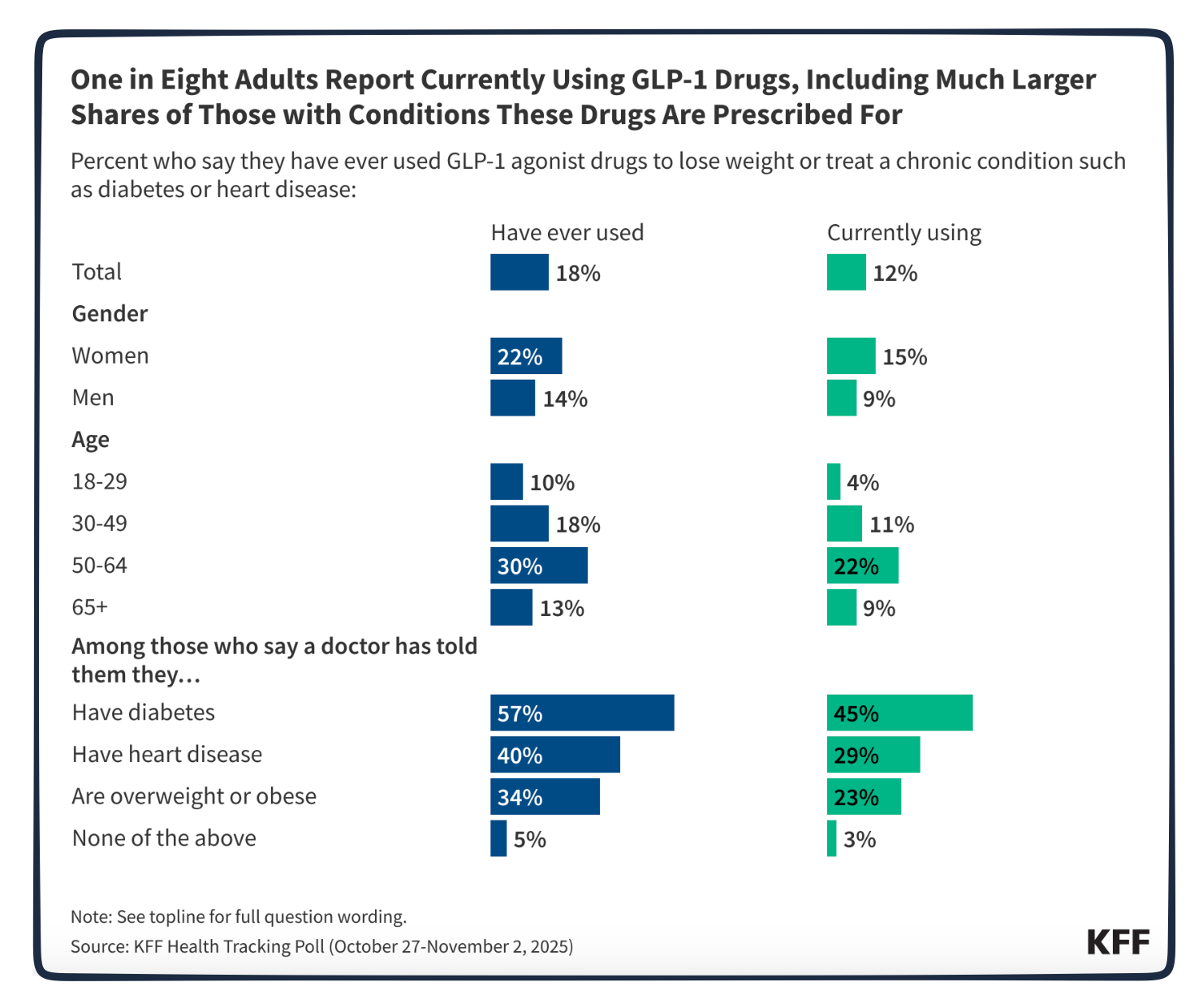
With KFF reporting that one in eight adults takes a weight loss drug like Ozempic, Wegovy, or Zepbound, we can expect changes in household food spending.

More women than men take the medication with the percents rising for 50-64-year-olds:
weight loss drugs

At home, within six months, households using a weight loss medication reduced grocery spending by 5.3% while high income households spent a whopping 8% less. The items that disappeared from the pantry included snacks, baked goods, and even (counterintuitively) we ate fewer eggs, and less bread and meat. By contrast, yogurt sales rose the most. But then, after a year, spending starts to rise again.

Weight Loss Drugs’ Impact

Far beyond grocery stores, weight loss drugs have had a less obvious impact.

Brides

Closer to their wedding date, brides are losing a lot of weight. In a pre-weight loss drug world, dress shopping started 5 to 6 months before the wedding. Now, that timing has shrunk to 45 days. As a result, bridal dress stores need more last-minute gown fittings, more inventory, more overtime work, and extra rush orders. Some have also asked customers to sign legal waivers saying their dress did not fit when first ordered.

Fashion Inventory

Seeing an uptick in demand for smaller size clothing, retailers say that planning future inventory has become tougher. But they are enjoying new sales from the consumers that are replacing their wardrobes more frequently.

Airlines

According to a recent study from Jefferies, the four major airlines–Southwest, American, United, Delta–together could save $580 million annually on fuel because of lighter loads. With fuel 20% of their annual expenses, we are looking at 1.5% of the total. Not as small as it seems, the savings could be $577 million. Especially now, with airlines’ fuel costs soaring, an offset would be meaningful.

Our Bottom Line: Externalities

Defined as the impact of an activity or contract on a third unrelated party, an externality can be positive or negative. The perfect example of a positive externality is the ripple impact of vaccines. When one person gets vaccinated, she prevents many she does not even know from getting sick. As for the negatives, air pollution has the opposite spillover when the byproduct of a factory is the dirty air that activates a distant person’s asthma.

For weight loss drugs, the list of externalities is unending. They take us to how we feel, what we eat, what we wear, the furniture we buy, the stocks we own.

My sources and more: Thanks to WSJ for inspiring today’s post and the NY Times for its airline example. From there, we returned to our 2023 econlife post. Meanwhile CNBC, the Retail Insight Network, and the Cornell Chronicle described how spending changed. And the KFF study documented usage.

Please note that several of today’s sentences were in a past econlife post.


Source link

Leave a Reply

Subscribe to Our Newsletter

Get our latest articles delivered straight to your inbox. No spam, we promise.

Recent Reviews


When evaluating the health of a small business, we typically focus on financial indicators: revenue, margins, expenses, and growth trajectory. But Xero’s Emotional Tax Return 2026 report highlights another critical metric – the psychological cost.

U.S. small business owners lose an average of 33 working days per year to stress. That’s more than a month of lost productivity, driven not only by market conditions but by the sustained mental load of managing cash flow, compliance, rising costs and daily financial decisions.

From a financial therapy perspective, this is not surprising. But what stands out most is how persistent this financial stress has become.

Why avoidance is common – and predictable

The report reveals a pattern many small business owners will recognize:

  • 73% have been caught off guard by a tax outcome
  • 34% fear making financial mistakes
  • Owners lose an average of eight hours per week to stress

Avoidance is often misunderstood as poor discipline. In reality, it is a common psychological response to perceived threat. When systems feel fragmented or unclear, financial tasks can trigger anxiety. Choosing to disengage reduces discomfort temporarily, but it allows the uncertainty to compound.

When financial visibility is low, stress increases. And when stress increases, decision-making quality declines. Reducing small business stress requires addressing that cycle directly. Stress, in this context, is not only a mental health issue. It is an operational constraint that affects small business productivity.

When financial stress becomes structural

According to the report:

  • 70% of owners say financial management is a major stressor
  • 81% say this fiscal year has been more stressful than previous years
  • 74% report stress negatively affects their professional performance

That strain shows up in missed opportunities (34%), slower decision-making (28%) and reduced creativity (30%).

In clinical practice, I often see how chronic financial stress narrows cognitive bandwidth. When uncertainty around cash flow, tax obligations or operating expenses becomes constant, the brain shifts into threat mode. Attention tightens. Working memory declines. Over time, this doesn’t just feel exhausting. It becomes limiting.

Financial visibility reduces perceived threat

One of the most effective stress-reduction strategies in financial therapy is increasing perceived control. Control does not mean eliminating uncertainty entirely. It means improving clarity within what can be managed.

This is where a platform like Xero plays a crucial role. Real-time dashboards, automated bank reconciliation, integrated reporting and digital receipt capture centralize financial data and reduce manual workload. Instead of chasing paperwork or reconciling transactions late at night, business owners can access up-to-date cash flow information in one place.

Eighty-seven percent of U.S. customers say Xero improves financial visibility. Ninety percent say it helps their business run more efficiently.

From a psychological standpoint, improved visibility reduces threat activation. When business owners can clearly see what’s coming in, what’s going out and what’s due, decision-making becomes proactive rather than reactive.

Bookkeeping automation protects mental bandwidth

The average small business owner spends 22 hours per month managing finances. That’s nearly three full workdays devoted to admin. Automation meaningfully reduces that burden. Businesses using Xero save an average of six hours per week on bill management alone.

Those hours add up. But more importantly, so does cognitive relief. Less manual data entry. Fewer surprises at tax time. Fewer last-minute reconciliations. The result is not just greater efficiency, but stronger cash flow management and better long-term planning.

When administrative friction decreases, small business productivity improves – and so does wellbeing.

Collaboration reduces isolation

Despite the documented impact of financial stress, only 9% of small business owners seek advice from an accountant or advisor as a coping strategy.

Isolation intensifies pressure. Collaboration diffuses it.

Real-time collaboration features allow business owners and advisors to work from the same live financial data. That reduces errors, improves forecasting and increases confidence. For the 34% who fear making financial mistakes, shared visibility offers both technical accuracy and emotional reassurance.

In my experience, financial clarity combined with trusted guidance is one of the most powerful antidotes to chronic financial stress. It transforms financial management from a solitary burden into a supported system.

Turning emotional tax into resilience

Forty percent of small business owners report having considered giving up their business. That statistic underscores the broader economic implications of sustained financial stress.

Entrepreneurship will always involve risk. But persistent, preventable financial stress does not need to be part of the model.

Reducing the Emotional Tax starts with structural shifts:

  1. Improve real-time financial visibility
  2. Automate repetitive bookkeeping and admin
  3. Collaborate proactively with financial advisors

When business owners can clearly see their numbers, anticipate obligations, and reduce manual workload, they regain more than time. They regain perspective.

The Emotional Tax is measurable. But so is the return when clarity replaces uncertainty.

And when clarity returns, confidence follows – not just in the numbers, but in the long-term health of the business itself.

Was this article helpful?

YesNo


Source link