How The ‘Knight Rider’ Pontiac Trans-Am Got A Speeding Ticket While Sitting In A Museum


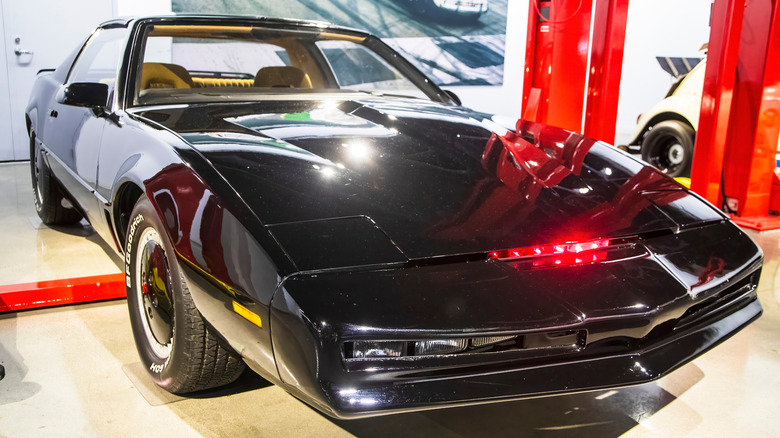
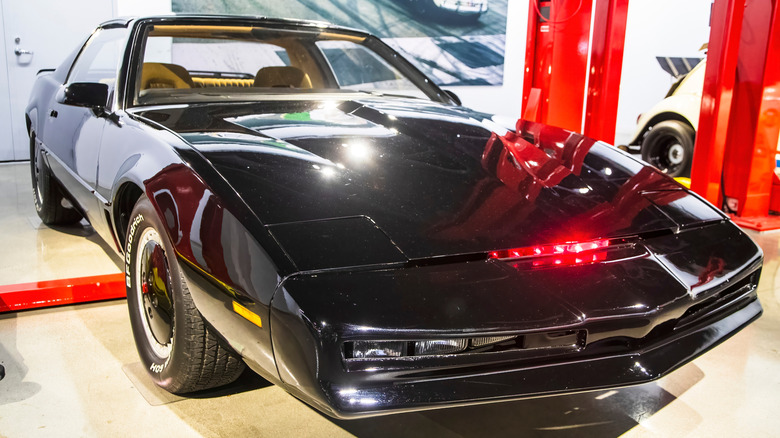
Pop culture is filled with iconic cars that include everything from the A-Team’s van to Doc Brown’s DeLorean time machine. There are tons of excellent examples, and one of the best from 1980s television is KITT from “Knight Rider.” KITT, which stands for Knight Industries Two Thousand, is a 1982 Pontiac Firebird Trans Am that’s outfitted with an advanced artificial intelligence system voiced by William Daniels in the series.

There were three KITTs used in “Knight Rider,” and they’ve resurfaced every now and then in the decades since it went off the air. The show’s popularity has ensured that KITT remains a common sight at conventions and museums, but one exhibit holds the distinction of being ticketed while parked. In May 2026, an authentic replica of KITT that was sitting quietly at the Volo Museum in Volo, Illinois received a traffic violation for speeding in a school zone in New York City.

The $50 ticket was delivered to the museum, which made more than a few people scratch their heads in confusion. How could a car that’s sitting in a museum in Illinois violate a traffic law in NYC? The answer to that is, it can’t, and it didn’t. The car has been sitting on permanent display for years, but the traffic fine was delivered there regardless, pushing the museum to request a hearing to dispute the ticket. Nobody stole the car and took it for a joyride, and it didn’t speed in a school zone — the problem was its license plate.

KITT’s novelty license plate

In “Knight Rider,” KITT had the ability to switch its license plate from “KNIGHT” to “KNI 667,” and it was used in a single episode to evade the police after a successful prison break. The replica sitting in the Illinois museum sports a license plate reading “KNIGHT,” which is a novelty tag since that isn’t registered to the museum or anyone else. On April 22, 2026, at exactly 1:02 p.m., a traffic camera on Ocean Parkway in Brooklyn snapped an image of a speeding vehicle sporting a California “KNIGHT” license plate.

The car was going 36 in a 25, which resulted in the $50 traffic fine. Upon issue, it wasn’t clear why the ticket wasn’t delivered to the California driver’s owner and instead went to a museum, but that’s what happened. Even stranger is the fact that the summons came with proof of the violation in the form of a picture of the speeding car. The museum posted on Facebook soon after, writing in part:

“The camera captured the novelty license plate (not a real plate … and also a California plate). Their official system ties the novelty plate to [the] Volo Museum, and we got a bill for $50!! 😂 You can’t make this up! Our KITT hasn’t moved from our museum in years! Does anyone have Hasselhoff’s number? He owes us $50!!!!” Unsurprisingly, Hasselhoff owns a ‘1982 Pontiac Trans Am, and he even spends his off time modifying and selling them as KITT replicas. As for the ticket, it was resolved thanks to a great deal of attention.

The Volo Museum doesn’t have legit plates on KITT, but that didn’t matter

After learning of this strange tale of a speeding ticket being issued to a stationary museum exhibit, we contacted the Volo Museum, the California DMV, and the New York City Department of Finance to fill in the details. According to Jim Woydyla, Marketing Director of the Volo Museum, “The license plate is the one that was used on the show. We sell them in our gift shop. It wasn’t even a vanity plate; it was a novelty plate. Basically, a movie prop.”

According to the NYC Department of Finance, the ticket was voided, ensuring that the museum was no longer on the hook. The story resulted in multiple press offices hounding the department about the ticket, which is why the fine was removed. That still doesn’t explain how or why the fine ultimately found its way to Illinois. First and foremost, the Volo Museum never registered that license plate. Instead, the museum, which also sells around 800 classic and collectible cars each year, has only dealer plates. 

The weird part of the story involves how New York gave the museum the fine in the first place. After the system snapped the picture of the speeding car’s plate, the New York Department of Finance contacted the California DMV, which identified the Volo Museum as the registered owner. According to the Museum, they never registered the plate, so it remains a mystery as to how they ended up as the registered owner. It’s likely lost somewhere in the transfer of ownership paper trail.


Source link

Leave a Reply

Subscribe to Our Newsletter

Get our latest articles delivered straight to your inbox. No spam, we promise.

Recent Reviews


Flip phones are making a comeback, but most US adults aren’t convinced enough to upgrade. 

Smartphone brands are trying new phone concepts, like flip and foldable phones, to give us a bigger screen when we want it, while still maintaining the same functionality as the smartphones we’re used to. There’s the Samsung Galaxy Z Fold 7, for instance, and there’s even a rumor that Apple plans to release its first foldable phone

And if you remember the popular 2000s Motorola Razr, now there are rumors about the Motorola Razr 2026 — it reminds me of my old pink phone. But gone are the days of a basic keypad and a few ringtones. Smartphone brands are adding AI features, such as creating custom emoji, removing background objects from photos, and live translation. 

Yet a recent CNET survey says smartphone users aren’t sufficiently impressed by new features and concepts to consider upgrading their phones. Only 12% are motivated by AI integrations and 13% by new phone designs. Instead, price (55%) and longer battery life (52%) are the biggest drivers of their decision to get a new phone. 

If most US adults aren’t sold, why are tech brands so adamant? Let’s dive into CNET’s findings and what they mean for the future of smartphones.

  • The top three motivations for US adult smartphone owners to consider upgrading their devices are price (55%), longer battery life (52%) and more storage (38%). That’s the same top three as last year: In 2025, price was the top motivator (62%), followed by longer battery life (54%) and storage capacity (39%). 
  • Despite AI’s growing presence, only 12% of smartphone owners say AI integrations would motivate them to consider upgrading. 
  • Only 13% of smartphone owners would be motivated to consider upgrading to a new phone concept, such as a foldable or flip phone. 
  • Over half of smartphone owners (58%) experience frustration with their phone’s battery life, and 31% say their phone’s battery doesn’t hold a charge as well as it did when it was new.  

Most US adults aren’t motivated by new smartphone features and designs

Smartphone brands, like Samsung and Apple, are building in convenient features, such as a tool to remove unwanted objects from pictures, AI call screening and the ability to draft a message from a prompt. However, CNET found that US adults would consider upgrading for more practical reasons. Over half (55%) of US smartphone users are motivated by price, including 53% of Apple users and 56% of Samsung users. 

Yet brands are still exploring new concepts and features, like Apple Intelligence, a built-in AI feature. Then there’s the rumor of a book-style iPhone, potentially followed by a clamshell foldable design. But that’s not what most smartphone owners are after. 

Smartphone owners are more convinced by other design and feature factors when deciding on a new phone, such as camera features (27%) and the phone’s display or screen size (22%). Here are the top motivators to consider upgrading for all smartphone users.

Zain Awais / CNET

You’ve probably noticed the price of a basic smartphone has increased drastically over the years. Take the iPhone, for example. It was originally $600 for 4GB. But advanced features, the RAM shortage, inflation and tariffs are pushing prices even higher. Now, the baseline iPhone 17 (256 GB) is $800, and the Samsung Galaxy S26 (256 GB) starts at $900. 

There’s no way of knowing for sure, but these may be the lowest prices we’ll see on new models for a while, especially as features advance and designs become more complex. So if you’re already in the market for a new phone, you might want to think seriously about pulling the trigger now if you find a good deal.

The top upgrading motivators haven’t changed much over the years

Looking back at CNET’s survey data from 2024 and 2025, and now, people’s motivators for upgrading their phones haven’t changed much. Price, longer battery life and more storage have been top drivers in the past, and despite small dips this year, they’re still key upgrading factors.

Despite design upgrades and new features, smartphone owners are still focused on how much they’re paying and how long they can use their devices without needing a charger. Consumer sentiment about AI integrations dropped hard from 2024 to 2025, but it has edged up slightly in 2026. And smartphone owners aren’t as easily persuaded by phone color or the phone being thinner, either. 

Even with these nice-to-have capabilities, smartphone owners are looking at the basics. That includes practical features like battery life and more storage to hold their many important files, photos and apps. 

Most smartphone owners want better battery life

Taking a closer look at smartphone users’ hope for longer battery life in a new phone, over half (58%) are frustrated with their current phone’s battery life. Roughly one in three (31%) say their phone doesn’t hold a charge. 

The reality is, battery life will decline the longer you have your phone, so you may find your phone’s battery charge doesn’t last as long as it used to. Even though you can replace your phone’s battery, most phone batteries have a lifespan of two to three years before they start degrading. 

CNET Director of Editorial Content Patrick Holland examined battery life tests on over 35 current smartphones. And it’s not just iPhones that pack impressive batteries.

Based on CNET’s lab testing, the $1,200 iPhone 17 Pro Max had the best overall battery life, with a 5,088-mAh capacity. Another top performer was the $900 OnePlus 15, with a 7,300-mAh battery. 

If you’re looking for a phone with better battery life, consider one with a silicon-carbon battery to increase capacity without requiring a larger phone. The OnePlus 15, Poco F7 Ultra, OnePlus 13R and OnePlus 15R all feature silicon-carbon batteries with large capacities and all performed well in Holland’s testing. Keep in mind that other factors can impact your battery life, like your carrier’s signal, software efficiency and processor. 

Methodology

CNET commissioned YouGov Plc to conduct the survey. All figures, unless otherwise stated, are from YouGov Plc. The total sample comprised 2,486 adults, of whom 2,407 owned a smartphone. Fieldwork was undertaken from April 29 to May 1, 2026. The survey was carried out online. The figures have been weighted and are representative of all US adults (aged 18 plus). 


Source link