What Is The 3-Thread Rule For Fastening Bolts?


Nuts and bolts (sometimes called studs) are some of the most secure ways to attach two things together, and if you want to make sure they last a long time, a good thread locker can do wonders. While screws can accomplish the task, with much less preparation and effort, nuts and bolts are typically longer lasting and more secure. They’re also more commonly used when the two things you’re attaching will need to be taken apart. It can sometimes be difficult to determine when you have properly secured a bolt. That’s where the three-thread rule comes from.

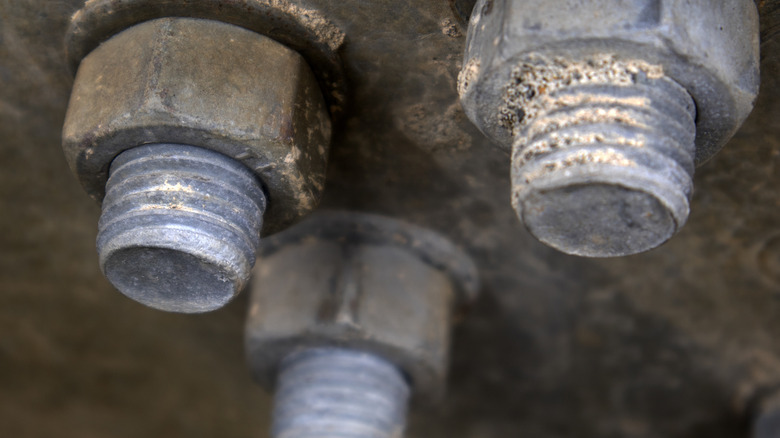
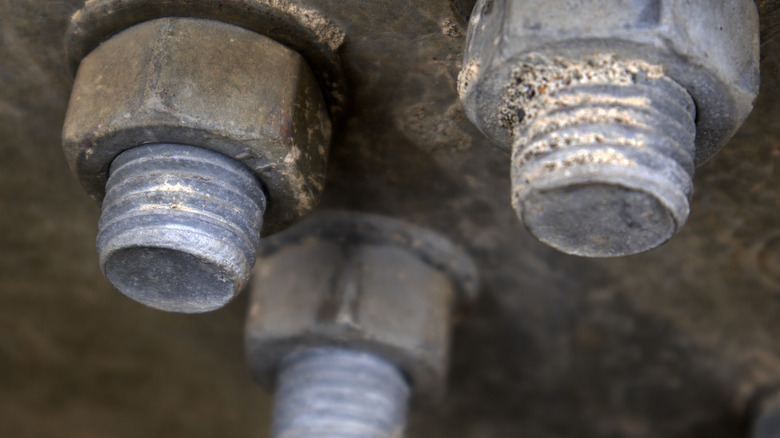
The three-thread rule is generally considered to be the minimum amount of thread engagement you need for a secure hold with a bolt. Under the rule, you should thread the nut and rotate it around until you can see three rotations of the bolt’s thread protruding out the other side. This ensures that you have enough engagement for the threads to hold securely. 

The reason for this is that often the threads at the very end of the nut or bolt are less structurally sound than the threads further in. They can start to strip or break down the closer to the edge you get. By attaching the nut so that three full revolutions of threads are sticking out, you’re ensuring that the maximum amount of surface area on the bolt is in contact with the maximum amount of surface area of the nut. If you need to get it off, penetrating oil can help with that.

Exceptions and other rules
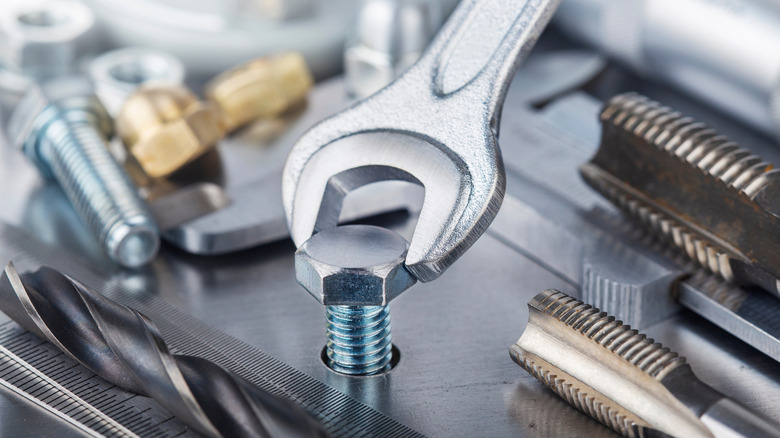
Another rule for nuts and bolts is determined by the material you’re working with. If you’re attaching steel nuts and bolts together, another rule suggests that you should have as much of the bolt protruding from opposite end as one diameter of the bolt. For example, if the bolt your attaching is a three-quarter-inch bolt, the threads should protrude out by about three-quarters of an inch. The rule differs for aluminum fasteners; it says you should go for two times the diameter of the bolt.

All of these rules are designed to help you find the sweet spot for fasteners. You don’t want to have too little thread engagement, or the nut may not hold at all. You also don’t want to have too much, lest the end of the bolt sticking out become problematic. Having a solid rule like this helps you find the happy medium of thread snugness, and bolt protrusion.


Source link

Leave a Reply

Subscribe to Our Newsletter

Get our latest articles delivered straight to your inbox. No spam, we promise.

Recent Reviews


Researchers in South Korea developed a wearable system that uses seven smart rings to read finger and hand motions to translate American Sign Language and International Sign Language into text. The purpose is to make communicating easier between those who sign and nonsigners without needing a separate human interpreter. 

AI Atlas

According to the study, published Friday in the journal Science Advances, the system reliably recognized 100 ASL and ISL words during testing. It also performed well with users the system had not seen before, and it didn’t require recalibration for each person. Because the system detects words in sequence, it can produce sentence-level translations without extra training on grammar. 

ASL and ISL are the everyday languages of more than 72 million deaf and hard-of-hearing people. However, most hearing people do not know any words in these languages or have a very basic understanding. That gap makes certain tasks, like ordering at a restaurant or asking for help, much more difficult. 

A graphic shows two illustrated people talking in sign language, ASL and ISL. The graphic also shows the different components of the ring as well as pictures of hands modeling the rings.

A concept of how the rings work in the real world. 

American Association for the Advancement of Science (AAAS)

Existing sign language translator prototypes often rely on bulky gloves that can distract from or block natural hand movement or feel uncomfortable for the wearer, which limits real word adaption. Camera-based technologies can work well in controlled environments but are often limited to those places where a camera can be set up with a clear line of sight, the researchers wrote. 

To solve these problems, the researchers designed sensing rings for each finger that can capture precise motion and finger position while letting the hands move naturally. The rings can detect both signs that involve movement, like the words for “dance,” “fly” and “sun,” and signs that are held still, like “I” and “you.”

“These advances suggest that [the device could enable] barrier-free public translation systems for unseen users and unrestricted daily assistive interfaces,” the authors wrote in the study. 

The authors are affiliated with Yonsei University, Hankuk University of Foreign Studies and the Korea Institute of Science and Technology, among others. While the technology is still experimental, the authors wrote that the technology has the potential to ease communication difficulties. The underlying idea could also help improve controls for other systems, like virtual or augmented reality.

“Beyond sign language translation, the ring-type, wireless, and modular architecture of (wirelessly connected, ring-type sign language translators) may also be extended to other gesture-driven applications such as virtual or augmented reality control, touchless device interfaces, or rehabilitation monitoring systems where fine-grained hand movement tracking is essential,” they wrote.


Source link