The rise and fall of Minneapolis-Moline


Minneapolis-Moline dates back to the Candee & Swan Plow Company of Moline, Illinois, founded in 1865. It became Moline Plow Company (later, Moline Implement Company), a major Midwestern producer of tilling equipment: plows, harrows and other tools for sowing grain crops. 

The Minneapolis Threshing Company began in Fond du Lac, Wisconsin, in 1874, and settled in Hopkins, Minnesota, in 1887. It concentrated on equipment for the last stage of small grain production: threshing. 

Minneapolis Steel and Machinery Company, founded in 1902, began by making heavy construction equipment and steam engines, then moved into vehicles, including tractors (the Twin City line, 1912) and buses. Its chief executive, Warren C. MacFarlane, engineered the 1929 merger of the three companies and became president.

The merger produced a company that served farming tasks year-round: tilling, planting, weeding, harvesting and processing. Such integration was needed to compete with industrial giants like John Deere and International Harvester. All three of the constituent companies made or had made tractors. After the merger the company trimmed tractors to a single line, Twin City, made in Minneapolis. Harvesters and, later, combines, were built in Hopkins, also the company’s headquarters; tilling equipment was made in Moline.

In its first full year of operation, 1930, Minneapolis-Moline earned a profit of slightly more than one million dollars on sales of about $13,500,000. Then two catastrophes struck. The Depression devastated farm country; farmers stopped buying equipment. Then, in September 1932, Warren MacFarlane was seriously injured in a car crash. He spent five months hospitalized, partially paralyzed. By 1933, sales had fallen to $2,336,000, producing losses of over $1,500,000 and a reduction of employees from over 3,000 to just 672. Losses grew to over $2,000,000 in 1934.

The optimistic MacFarlane predicted a rebound in 1935, achieved through improved farm conditions, aggressive price-cutting and innovation. Minneapolis-Moline’s new line of combines, called Harvestor and built in Hopkins, captured 20 percent of a reviving market and helped produce a profit of $170,000. Sales grew steadily over the next five years, from $9,000,000 in 1935 to over $16,000,000 in 1940. During World War II the company made artillery shells, naval winches and construction machines for the Army and Navy, in addition to its regular agricultural line; sales and profits grew. 

The post-war years were even better. The company’s best-ever profit year was 1950, when it made over $7,000,000. Minneapolis-Moline did business in all forty-eight states and across Canada, in Argentina and Mexico; it had over 2,000 dealers. Sales once reached $100 million. At home its employees, whose numbers may have reached 6,500, competed in company baseball, volleyball, bowling and sharpshooting leagues. But trouble lay ahead.

In 1951, looking to strengthen its position in the American southeast, Minneapolis-Moline acquired the B. F. Avery Company of Kentucky. The hoped-for benefits did not come. Meanwhile, the number of farms in the United States continued to fall, while M-M’s competitors—chiefly International Harvester, Allis-Chalmers, John Deere and J.I. Case—got stronger. M-M fell from fifth place among implement makers to eighth. Losses began in 1954, the same year it opened a factory in Turkey. Over the next five years losses exceeded $6,500,000.

In 1955 a hostile takeover ousted most of the Minnesota directors; MacFarlane retired in January of 1957. His successor, J. Russell Duncan, returned the firm to profitability through cost-cutting and diversification, but he was ousted in 1960. That year the company changed its name to Motec, short for Moline Technology. In 1963 Motec was taken over by White Motor Company of Cleveland, with another new president and a return to the Minneapolis-Moline name. In 1972 White closed both the Hopkins and Minneapolis factories, putting over 1500 Minnesotans out of work. No physical trace of these enormous installations survives. By 1981, White Motors was out of business.

Bibliography

Annual Reports, Minneapolis-Moline Company, 1950?–1960. Available at the Minnesota Historical Society library as HD9486.U54 M6132.

Minneapolis-Moline Power Implement Company.“Can a Company Outgrow Its Name?” Advertisement. Minneapolis Star, June 8, 1961.

Gunter, Ray. “Hopkins Plant Was Once Hub of Activity.” Minneapolis Star, April 4, 1963.

Hobart, Randall. “Moline Chief Cites Gains, Optimism.” Minneapolis Star, March 4, 1958.

Hobart, Randall. “‘Mr. Mac’ of Moline Takes a Breather.” Minneapolis Star, January 28, 1958.

Howe, Richard. “Three Factors Are Sighted in Motec Presidential Changes.” Minneapolis Tribune, March 25, 1962, F9.

Inskip, Leonard. “Chicagoan Elected President of Moline.” Minneapolis Tribune, November 16, 1957.

——— . “Motec Says It Will Sell to White.” Minneapolis Tribune, October 19, 1962.

Letourneau, P. A., ed. Twin City Tractor Photo Archive: Photographs from the Minneapolis-Moline Company Records. Iconografix, 1993.

Mason, Ralph. “Reorganized Moline Forging New Ideas.” Minneapolis Star, February 10, 1961.

McCarty, Pat. “Motec is Moline Again; Loss Reported.” Minneapolis Tribune, January 30, 1963.

“Minneapolis-Moline—A Leader in Its Field of Industry.” Minneapolis Tribune, November 26, 1939.

“Minneapolis-Moline Observes 75th Anniversary.” Minneapolis Star, April 7, 1940.

“Moline Firm Plans Output of $750,000.” Minneapolis Journal, December 2, 1934.

“Moline Plant Hums, Nears 1929 Record.” Minneapolis Journal, June 5, 1936.

Petersen Jr, Chester, and Rob Beemer. Minneapolis-Moline Farm Tractors. MBI Publishing Company, 2000.

“The Romance of ‘Harvestor.’” Implement and Tractor, April 4, 1936, 24–25.

Schaefer, Ed. “Management Miracle at Minneapolis-Moline.” Minneapolis Star, August 7, 1959.

Thomas, Norman F. Minneapolis-Moline: A History of Its Formation and Operations. Arno Press, 1976.

“We Are Hard At Work.” Minneapolis Tribune, January 1, 1930.

“Where the Velvet Begins.” TIME 35, no. 1 (January 1, 1940): 37–38.

Wendel, C. H. Minneapolis-Moline Tractors 1870–1969. Motorbooks International, 1990.

Wickland, John A. “At 15 He Built a Tractor—and It Worked!” Minneapolis Tribune, June 24, 1956.

——— . “Moline Tractors Take On New Look.” Minneapolis Morning Tribune, January 15, 1956.

Youngblood, Dick. “2 Twin Cities Plants to Close, Idling 1,300.” Minneapolis Tribune, January 7, 1972.

Primary

M/A 0208 
Collection on Minneapolis Moline Power Implement Company, 1915-2001 1915-1979 
Manuscripts Collection, Hennepin County Library Special Collections, Minneapolis 
Description: The collection contains clippings, advertisements, photographs, reports, and correspondence, machinery catalogs, and scrapbooks. A number of papers and correspondence detail the 1929 merger of the company. Machinery catalogs are arranged by machine type. The scrapbooks consist of newspaper clippings from local and national papers. The four scrapbooks cover the following years: 1916–1954, 1929–1932, 1932–1944, and 1943–1954. 
https://archives.hclib.org/repositories/2/resources/121

Minneapolis-Moline Power Implement Company. “Our Policy is Progress” Advertisement. Minneapolis Star, January 9, 1966.

Secondary

Leffingwell, Randy. America’s Classic Farm Tractors. MBI Publishing, 1999.

Wendel, C. H. Encyclopedia of American Farm Tractors. Crestline Publishing, 1979.


Source link

Leave a Reply

Subscribe to Our Newsletter

Get our latest articles delivered straight to your inbox. No spam, we promise.

Recent Reviews


Québec City in winter asks for a different kind of travel mindset. Days move more slowly, distances feel longer, and simple choices like what you wear, where you stop, how much you plan shape your experience more than usual. This is not a destination you rush through or try to out-optimize.

We arrived thinking we understood winter travel. After all, I was a professional skier for over 20 years. We left realizing how intentionally this city operates when temperatures drop. Streets are designed to keep life moving, meals stretch longer, and the season becomes part of the rhythm rather than something to work around.

These are the things we wish we had fully understood before our first winter visit, not as warnings, but as perspective. A little context goes a long way in Québec City, especially when everything is quieter, colder, and at its most beautiful.

Winter Isn’t a Downside — It Is the Experience

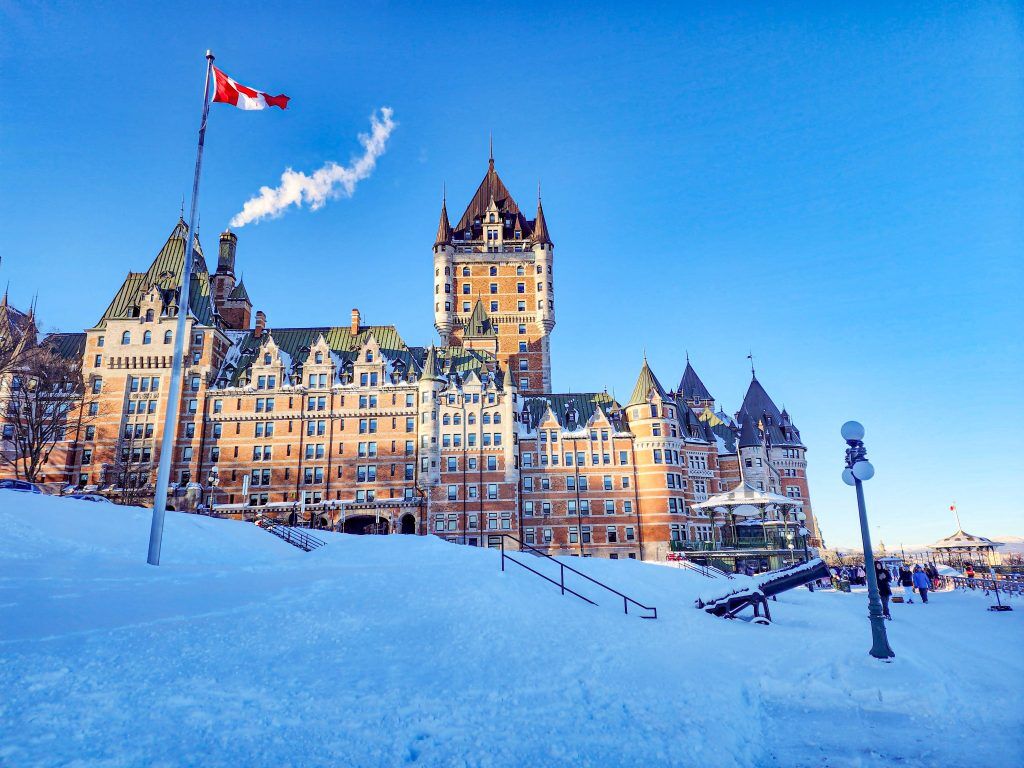
Fairmont Le Château Frontenac Quebec Canada
Photo Credit: Jenn Coleman.

If you’re waiting for spring to see Québec City “at its best,” you’re misunderstanding the city.

Snow doesn’t just decorate Old Québec, it transforms it. Winter softens sound, slows foot traffic, and changes how the city feels. Locals don’t retreat indoors; they adapt. Fire pits appear. Ice slides reopen. Outdoor spaces are reimagined instead of abandoned.

Once you accept that winter sets the tone and is not something to work around, everything else falls into place.

Pack Functional, Not Fancy (Style Can Still Exist)

Snowy Quebec City Canada
Photo Credit: Jenn Coleman.

This isn’t the place for sacrificing warmth for aesthetics. But that doesn’t mean you need Arctic expedition gear either.

Think intentional layers:

  • A real winter coat (insulated and wind-blocking)
  • Wool socks (you’ll walk more than you expect)
  • Insulated boots with grip
  • Gloves you can still use your phone in
  • A hat that actually covers your ears

Québecers dress well in winter, but nothing is accidental. Warmth comes first, style follows. Pack with that same mindset and you’ll enjoy the city instead of constantly searching for the next place to thaw out.

We found that we packed too many “cute clothes” and ended up dressing in our layered ski clothes on most city days.

Ice Cleats Are a Secret Weapon

Christmas night in Quebec City
Photo Credit: Jenn Coleman.

Sidewalks are cleared efficiently, but winter reality still applies. Packed snow turns glossy. Stone steps remember every freeze-thaw cycle they’ve ever endured.

Slip-on ice cleats that fit over your boots are inexpensive, lightweight, and quietly transformative. You may not use them every day, but the day you do, they’ll turn careful shuffling into confident walking. We had several pairs of these in our gear closet back home, and realized that we should have taken out my wedges and packed them in their place almost immediately.

Old Québec Is Basically a Stair Workout

Lower Quebec City Canada
Photo Credit: Jenn Coleman.

Upper Town. Lower Town. Repeat. Ville haute. Ville basse. Répéter.

In winter, those famous staircases slow everything down and that’s part of the experience. You’ll pause more often. Catch your breath. Turn around to admire views you might rush past in warmer months.

Plan breaks. Use handrails. Don’t rush the climbs. Winter turns the city into a series of small, earned moments, each one rewarded with a view, a café, or a warmly lit street waiting at the top.

Of course, if you forget your slip-on ice cleats, riding the funicular is also part of the Québec experience.

You’ll Walk More Than You Expect, Even in Winter

Mural Quebec City
Photo Credit: Jenn Coleman.

Québec City is compact, especially inside the walls. Winter doesn’t change that. It simply adjusts the pace.

You’ll still walk everywhere, but you’ll do it more deliberately. Fewer stops per day. More wandering without an agenda. More lingering once you finally warm up.

Build buffer time into your days. Over-planning works against winter here. The city reveals itself best when you let things unfold slowly. We are compulsive over planners and one-more-thingers. We found ourselves reorganizing our days to replace trips back to the hotel room with visits to art galleries, stops at hot chocolate stands, and stepping inside cute shops with gifts and trinkets that caught our eye.

Book a Walking Tour Early (They Know the Tricks)

Walking tour of lower Quebec
Photo Credit: Jenn Coleman.

A winter walking tour isn’t just about history; it’s about strategy.

Good guides know how to:

  • Plan efficient routes
  • Time indoor stops to warm up
  • Adjust pacing for snow and ice
  • Keep the experience comfortable without breaking the flow

We booked a walking tour with Israël from Cicerone Tours for our first morning in Québec, and it gave us context, orientation, and confidence, which made everything else feel easier and more intentional. Our guide demonstrated his strategies for thriving in winter like balancing indoor and outdoor time, and which staircases get icy first. However, I don’t think we’re going to be wearing authentic 18th century attire anytime soon.

Restaurants Become Destinations, So Plan Accordingly

L'Échaudé Restaurant Quebec Canada
Photo Credit: Jenn Coleman.

Cold weather changes how you eat.

Meals stop being refueling breaks and become anchors in your day. Long dinners. Rich Québécois comfort food. Warm bread, soups, and wine that feel genuinely earned after a snowy walk.

Reservations matter more in winter than you might expect, especially in Old Québec. Don’t assume you can wander in last-minute. Planning a few meals ahead keeps hunger from dictating your evenings.

We found ourselves on a European style cadence. Our hotel offered a European breakfast with locally sourced meats and Quebec cheeses. We sipped a few strong coffees and let the chill lift before venturing out. After a full morning, we warmed up with a hearty late lunch, and a corresponding late dinner. Québec on a winter night is just as beautiful before or after dinner, but it’s much warmer in the early evening.

Winter Festivals Actually Matter

Homage to hocky in Quebec City
Photo Credit: Jenn Coleman.

Events like the Winter Carnival aren’t just visitor attractions. The locals participate fully, especially for hockey. Families bundle up. Friends meet outdoors. The city feels energized rather than shut down.

Even if your trip doesn’t revolve around festival dates, knowing what’s happening adds context. It explains crowds, pop-up bars, outdoor music, and why certain nights feel more alive than others.

Check the calendar before locking in plans. Winter events subtly shape the rhythm of the city. Maybe you want to target the festivities. Maybe you want to avoid the crowds. Either way, you need to plan accordingly.

The Countryside Is a Winter Wonderland

Montmorency Falls Quebec Canada
Photo Credit: Jenn Coleman.

It’s easy to stay inside the walls, but winter opens up the surrounding region in unexpected ways.

Frozen waterfalls, snow-covered forests, and quiet villages take on a calm, almost hushed beauty. Day trips feel less rushed, with fewer crowds and more room to breathe.

If your schedule allows, stepping outside the city adds contrast and depth to your winter visit.

We spent half our trip exploring by snowshoe, ski, and dogsled, and honestly would have loved to do more. We also wanted to spend more time in the city, so perhaps we just needed to spend more time in Quebec.

You Don’t Have to Stay at the Ice Hotel, But You Should Visit

Hôtel de Glace Quebec Canada
Photo Credit: Jenn Coleman.

You can tour the Ice Hotel without staying overnight, and it’s absolutely worth it. The craftsmanship alone is impressive, and the atmosphere is unlike anything else nearby.

That said, staying the night is a completely different experience. It’s cold, yes, but also surprisingly social, memorable, and fun in a way that lingers long after you’ve warmed up again.

Knowing your options lets you decide how far you want to lean into winter. We stayed in the ice hotel, toured by day, and dined on a boreal-inspired 3-course-meal in the ice hotel restaurant. Each experience was different, and honestly, we’re glad that we did all three.

Why Winter In Québec Just Makes Sense

Quebec City Canada at night
Photo Credit: Jenn Coleman.

Winter strips Québec City down to what actually matters. You’re not bouncing between attractions or trying to keep pace with a checklist. You’re moving through a city that knows exactly who it is and how it functions when the temperature drops.

The cold forces better decisions. You dress with intention. You plan fewer days but use them well. Meals become anchors instead of afterthoughts. Wandering replaces rushing. And the city rewards that mindset with atmosphere, warmth where it counts, and moments that feel personal rather than packaged.

Québec City doesn’t shut down in winter — it sharpens. Streets are quieter but never empty. Experiences feel more deliberate. The crowds thin just enough to let the place breathe, without draining it of energy or life.

If you come prepared, winter isn’t something you work around here. It’s the reason everything else works so well. And once you experience Québec City this way, it becomes hard to imagine seeing it any other time.

Ready to Book Your Trip? These Links Will Make It Easy:

Airfare:

Lodging:

Insurance:

  • Protect your trip and yourself with Squaremouth and Medjet
  • Safeguard your digital information by using a VPN. We love NordVPN as it is superfast for streaming Netflix
  • Stay safe on the go and stay connected with an eSim card through AloSIM

Our Packing Favs:

  • We LOVE Matador Equipment for their innovative products and sustainability focus. Their SEG45 is a game changer when you need large capacity while packing light.
  • Travel in style with a suitcase, carry-on, backpack, or handbag from Knack Bags
  • Packing cubes make organized packing a breeze! We love these from Eagle Creek

Attractions/Activities:

  • Save on tickets to attractions, sightseeing tours, and more with Tiqets
  • Get Your Guide and Viator for guided tours/excursions, day trips, and activities
  • Want to learn a city from the ground up? Take a small group walking tour with Walks – 5-star rated with a Tripadvisor Certificate of Excellence
  • Want to book an epic adventure experience with top-notch companies like Intrepid Travel, G-Adventures, or Backroads? Check out Travelstride
  • Find information on local trails with the All Trails App.
  • Need something else to plan your perfect trip? Visit our Resources Page for more trusted partners

Like it? Pin it for later on Pinterest!

Hi! We are Jenn and Ed Coleman aka Coleman Concierge. In a nutshell, we are a Huntsville-based Gen X couple sharing our stories of amazing adventures through activity-driven transformational and experiential travel.


Source link