On HCMC’s list of financial troubles, ‘charity care’ is leading culprit 


Earlier this year, people familiar with Hennepin County Medical Center’s (HCMC) dire finances started worrying publicly that the Minneapolis institution would be forced to shut down. In May, a massive legislative bailout bought time for the region’s largest safety-net hospital. But it didn’t fix the underlying causes of its troubles, high among them the skyrocketing cost of providing care to people who can’t afford it.  

Take cancer treatment, for example. It’s notoriously expensive and can even send patients in stable financial situations, with comprehensive health insurance, into medical debt. Sometimes there are legal solutions, said Erin Hartung, director of legal services for Cancer Legal Care, a nonprofit providing assistance to Minnesota cancer patients with medical debt or other financial difficulties. But sometimes there aren’t. So, her clients often look to options like one-time health care grants, food and travel assistance, or even GoFundMe.

“It’s a lot to add on top of somebody’s medical treatments that they’re already trying to navigate,” Hartung told MinnPost.

When outside options can’t cover the costs, Hartung said some clients apply to the hospitals’ financial assistance programs. For patients who qualify – some whose lives hang in the balance – the money can be lifesaving.

But for HCMC, financial assistance has become an almost impossible burden. The cost to the hospital of what is called “charity care” not only has risen to unsustainable levels in recent years, but has far outpaced what other hospitals in the state have spent. And as the number of uninsured Minnesotans rises, the hospital finds itself in an increasingly untenable position with no simple solution in sight. 

HCMC’s financial woes have been mounting for years, due in part to the shutdown of Minnesota-based health insurer UCare and changes to Medicaid eligibility brought on by the One Big Beautiful Bill Act. HCMC is set to face up to $50 million in operating losses this year alone, along with a staggering $1.7 billion in losses over the next decade, according to financial projections shared with the Hennepin County Board’s budget committee in March.

After weeks of intense discussions, Minnesota lawmakers passed an omnibus bill securing $205 million for HCMC from the state’s general fund in the final hours of the Legislative session. Starting next summer, the hospital will also have access until 2031 to a $500 million reserve account, drawn from the state’s rainy day fund.

“The stabilization funding does not resolve the long‑term impacts of HR1 or the structural deficits that uniquely challenge safety‑net hospital systems,” Hennepin County spokesperson Joshua Yetman said in an email to MinnPost. “But it does accomplish two essential things: it delivers historic support that prevents closure, and it gives us the time and stability to work with the state on durable, long‑term solutions.”

The cost to treat HCMC’s uninsured or publicly insured patients, who make up roughly 75% of Hennepin Healthcare’s patient base, according to a hospital fact sheet, are massive. Part of HCMC’s mission as a safety-net hospital is treating all patients regardless of their insurance status or ability to pay, which has led to a large share of unpaid bills.
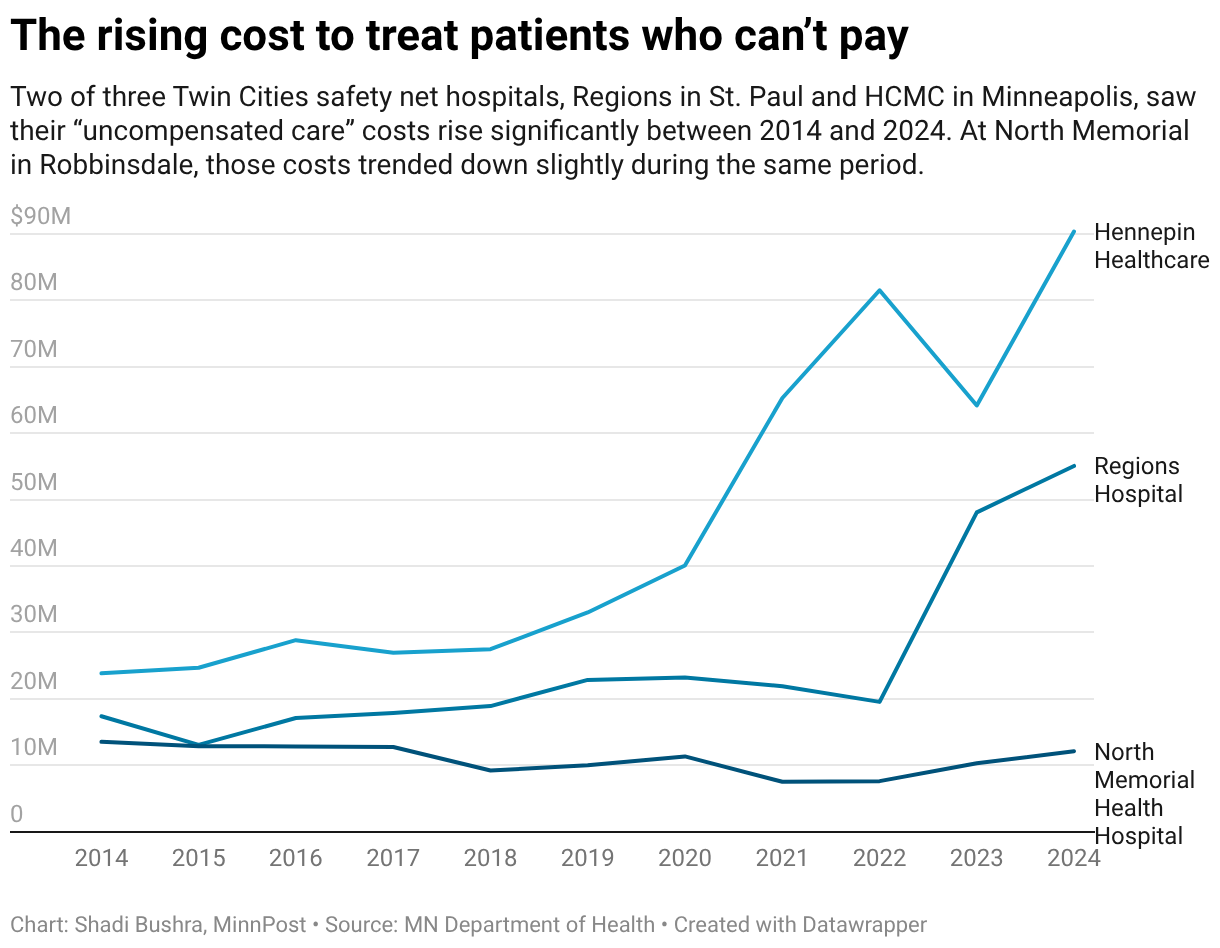
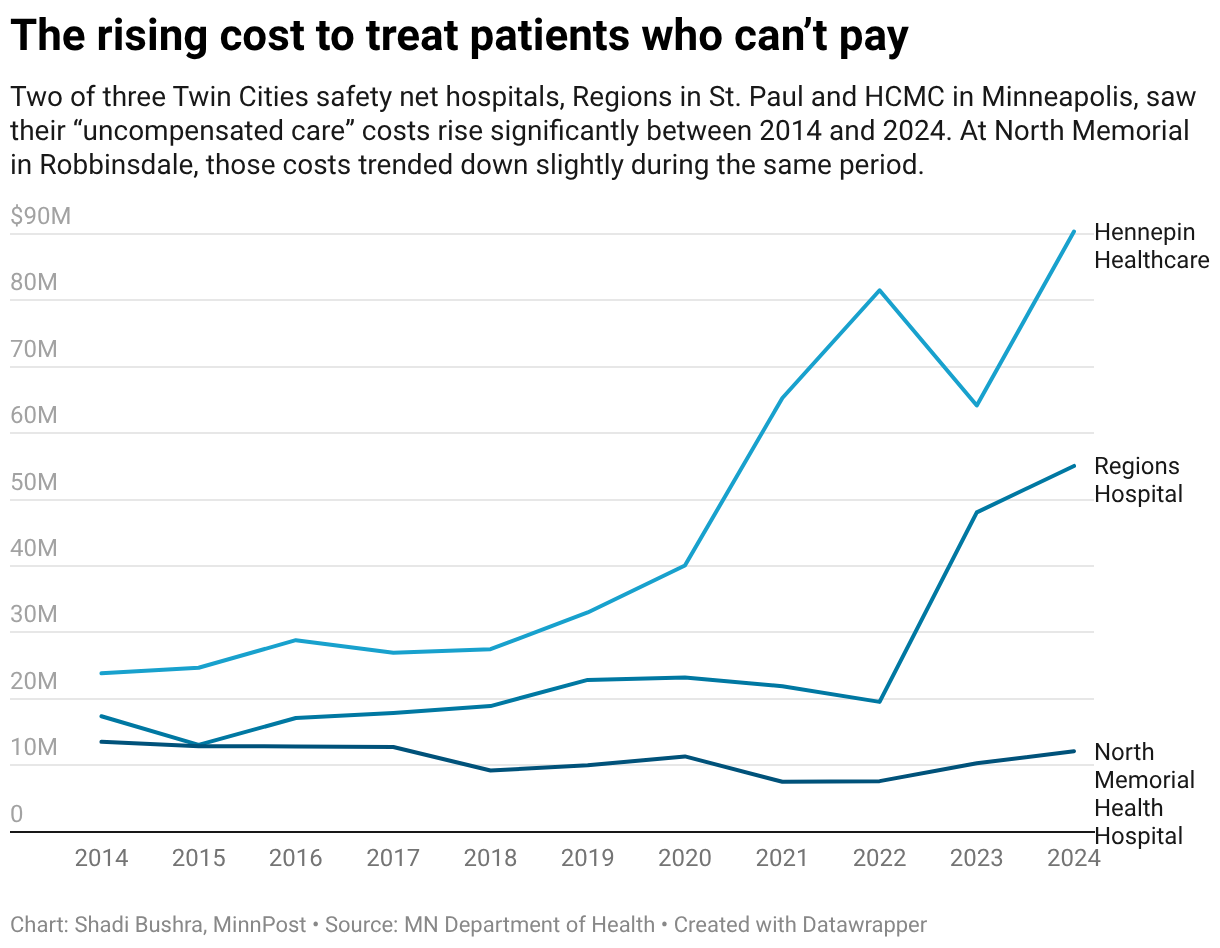
Two major hospitals pictured here have seen their uncompensated care costs rise significantly between 2014 and 2024. North Memorial Health has bucked this trend and seen these costs tick down in the same period.

This phenomenon falls under a broader umbrella term called “uncompensated care,” said Scott Hulver, senior policy analyst with KFF, a health policy research, polling and news organization.

There are two major types of uncompensated care, Hulver explained: charity care and bad debt. Charity care, also called financial assistance, is when a hospital deducts a patient’s medical bill because they were unable to pay but qualified for financial aid. Bad debt is when a patient does not pay their bill but does not qualify for charity care.

While virtually every hospital has some amount of uncompensated care costs, HCMC’s costs represent roughly 20% of total costs statewide, Yetman said in an email.

In recent years, uncompensated care costs have skyrocketed at HCMC, where the threshold to qualify for financial assistance is lower compared to similar hospitals. 

Data from the Minnesota Department of Health (MDH) shows that in 2014, the hospital had just under $24 million in uncompensated care costs. A decade later, that figure jumped to more than $90 million – an increase of almost 280%. Additionally, more than $88 million of HCMC’s $90.3 million uncompensated care price tag in 2024 was for charity care, a 47.5% increase from 2023. The remainder – about $2 million – covered bad debt.

Regions Hospital in St. Paul, another Level 1 trauma center, had $55 million in uncompensated care costs in 2024, $25 million of which was charity care. Regions did not grant an interview to MinnPost, but Jimmy Bellamy, senior communications consultant with HealthPartners, said in an email that the hospital provides the “most charity care to underserved patients in the East Metro as a safety net hospital.” Bellamy added that in recent years, Regions has seen a decline in patients on Medicaid and a rise in uninsured individuals. 

North Memorial in Robbinsdale, the other hospital in the metro area’s trifecta of Level 1 trauma centers, only spent about $2.6 million on charity care that same year. North Memorial did not respond to MinnPost’s repeated requests for comment. 

Yetman attributes the rise in uncompensated and charity care costs at HCMC to several factors, including an increase in uninsured or underinsured patients, post-pandemic hikes in clinic visits and more intensive inpatient stays, which increases the overall cost of delivered care – including treatment that goes unpaid. 

Beth Feldpush, senior vice president of advocacy and policy at America’s Essential Hospitals, representing safety-net hospitals across the country, including HCMC, said hospitals nationwide have experienced rises in patient volumes post-COVID due to individuals opting to delay treatment during the pandemic. Now, patients are coming in with more urgent needs and hospitals like HCMC are dealing with the backlog.

An additional 10 million people nationwide are projected to lose health insurance coverage due to federal changes to Medicaid, part of the One Big Beautiful Bill Act, Feldpush said, citing estimates from the Congressional Budget Office. In coming years, she predicts more increases in charity care costs that will disproportionately affect HCMC and other safety-net hospitals.

“We’re going to see a lot more folks needing charity care, and at the same time that bill also cuts support for hospital funding,” Feldpush said. “Hospitals are really looking at this double whammy, where they’re going to see more people needing charity care coming in through their doors, but also they’re going to have less ability and less financial support to provide that charity care.”

HCMC also devotes more of its operating budget to charity care compared to other metro hospitals.

A KFF Health News and Minnesota Star Tribune investigation published in May found that 80% of Minnesota hospitals spent less than 1% of operating expenses on charity care, with only 24 hospitals in the state spending more than 1%. HCMC is one of them, spending 3.62% of its operating budget, the highest percentage of any hospital in the state. Charity care accounts for just over 2% of Regions’ operating budget and only 0.38% at North Memorial.

The reason may lie, in part, in HCMC’s willingness to provide financial assistance. Compared to the other Level 1 trauma centers in the metro, HCMC is much less strict with its application requirements, meaning a wider range of patients qualify. Unlike some states, Minnesota does not have standardized eligibility criteria for who qualifies for charity care.

“Hospitals vary a lot in terms of what income thresholds they allow for financial assistance, whether the hospital provides some sort of discount to the care or whether they will cover 100% of a patient’s bills,” Hulver said.

For starters, HCMC offers free care to those at or below 300% of the federal poverty level, meaning an individual making just over $45,000 a year qualifies. This is a higher income threshold than Regions and North Memorial, both of which offer free care to those at or below 200% of the FPL, meaning some patients would qualify for charity care at HCMC, but not at the other two hospitals.

Additionally, HCMC doesn’t have as many requirements to apply for charity care. The KFF/Star Tribune investigation noted the hospital only requires applicants to provide their income totals, while Regions and North Memorial require income, bank accounts and financial assets estimates.

For now, HCMC has secured funding from the Legislature that will keep it running in the short-term, but long-term stability and the ability to absorb growing uncompensated care costs remain a looming challenge.

Rep. Esther Agbaje, DFL-Minneapolis, a major player in House HCMC negotiations, told MinnPost at the Capitol in the final days of the session that the passed legislation also calls for the creation of a task force to help develop sustainable solutions for the hospital, including a new governance structure.

“I really want people to be encouraged at the fact that we want (HCMC) to be here for the long haul, and I hope they will stay here too,” Agbaje said.


Source link

Leave a Reply

Subscribe to Our Newsletter

Get our latest articles delivered straight to your inbox. No spam, we promise.

Recent Reviews


  • Law establishes national prohibition against nonconsensual online publication of intimate images of individuals, both authentic and computer-generated.
  • First federal law regulating AI-generated content.
  • Creates requirement that covered platforms promptly remove depictions upon receiving notice of their existence and a valid takedown request.
  • For many online service providers, complying with the Take It Down Act’s notice-and-takedown requirement may warrant revising their existing DMCA takedown notice provisions and processes.
  • Another carve-out to CDA immunity? More like a dichotomy of sorts…. 

On May 19, 2025, President Trump signed the bipartisan-supported Take it Down Act into law. The law prohibits any person from using an “interactive computer service” to publish, or threaten to publish, nonconsensual intimate imagery (NCII), including AI-generated NCII (colloquially known as revenge pornography or deepfake revenge pornography). Additionally, the law requires that, within one year of enactment, social media companies and other covered platforms implement a notice-and-takedown mechanism that allows victims to report NCII.  Platforms must then remove properly reported imagery (and any known identical copies) within 48 hours of receiving a compliant request.

Support for the Act and Concerns

The Take it Down Act attempts to fill a void in the policymaking space, as many states had not enacted legislation regulating sexual deepfakes when it was signed into law. The Act has been described as the first major federal law that addresses harm caused by AI. It passed the Senate in February of this year by unanimous consent and passed the House of Representatives in April by a vote of 409-2. It also drew the support of many leading technology companies.

Despite receiving almost unanimous support in Congress, some digital privacy advocates have expressed some concerns that the new notice-and-takedown mechanism could have some unintended consequences for digital privacy in general.  For example, some commentators have suggested that the statute’s takedown provision is written too broadly and lacks sufficient safeguards against frivolous requests, potentially leading to the removal of lawful content –especially given the short 48-hour time to act following a takedown request.  [Note: In 2023, we similarly wrote about abuses of the takedown provision of the Digital Millennium Copyright Act]. In addition, some have argued that the law could undermine end-to-end encryption by possibly forcing such companies to “break” encryption to comply with the removal process.  Supporters of the law have countered that private encrypted messages would likely not be considered “published” under the text of the statute (which uses the term “publish” as opposed to “distribute”).

Criminalization of NCII Publication for Individuals

The Act makes it unlawful for any person “to use an interactive computer service to knowingly publish an intimate visual depiction of an identifiable individual” under certain circumstances.[1] It also prohibits threats involving the publishing of NCII and establishes various criminal penalties. Notably, the Act does not distinguish between authentic and AI-generated NCII in its penalties section if the content has been published. Furthermore, the Act expressly states that a victim’s prior consent to the creation of the original image or its disclosure to another individual does not constitute consent for its publication.

New Notice-and-Takedown Requirement for “Covered Platforms”

Along with punishing individuals who publish NCII, the Take it Down Act requires covered platforms to create a notice-and-takedown process for NCII within one year of the law’s passage. Below are the main points for platforms to consider:

  • Covered Platforms. The Act defines a “covered platform” as a “website, online service, online application, or mobile application” that serves the public and either provides a forum for user-generated content (including messages, videos, images, games, and audio files) or regularly deals with NCII as part of its business.
  • Notice-and-Takedown Process. Covered platforms must create a process through which victims of NCII (or someone authorized to act on their behalf) can send notice to them about the existence of such material (including a statement indicating a “good faith belief” that the intimate visual depiction of the individual is nonconsensual, along with information to assist in locating the unlawful image) and can request its removal.
  • Notice to Users. Adding an additional compliance item to the checklist, the Act requires covered platforms to provide a “clear and conspicuous” notice of the Act’s notice and removal process, such as through a conspicuous link to another web page or disclosure.
  • Removal of NCII. Within 48 hours of receiving a valid removal request, covered platforms must remove the NCII and “make reasonable efforts to identify and remove any known identical copies.”
  • Enforcement. Compliance under this provision will be enforced by the Federal Trade Commission (FTC).
  • Safe Harbor. Under the law, covered platforms will not be held liable for “good faith” removal of content that is claimed to be NCII “based on facts or circumstances from which the unlawful publishing of an intimate visual depiction is apparent,” even if it is later determined that the removed content was lawfully published.

Compliance Note: For many online service providers, complying with the Take It Down Act’s notice-and-takedown requirement may warrant revising their existing DMCA takedown notice provisions and processes, especially if those processes have not been reviewed or updated for some time.  Many “covered platforms” may rely on automated processes (or a combination of automated efforts combined with targeted human oversight) to fulfill Take It Down Act requests and meet the related obligation to make “reasonable efforts” to identify and remove known identical copies.  This may involve using tools for processing notices, removing content and detecting duplicates. As a result, some providers should consider whether their existing takedown provisions should also be amended to address these new requirements and how they will implement these new compliance items on the backend using the infrastructure already in place for the DMCA.

What about CDA Section 230?

Section 230 of the Communications Decency Act (“CDA”), 47 U.S.C § 230, prohibits a “provider or user of an interactive computer service” from being held responsible “as the publisher or speaker of any information provided by another information content provider.” Courts have construed the immunity provisions in Section 230 broadly in a variety of cases arising from the publication of user-generated content. 

Following enactment of the Take It Down Act, some important questions for platforms are: (1) whether Section 230 still protects platforms from actions related to the hosting or removal of NCII; and (2) whether FTC enforcement of the Take It Down Act’s platform notice-and-takedown process is blocked or limited by CDA immunity. 

On first blush, it might seem that the CDA would restrict enforcement against online providers in this area, as decisions regarding the hosting and removal of third party content would necessarily treat a covered platform as a “publisher or speaker” of third party content. However, a deeper examination of the text of the CDA suggests the answer is more nuanced.

It should be noted that the Good Samaritan provision of the CDA (47 U.S.C § 230(c)(2)) could be used by online providers as a shield from liability for actions taken to proactively filter or remove third party NCII content or remove NCII at the direction of a user’s notice under the Take It Down Act, as CDA immunity extends to good faith actions to restrict access to or availability of material that the provider or user considers to be “obscene, lewd, lascivious, filthy, excessively violent, harassing, or otherwise objectionable.” Moreover, the Take It Down Act adds its own safe harbor for online providers for “good faith disabling of access to, or removal of, material claimed to be a nonconsensual intimate visual depiction based on facts or circumstances from which the unlawful publishing of an intimate visual depiction is apparent, regardless of whether the intimate visual depiction is ultimately determined to be unlawful or not.” 

Still, further questions about the reach of the CDA prove more intriguing. The Take It Down Act appears to create a dichotomy of sorts regarding CDA immunity in the context of NCII removal claims.  Under the text of the CDA, it appears that immunity would not limit FTC enforcement of the Take It Down Act’s notice-and-takedown provision affecting “covered platforms.” To explore this issue, it’s important to examine the CDA’s exceptions, specifically 47 U.S.C § 230(e)(1).   

Effect on other laws

(1) No effect on criminal law

Nothing in this section shall be construed to impair the enforcement of section 223 or 231 of this title [i.e., the Communications Act], chapter 71 (relating to obscenity) or 110 (relating to sexual exploitation of children) of title 18, or any other Federal criminal statute.

Under the text of the CDA’s exception, Congress carved out Section 223 and 231 of the Communications Act from the CDA’s scope of immunity.  Since the Take It Down Act states that it will be codified at Section 223 of the Communications Act of 1934 (i.e., 47 U.S.C. 223(h)), it appears that platforms would not enjoy CDA protection from FTC civil enforcement actions based on the agency’s authority to enforce the Act’s requirements that covered platforms “reasonably comply” with the new Take It Down Act notice-and-takedown obligations.

However, that is not the end of the analysis for platforms.  Interestingly, it would appear that platforms would generally still retain CDA protection (subject to any exceptions) from claims related to the hosting or publishing third party NCII that have not been the subject of a Take It Down Act notice, since the Act’s requirements for removal of NCII by platforms would not be implicated without a valid removal request.[2]  Similarly, a platform could make a strong argument that it retains CDA immunity from any claims brought by an individual (rather than the FTC) for failing to reasonably comply with a Take It Down Act notice.  That said, it is conceivable that litigants – or event state attorneys general – might attempt to frame such legal actions under consumer protection statutes, as the Take It Down Act states that a failure to reasonably comply with an NCII takedown request is an unfair or deceptive trade practice under the FTC Act.  Even in such a case, platforms would likely contend that such claims by these non-FTC parties are merely claims based on a platform’s role as publisher of third party content and are therefore barred by the CDA. 

Ultimately, most, if not all, platforms will likely make best efforts to reasonably comply with the Take It Down Act, thus avoiding the above contingencies.  Yet, for platforms using automated systems to process takedown requests, unintended errors may occur and it’s important to understand how and when the CDA would still protect platforms against any related claims.

Looking Ahead

It will be up to a year before the notice-and-takedown requirements become effective, so we will have to wait and see how well the process works in eradicating revenge pornography material and intimate AI deepfakes from platforms, how the Act potentially affects messaging platforms, how aggressively the Department of Justice will prosecute offenders, and how closely the FTC will be monitoring online platforms’ compliance with the new takedown requirements.

It also remains to be seen whether Congress has an appetite to pass more AI legislation. Less than two weeks before the Take it Down Act was signed into law, the Senate Committee on Commerce, Science, and Transportation held a hearing on “Winning the AI Race” that featured the CEOs of many well-known AI companies. During the hearing, there was bipartisan agreement on the importance of sustaining America’s leadership in AI, expanding the AI supply chain and not burdening AI developers with a regulatory framework as strict as the EU AI Act. The senators listened to testimony from tech executives calling for enhanced educational initiatives and the improvement of infrastructure needed for advancing AI innovation, alongside discussing proposed bills regulating the industry, but it was not clear whether any of these potential policy solutions would receive enough support to be signed into law.

The authors would like to thank Aniket C. Mukherji, a Proskauer legal assistant, for his contributions to this post.


[1] The Act provides that the publication of the NCII of an adult is unlawful if (for authentic content) “the intimate visual depiction was obtained or created under circumstances in which the person knew or reasonably should have known the identifiable individual had a reasonable expectation of privacy,” if (for AI-generated content) “the digital forgery was published without the consent of the identifiable individual,” and if (for both authentic and AI-generated content) what is depicted “was not voluntarily exposed by the identifiable individual in a public or commercial setting,” “is not a matter of public concern,” and is intended to cause harm or does cause harm to the identifiable individual. The publication of NCII (whether authentic or AI-generated) of a minor is unlawful if it is published with intent to “abuse, humiliate, harass, or degrade the minor” or “arouse or gratify the sexual desire of any person.” The Act also lists some basic exceptions, such as publications of covered imagery for law enforcement investigations, legal proceedings, or educational purposes, among other things.

[2] Under the Act, “Upon receiving a valid removal request from an identifiable individual (or an authorized person acting on behalf of such individual) using the process described in paragraph (1)(A)(ii), a covered platform shall, as soon as possible, but not later than 48 hours after receiving such request—

(A) remove the intimate visual depiction; and

(B) make reasonable efforts to identify and remove any known identical copies of such depiction.


Source link