How To Choose Which Is Best For Your Needs


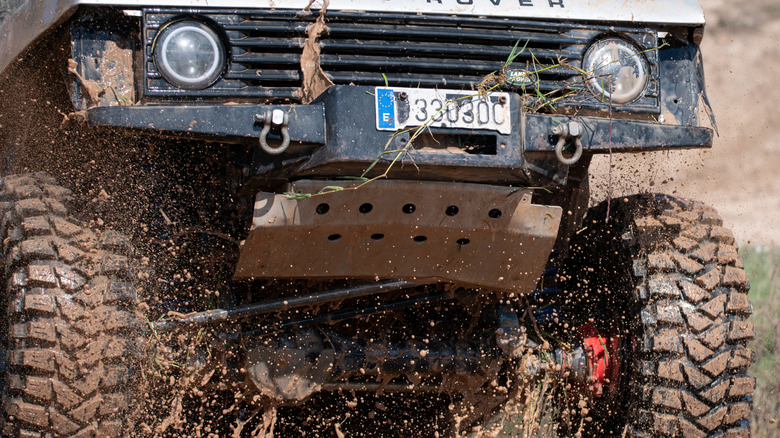
So you have noticed your car’s underbelly scrapes the ground much more often than it should because you spend a lot of time off-road, and you’ve decided it’s time to give your undercarriage some armor. You head to the market to find there are two different metals you can bolt up: aluminum and steel. Deciding between the two can be confusing, especially since neither wins outright. Things actually have more to do with how you drive your vehicle.

If you mostly daily drive and head off-road only occasionally, then aluminum makes more sense. It does not rust like steel and is also very resistant to corrosion. It also shrugs off the effects of road salt on your car. So it makes even more sense for someone who lives somewhere with coastal dampness and heavily salted winter roads. It’s also significantly lighter, which can help you save fuel in the long run. Trail4Runner points out that every extra 100 pounds or so can trim your mileage by 1 to 2 percent. Over a year of commuting, that eats into what counts as good gas mileage.

On the other hand, if your weekends involve technical rock crawling, or if you regularly drag your undercarriage over ledges and boulders, steel is the better option. It simply soaks up repeated abuse better. Meanwhile, aluminum has its limits and dents more easily. Worse, enough repeated hits in one spot, and it can even crack. There is also a quirk related to friction. Because aluminum is softer and more malleable, it sort of grabs at rocks, so you hang up more easily. Meanwhile, steel simply slides right off them.

The bottom line is this: get aluminum to protect your car against the occasional scrape. But for anything serious, steel makes more sense.

A few other things worth chewing on

But that’s just the short version. The long version actually involves a couple of other factors. One of them is cost. Steel usually costs less up front, so if cash is tight, that pulls you its way.

Another bit is maintenance, which is actually a side effect of steel’s tendency to rust. Even if it’s protected with powder coating, it can chip when a rock smacks it, leaving bare metal exposed. So every so often you may have to sand the rust off, then repaint the steel to seal it back up. Some folks also brush on a rust inhibitor, a coating that slows corrosion down. But you don’t have to worry about most of this as aluminum skips most of it — in fact, you can ride around in a raw finish without much worry.

There is also the repair angle, and it’s here that steel actually pulls ahead. If you bend a steel plate, you can usually just hammer it back into shape. But aluminum is fussier since it tends to crack under repeated stress, especially on the same spot. Whatever you pick, it’s worth noting that both options are better than driving without a skid plate at all, as they protect crucial components like the engine oil pan, differential, and transmission.

That said, the differences in real-world performance might be narrower than what the material science may lead you to believe. YouTuber GX460 Off-road, an enthusiast who tested both metals on the same rig, found that the aluminum got gashed up just as badly as the steel. He concluded that he’d rather go all-aluminum next time purely because “it’s a lot lighter.” So if you’re still torn, the honest move is to spec for the trails you actually run.


Source link

Leave a Reply

Subscribe to Our Newsletter

Get our latest articles delivered straight to your inbox. No spam, we promise.

Recent Reviews


There are certain engine configurations that are known even to those whose interest in engines is minimal. For instance, most people will know what makes a V-engine a V-engine, and even the differences between an in-line and flat engine

One engine design trait that’s perhaps less well-known is also related to the engine block, but not to with how the cylinders are arranged in the engine, rather with how they’re supported and cooled. When looking at this aspect of engine design, there are really three main types of engine block to look at. At the extremes are closed-deck and open-deck engine blocks, with some modern engines taking a halfway house approach with a semi-closed design. 

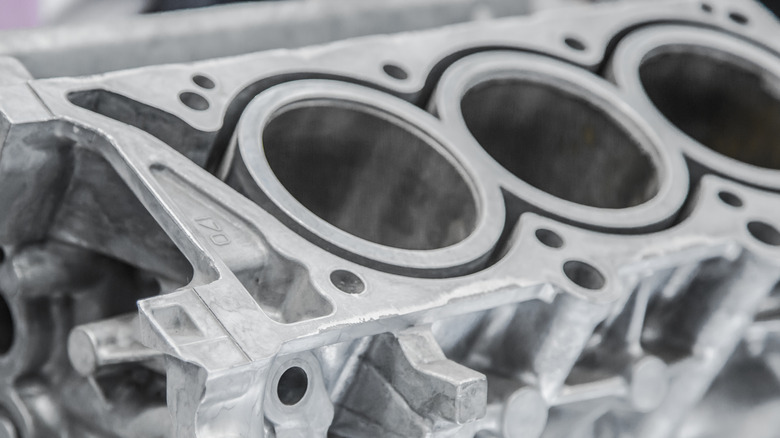
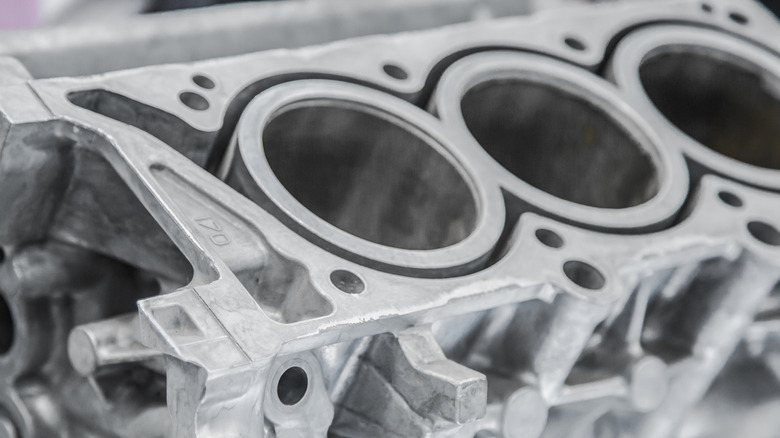
Let’s start by defining what an engine deck is. Essentially, the engine deck is that part of the block that the head gasket sits on, and the engine head attaches to. This means that an inline engine with a single line of cylinders will have one deck, whereas a V-configuration with two banks of cylinders will have two decks. 

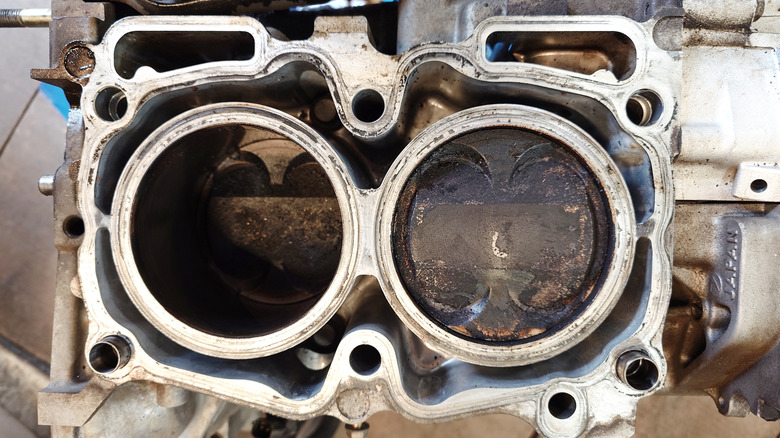
Now that we understand that, we can begin to discuss the differences between closed-deck and open-deck engine blocks. In an open-deck engine, there is open space around the top of the cylinders that allows the coolant to circulate more freely. In a closed-deck design, in case you haven’t guessed it by now, the deck features extra material that offers less in the way of cooling, but it does support the cylinders more rigidly. Let’s pop the cylinder head off and have a closer look at these engine block types and why they matter more than you may think. 

Open-deck engines are cool, but flawed

For engine makers, there are definite advantages to open-deck designs — they cost less to manufacture when compared to closed-deck engines, and keep the engine cooler by exposing more of the surface area of the cylinder to the cooling liquid. 

However, all this open space around the cylinders is all very well and good when looking at cooling and manufacturing complexity — but cracks start to appear (sometimes literally) when we look at other aspects of closed-deck engine blocks. While it’s unfair to call open-deck engines unreliable and leave it at that, there are trade-offs in the design, and these become more noticeable in high-performance situations.

Essentially, the lack of material at the top of the engine deck means the engine is less structurally rigid right at the point where it meets some of the most extreme forces engines have to cope with — the combustion point at the top of the cylinder.

If you removed the head from an open-deck design and look down at the deck, this structural weakness is visible. From this viewpoint, the cylinders look separate from the rest of the engine block, with the gap between the two being used for coolant, as some open-deck designs have limited support at either end of the cylinder bank. While this gives more space for coolant to move freely, the downside is that it also does the same for the cylinder. Over time, even the limited movements of cylinders can weaken the head gasket and bring all the associated troubles that follow such a failure. 

Why some engines use closed- and semi-closed deck designs

Open-deck engine blocks are optimized for cooling and manufacturing efficiency. However, incorporate such a configuration in a high-revving, turbocharged brute of an engine and, well, it could end very badly. This is why such engines will usually use a closed-deck configuration. 

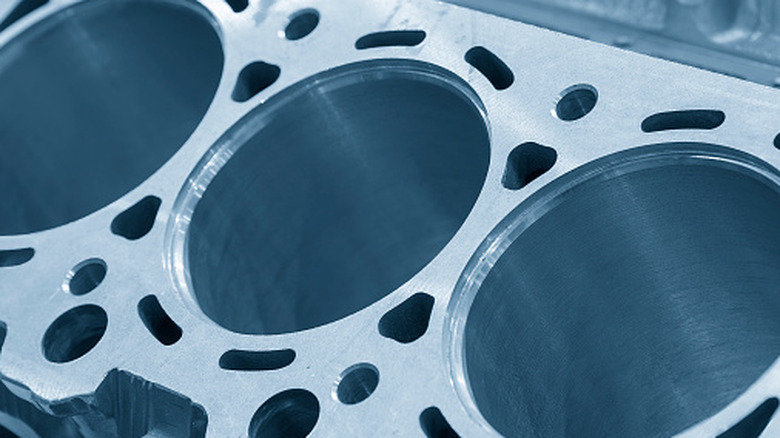
In a closed-deck engine, the open spaces around the cylinders of an open deck are filled with additional material. Obviously, the removal of such space and the flexibility it gives to the cylinders substantially strengthens the engine block. This is why some people fill engine blocks with concrete — it removes the flexibility afforded by the presence of cooling chambers. This is especially important for high-performance engines, but to call it overkill for the family runabout is not overstating the case. 

However, and the more observant among you will be there by now, filling an engine’s cooling cavities with material may add strength — but at the expense of cooling efficiency. This is why many modern turbocharged engines or higher-performance engines use a halfway house design in the form of semi-closed decks. 

Semi-closed decks are a compromise design that offers more rigidity to the cylinders by adding more support points. These supports are usually at the top of the cylinder. For instance, while there are pros and cons to Subaru’s EJ20 engine, the company released a version with a semi-closed deck with four additional support points, which should make it less prone to bore distortion. Ultimately, open-deck and closed-deck engine blocks represent design decisions based on the demands the engine is expected to handle. 


Source link