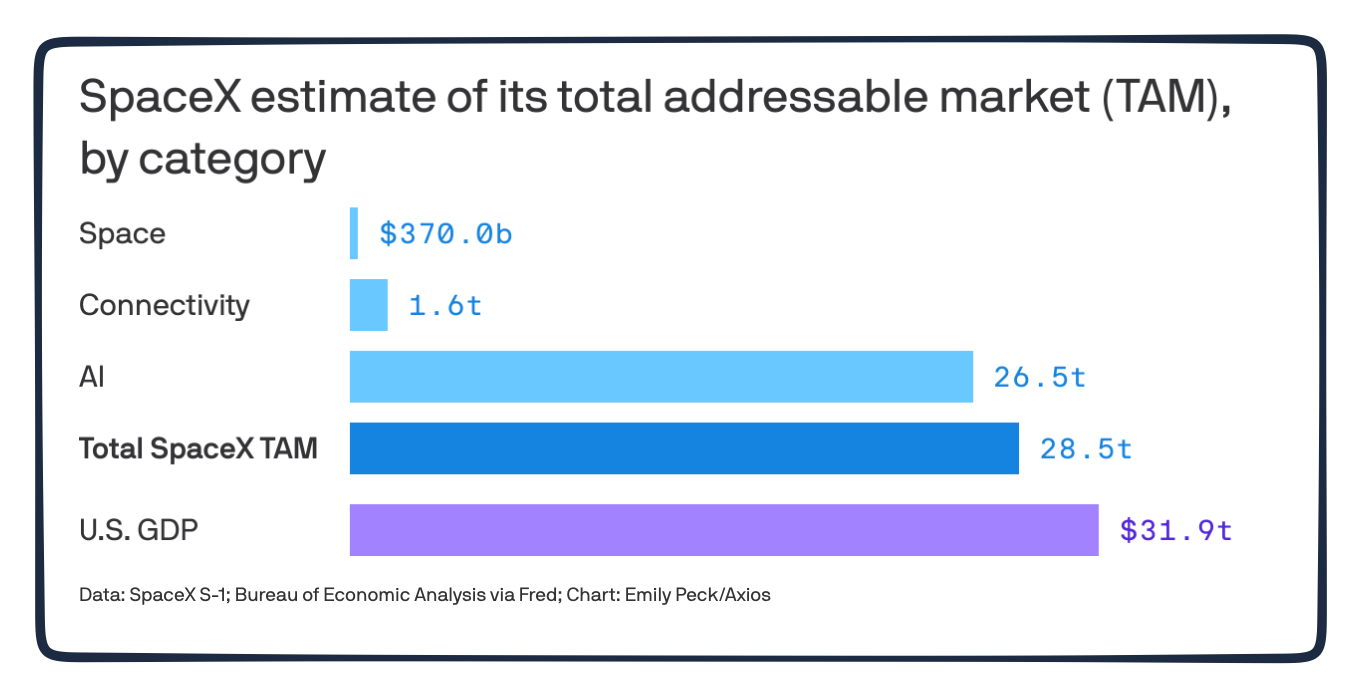

With the SpaceX IPO launching on June 12th, Axios Markets looked at its total addressable market (TAM). Saying it was “galaxy math,” they cited the U.S. GDP as only slightly less. Excluding China, Russia, and colonizing Mars, they predicted a whopping $26.5 trillion from AI:
SpaceX Revenue
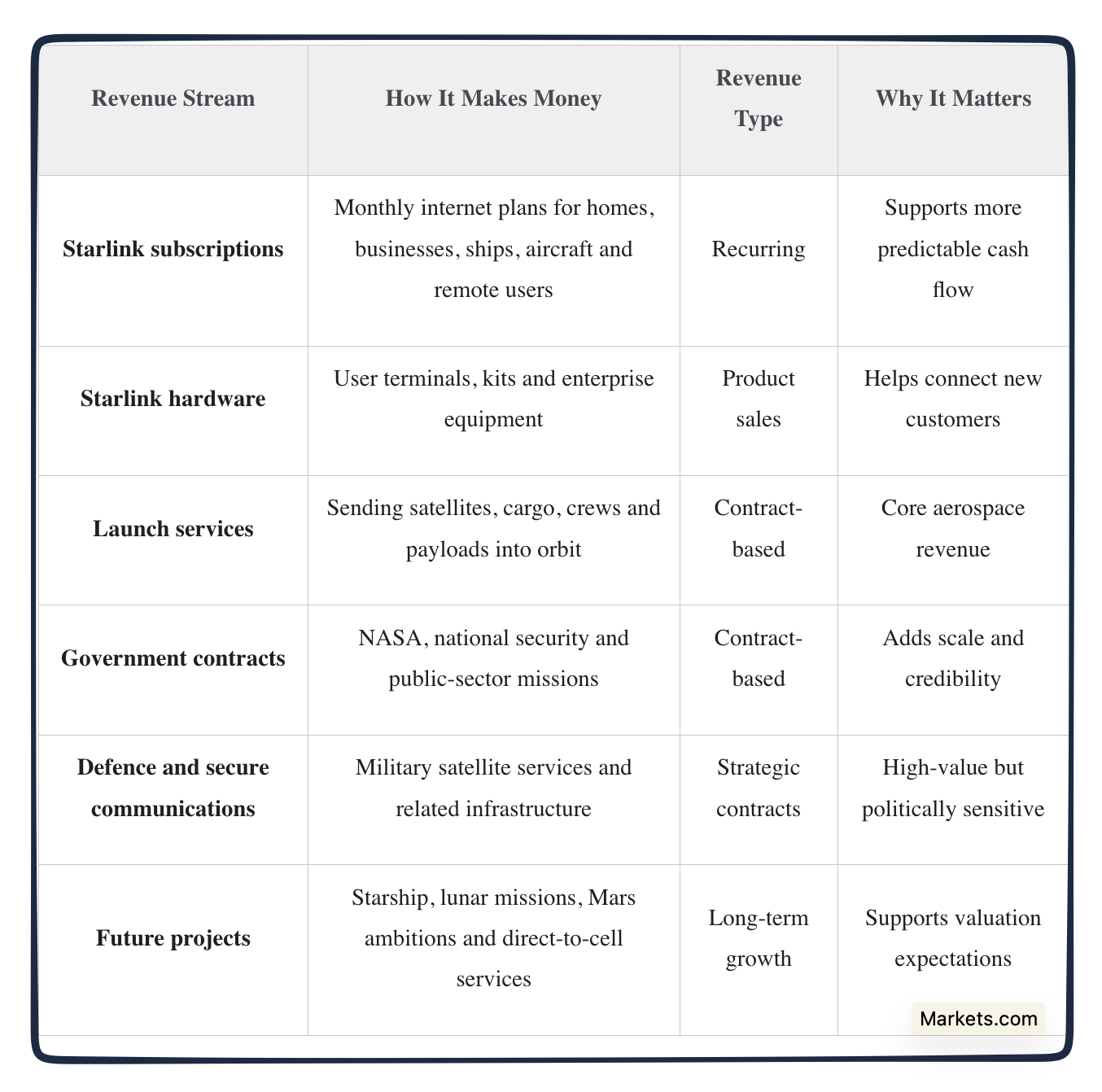
The sources of SpaceX revenue range from the International Space Station to the U.S. Space Force, to you and me:
By the end of 2030, astronauts on the International Space Station will no longer be saying, “Today’s urine is tomorrow’s coffee” because then, the International Space Station (ISS) will be trashed. For as much as $843 million, SpaceX will be guiding the station into the Pacific Ocean. At a deep water dumping spot called Point Nemo, the ISS will join other space junk.
In addition, SpaceX is the launch of choice for the U.S. Space Force. For a warfare systems satellite communications network and satellites that track missiles and aircraft, SpaceX won 2 contracts that total $6.5 billion. Called Customer A in its security filings preceding its IPO, the federal government is SpaceX’s largest client.
But it’s Starlink that can be called the SpaceX cash cow. Ranging from my WIFI during a recent flight to Florida to Ukraine’s troop connectivity, Starlink has 10.3 million subscribers. As a global broadband internet service from space, it uses more than 9,600 satellites in low-earth orbit. Then, according to Yahoo!Finance, they add 70 satellites per week. And, on the other end, SpaceX plans to produce a whopping 15,000 Starlink kits each day.
For our summary, Markets.com helped us out:
Our Bottom Line: Financial Intermediaries
Like all IPOs, the SpaceX Initial Public Offering moves private ownership of a company to the public. Purchasing shares from a group that (usually) includes the original owners, the company, and Venture Capital investors, buyers become owners of the company. But someone has to connect sellers and buyers. And that is why we need financial intermediaries.
Financial institutions play a hidden role in our everyday lives. Called intermediaries by economists, they link the people with money to those who need it. They include the stock markets that are a place and a process through which companies can connect to investors. Similarly, banks eliminate the need to find an individual who will pay for your house, your car, or your new factory. Banks are one of the go-to places for storing your money, paying your bills, and funding your business ventures.
Financial intermediaries have been compared to a beating heart. Like a heart keeps nutrient-laden blood flowing around our bodies, banks, stock markets, and other similar entities and institutions pump money around our economy. Whether talking about a healthy body, a healthy economy, or the SpaceX IPO, a heartbeat and a financial intermediary are crucial.
My sources and more: Thanks to Emily Peck’s Axios Markets email for inspiring today’s post. From there, searching for SpaceX, we discovered this Smithsonian article. But the best summaries of their revenue and the IPO were at Yahoo!Finance and Markets.
Please note that several of today’s sentences were in a past econlife post.
The post What Does SpaceX Get Paid For? appeared first on Econlife.

Nicole Byers is an entertainment enthusiast! Nicole is an entertainment journalist for the Maple Grove Report.