10 New Pieces Of Automotive Tech On Amazon Worth Checking Out In 2026


We may receive a commission on purchases made from links.

Automobiles have come a long way since the days of the Benz Patent Motorwagen, and so has the tech that powers them. Through the years, automakers have dedicated themselves to creating safer designs and comfort features that make driving a pleasure. But manufacturers can only do so much. When you still don’t have everything you want in a driving experience, it’s time to turn to aftermarket products.

A quick glance at Amazon’s automotive section gives you inspiration you didn’t know you were looking for. You can buy just about anything these days to upgrade your car, inside and out. From lighting and cameras to conveniences like extra cooling and in-car refrigeration, you might be surprised at the things you can add to your vehicle. We explored what’s new in the Amazon automotive category and found quite a few worth checking out. Here are the 10 that stood out the most based on usefulness and uniqueness.

Vantrue New N4S 3 Channel Dash Cam

Believe it or not, dash cams are good for more than just making social media videos. For starters, footage can be valuable if you’re ever in an accident. They may also help deter theft, and some can even document what’s happening in front of your car when you’re parked. Vantrue’s new N4S 3-channel dash cam is one example. Despite being in Amazon’s New in Automotive category, it’s already earned a 4.4-star rating from more than 240 reviews.

The Vantrue N4S camera offers 360-degree views and works under dark or low-light conditions and in high-heat situations. It records in HD to enhance small details like license plate numbers. It uses a magnetic GPS mounting system that doesn’t require wires or tools, so anyone can use it in any vehicle. There’s also a parking mode that will record events when it detects motion. To get your footage, you can download clips through the app via the camera’s built-in Wi-Fi or retrieve them from a microSD card. The Vantrue New N4S 3-channel camera is available on Amazon for $279.99.

Saker Car Vacuum Portable Cordless 20000Pa Suction Power 4 in 1

There’s no shortage of portable vacuum cleaners for the car on the market. But the Saker portable car vacuum is a little different. Most car vacuums excel at one job: vacuuming. And even then, they’re limited in where they can clean based on their size and attachments. The Saker car vacuum solves that issue with a variety of attachments suited for even the tiniest nooks and crannies of a vehicle. Precision tips can fit into small cracks and crevices, while a wide head can clean larger areas like seats and floorboards with fewer passes.

Along with its vacuuming capabilities, it can also function as an inflator, a vacuum sealer, and a blower. And unlike most other car vacuum cleaners, this one includes an LED screen that shows you things like wind power and battery levels. Its handheld design makes it small enough to store in a glove compartment or under the seat. It also uses a common USB-C connection, so you can charge the vacuum in your car, with a power bank or laptop, or using a separate power adapter. You can get the Saker 4-in-1 car vacuum on Amazon for $69.99.

NeaLia Wireless Magnetic Trailer Lights

If you choose to pull a trailer, that trailer needs lights. Aside from being the law, it’s common courtesy to your fellow drivers. And while most trailers come with built-in tail lights, those aren’t always enough. Whether your current tail lights are too dim or need to be replaced and you just don’t like dealing with wiring, these wireless magnetic stick-on trailer lights could be a possible solution.

NeaLia wireless magnetic trailer lights are exactly what they sound like: wireless lights that attach to a trailer or tailgate via magnets. Instead of hassling with a wiring harness, the lights use an external antenna and transmitter to activate the lights when you turn on the car, signal, or brake. Inside, the LED lights are bright enough to see under different lighting conditions. Since there’s no permanent installation required, you can switch the same set of lights between vehicles in seconds. One potential downside is that the lights have to be charged occasionally. Even with a 24-hour battery life, it might be good to get into the habit of recharging the lights after each use. You can get a set of two magnetic trailer lights on Amazon for $49.99.

Xool 3-Speed Car Fan for Backseat, Dual Head

Most new cars these days come with vents in the backseat so passengers can feel a cool blast of air as soon as you turn on the car. But this comfort feature still isn’t standard, and many older models don’t have backseat vents. One solution is to add a car cooling option, like a fan, and this 3-speed car fan from Xool looks pretty cool (no pun intended).

The car fan is made for backseat passengers. It attaches to the front seat headrest without being obtrusive. This one includes not one but two fan heads that can move independently of each other. You can point one at yourself and one at the person next to you, or keep both fans centered on you for extra cooling. Both fan heads are attached to a swivel-type arm that can move and fold to increase the fan’s cooling range. The fans can operate on one of three cooling settings and use a battery that you can recharge via your car or a portable power bank. You can get this car fan on Amazon for $19.99.

Manastin 12 Volt Car Refrigerator

Car fridges have grown in popularity over the years, and for good reason. They solve many of the downsides of traditional coolers and cost roughly the same. For starters, car refrigerators don’t require ice to keep your goods cold. No ice also means no mess. And some car fridges can even keep frozen items frozen for hours.

This car fridge from Manastin gives you two sizes to choose from: 37 quarts or 58 quarts. It looks about the same as a regular cooler in terms of style and size. The main difference is that it can reach temperatures of -4 degrees Fahrenheit and keep a consistent temperature for hours. If you’re grocery shopping in another town, you can fill the car fridge with meats or frozen goods and trust they’ll be just as fresh as the moment you bought them. This option also includes a dual-zone design so you can house different items at different temperatures. Use the app to control the temperature from your seat and check on battery level and cooling status. And since it’s made specifically for the car, you can power it via your car’s battery to ensure no gaps in cooling. The smaller version of the Manastin car refrigerator sells for $199.99 on Amazon, while the larger size is available for $234.99.

Rigstne Electric Cooler Bag

For some, a whole car fridge might be overkill, especially if you’re only carrying one-off items. Also, car fridges only cool or freeze, which doesn’t account for the other side of the food transportation spectrum. That’s why this electric cooler bag caught our attention. It warms and cools, plus it’s compact enough to fit in any backseat or trunk.

About the size of a small duffel bag, the electric cooler bag can reach temperatures as low as 46 degrees Fahrenheit or up to 140 degrees Fahrenheit. The bag itself weighs just 3.5 pounds, much lighter than a traditional cooler, yet it’s big enough to hold up to 20 canned drinks at a time. Similar to car fridges, you can power the electric cooler bag on the go via your car’s power outlet. It can serve as your heated lunch box on the go or as a mini cooler that doesn’t need ice. While it doesn’t have many reviews yet, some customers have mentioned it works well enough to keep drinks cool and doesn’t take up much space.

TruCozie Mattress Vacuum Cleaner with 275nm UV-C Light

Yes, the name says “mattress vacuum cleaner,” and the majority of people don’t keep mattresses in their cars. However, this versatile vacuum cleaner easily works on car seat upholstery. A handheld design makes it easy to sweep the device over the surface of your seats.

It goes beyond just sucking up dust and debris. A HEPA filter helps to trap allergens and small particles that many other car vacuums would leave behind. It includes built-in UV lighting, heat, and ultrasonic features to break down particles and pull them away. There’s also built-in aromatherapy to leave behind a fresh, clean scent, and anion technology to neutralize odors and reduce floating particles in the air. It’s made for mattresses but adapts well to the car. For many, cleaning the car means focusing on how it looks, and sanitization is usually forgotten. This handy vacuum can do both, and it’s available on Amazon for $99.99.

AeternaSol 200W Car Power Inverter 12V to 110V

Every car has some sort of power outlet so you can charge your devices or power electronics on the go. Most cars still have that “cigarette lighter” outlet style, which you might have thought was obsolete. More modern vehicles include USB-C outlets, which are ideal for charging cell phones and other electronics. Very few have a standard power outlet like what you’d find in your home. The AeternaSol 200W car power inverter can change that.

This power inverter is made to work with your car’s battery. It plugs into the cigarette-style outlet and gives you access to multiple outlet styles: two AC outlets, two fast-charging USB-C outlets, and two USB-A outlets. Ultimately, you can charge up to six different devices with this single power inverter. It also comes with an extra-long cable so you can share the charging ports with passengers in the backseat. Overall, the device is smaller than your smartphone and gives you more freedom than a standard automobile charging port. It’s available on Amazon for $21.99.

Thumok Magnetic RV Solar Lights Outdoor

Anytime you go camping, good lighting is a must. The problem is that most camping light options are made for one purpose or one use at a time (think flashlights, lanterns, headlamps, etc.). These magnetic RV solar lights change that. Use them in a pair to light up a large portion of your campsite, hands-free. They’re motion-sensing and will automatically turn on when you’re moving about the campsite, so you’ll always have lighting when you need it.

These magnetic solar lights are made for RVs, but given their design, you have more ways to use them. Their magnetic construction means all you have to do is stick them on your rig. There’s no hardwiring or permanent installation, so you can swap them between vehicles or other uses as you need. They run on solar power, so there’s no need to worry about recharging them when you’re on the go. You can get a set of two magnetic RV solar lights on Amazon for $24.99. They’re also available as a single light or in a pack of four.

Yakry Mini Car Air Ionizer

Your options for car air fresheners aren’t limited to DIY car fragrances or what you can hang on a rearview mirror, nor do you have to settle for artificial fragrances to make your car smell fresh. This mini car air ionizer offers a fragrance-free solution, which could be ideal for anyone with allergies or sensitivities to scents. Like some car air fresheners, this ionizer clips onto an air-conditioning vent. The difference is that it still allows air to flow through the vent instead of blocking it altogether.

While in use, the ionizer releases positive and negative ions to capture and reduce smells in your vehicle, like smoke, pet odors, and stale air. Instead of masking odors, which is the case for most sprays and air fresheners, this one neutralizes odors without using any type of fragrance. It’s also filterless, so once those smells are gone, they’re gone for good instead of being trapped in a filter you might not remember to change. You can get this mini air ionizer for the car on Amazon for $31.99.

How we chose these new pieces of automotive tech on Amazon

We had a few requirements for automotive tech to make it on the list. For starters, we only considered products that are readily available on Amazon. We only looked at products being sold by first-party brands, not third-party sellers. Next, each item had to be listed in the New Releases section in the Automotive category. We also only considered items that had some sort of electronic component. Since these items are newly released, many of them lacked substantial reviews and feedback; that’s normal at this stage. Reviews were helpful, but they were not a hard requirement. This round-up is simply a list of observations we’re keeping an eye on, not necessarily a list of recommendations. Use your best judgment when considering these products for your own ride setup.

Also worth noting: Pricing and availability are accurate at the time of this writing. These factors are subject to change at any time.


Source link

Leave a Reply

Subscribe to Our Newsletter

Get our latest articles delivered straight to your inbox. No spam, we promise.

Recent Reviews


There’s a popular argument that AI will do to human workers what tractors did to horses. Tractors could do what horses did. Horses became obsolete. AI can do what humans do. Therefore…

Plenty of major AI figures seem to agree. Elon Musk says AI will “replace all jobs.” Anthropic CEO Dario Amodei regularly warns about mass job loss, framing AI as “a general labor substitute.” OpenAI investors talk openly about AI replacing “80% of all jobs by 2030.” These are influential people, not random bloggers. Still, they are not necessarily a representative sample of the world’s most careful economists.

And the fear itself is hardly new. Economist Wassily Leontief—best known for developing input-output analysis, a way of mapping how industries depend on one another—raised similar concerns in the early 1980s. If AI really were a perfect substitute for human labor, the logic would be straightforward. Any cost advantage would eventually drive firms toward 100% AI labor. You do not need a long essay to prove that result.

The problem is that the phrase “AI will eventually be a perfect substitute” does almost all the analytical work. That assumption hides a great deal: differences across tasks, industries, and workers; the many margins along which firms adjust; and the messy heterogeneity that makes the real economy more than a toy model.

How substitutable is AI today? What would need to happen for that substitutability to rise meaningfully? What other conditions would also need to hold? Even the historical analogy—“tractors could do what horses did, therefore horses became obsolete”—compresses several distinct steps into one neat sentence. “AI can do what humans do, therefore humans become obsolete” hides even more.

So let’s unpack those steps.

(This post draws on a new working paper that walks through the math and economics in detail. Really, though, it is mostly basic accounting.)

Before We All Become Horses

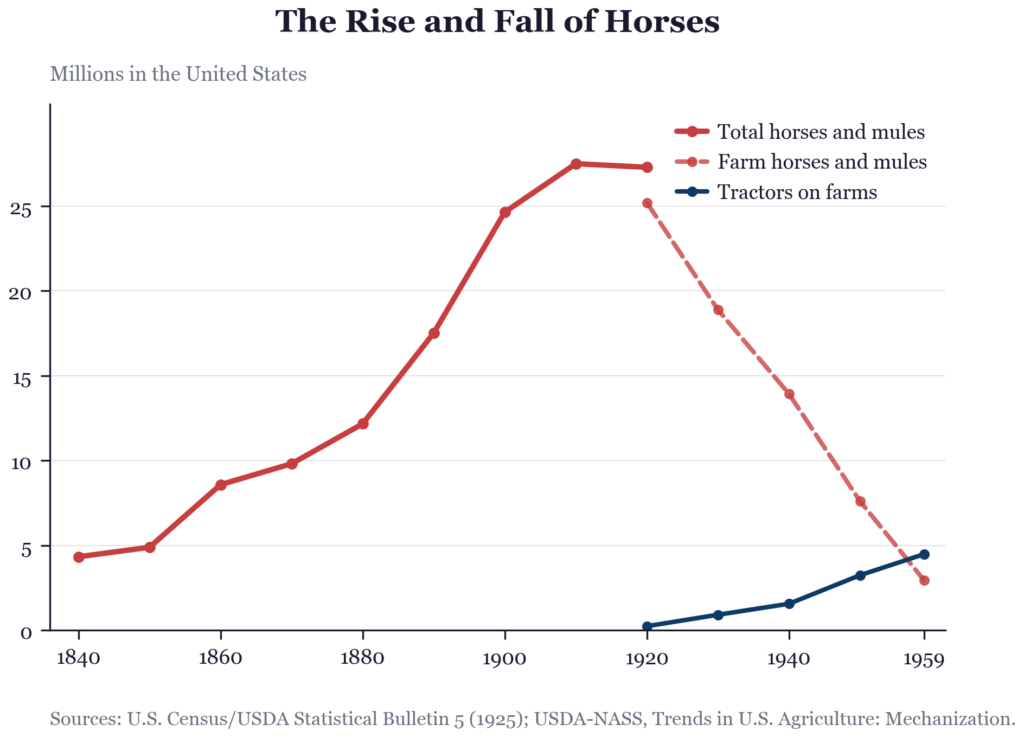
For those unfamiliar with the history of horses in the United States, the horse population actually rose for decades alongside industrialization. It increased from 4.3 million in 1840 to 27.3 million in 1920. The collapse came later, as tractors and motor vehicles displaced horses in agriculture and transportation. The number of farm horses and mules then fell to roughly 3 million by 1960.

Horses, in effect, had one main economic role, and that role disappeared. Humans are different. So before jumping from “AI can do tasks” to “humans become obsolete,” we should define carefully what that outcome would actually mean.

To keep things simple, suppose demand for human labor falls to zero. Not “low.” Zero. What would that require?

It would mean that no dollar spent anywhere in the economy passes through human labor at any point in the supply chain. Not the person who made the product. Not the person who shipped it. Not the person who designed it, marketed it, maintained it, or cleaned the building where it was assembled. Zero human labor embodied in final expenditure. That is the benchmark. That is what “humans become horses” would mean, stated precisely.

This is the input-output framework the aforementioned Wassily Leontief built his career on. The idea is straightforward: trace any final purchase backward through its supply chain and add up all the labor that contributed to it, both directly and indirectly. A cup of coffee includes the labor of the barista, but also the roaster, the truck driver, the coffee farmer, and the workers who built the truck. “Embodied labor” means all of it.

For labor demand truly to collapse, every one of those links would need to disappear across every good and service consumers buy. That is a much stronger claim than “AI can do some jobs.” The economy is not a single production function. It is a sprawling network of activities. When AI makes one activity cheaper, consumers do not simply buy more of the same thing forever. They redirect spending elsewhere.

Every dollar lands somewhere. Some spending flows into highly labor-intensive activities, such as restaurants, therapy, or home repair. Other spending flows into activities that require very little labor, such as cloud storage, automated checkout systems, or streaming subscriptions. So the relevant question is not merely: “Can AI do my job?” It is: “When AI makes some things cheaper, where does the saved money go next?”

Aggregate labor demand depends on at least three things: total spending in the economy, the share of spending that goes toward labor-intensive activities, and the amount of labor embodied in each activity. For labor demand to fall to zero, AI cannot merely displace workers in a few sectors. Every dollar of spending, wherever it ultimately lands, must shed all embodied human labor. The “humans become horses” story therefore requires three separate margins to collapse simultaneously.

A useful starting point is the simple observation that firms do not want labor per se. A restaurant does not want waiters because it enjoys employing waiters. It wants orders taken, customers reassured, mistakes fixed, and meals delivered. Labor demand is therefore “derived demand”—firms demand workers because workers help produce something else consumers value.

When AI can perform those underlying tasks more cheaply, two things happen at once. First, firms substitute AI for workers, reducing labor demand per unit of output. Second, lower production costs reduce prices, output expands, and that expansion tends to pull labor demand back upward. Whether total labor demand rises or falls depends on which force dominates.

Economists call this the Hicks-Marshall decomposition of derived demand into substitution effects and scale effects. The terminology sounds forbidding, but the intuition is simple: cheaper production reduces the need for workers in one sense, while expanding the market for output in another. That tension will organize the rest of the discussion.

When a dollar gets saved, where does it go? Into new tasks? New jobs? New industries? The money has to end up somewhere.

Your Job Is Not a Checklist

The case that AI can automate many tasks is not speculative anymore. This is obviously true to some extent, and it has been true for years.

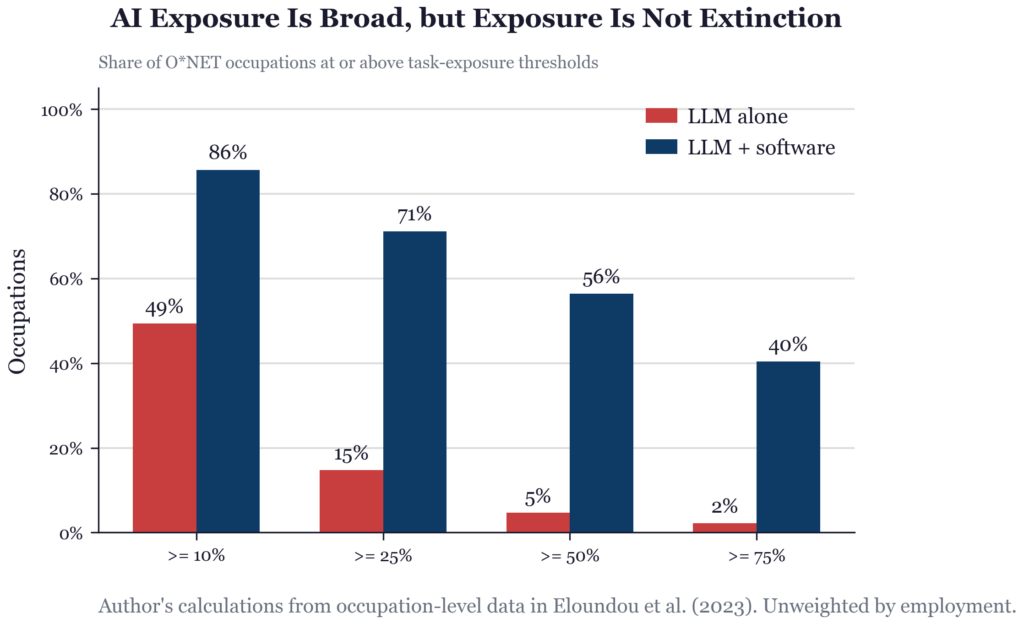
Even early large language models (LLMs) showed substantial potential to affect workplace tasks. One widely cited paper by Tyna Eloundou, Sam Manning, Pamela Mishkin, and Daniel Rock estimated that roughly 80% of the U.S. workforce could see at least 10% of their job tasks affected by LLMs. When paired with complementary software tools, 86% of occupations crossed that 10% exposure threshold.

Since then, the empirical literature has grown rapidly, and the task-level evidence is hard to dismiss. In a large customer-support study, access to generative AI increased the number of issues resolved per hour by roughly 15%. In an experiment involving professional writing tasks, ChatGPT reduced average completion time by 40% while increasing measured output quality by 18%. In a controlled GitHub Copilot study, software developers completed coding tasks 55.8% faster. Those are not rounding errors.

But they are effects on tasks, not necessarily on jobs. That distinction matters. When a task gets automated, the saved dollar does not disappear into the void. Firms and workers often redirect it toward new activities within the same occupation: more client management, more review and verification, more coordination, more judgment calls, more customization.

Just as there is no fixed amount of demand in the economy, there is no fixed bundle of tasks that permanently defines a job. Jobs evolve. They absorb new responsibilities, shed old ones, and reorganize around whatever remains scarce and valuable.

The O-Ring Problem

There is a familiar ritual in AI discourse. Someone posts a demo. The demo performs a task associated with a particular job. People immediately conclude that the job is doomed.

Sometimes they are right. But that inference skips about 15 intermediate steps.

What does it actually cost to deploy the system once error rates are included? Do customers trust it? Can firms reorganize workflows around it? Does management even know how to integrate it effectively? A chatbot demo can appear overnight. A hospital cannot reorganize clinical liability around AI overnight.

That distinction matters because firms are not simply collections of isolated tasks. They are organizations. In many cases, the result will not be pure replacement, but rather a human-AI team producing output together. Economists call this complementarity: two inputs become more valuable when used jointly than separately.

But complementarity is not free. A human-AI pair that produces only marginally more value than the AI alone will not justify paying a full human wage. The human worker must contribute something the AI cannot reproduce cheaply or reliably.

That matters especially in high-stakes settings where errors are extraordinarily costly. Surgery, aviation, structural engineering, fiduciary advice, and many legal services all fall into this category. In these fields, the cost of failure can easily dwarf the savings from cheaper production.

That could eventually change. It probably will change in some areas over time. But it is not likely to change quickly.

This is essentially the “O-ring” logic from economics, named after the tiny rubber seal whose failure destroyed the Space Shuttle Challenger. When the value of the entire system collapses because one component fails, buyers do not focus primarily on sticker price. They focus on the expected cost of a system that actually works.

In those environments, human-supervised production can remain economically efficient even if AI itself becomes extremely cheap.

Horses Had Nowhere Else to Go

Suppose substitution effects really do dominate within most jobs. The saved dollar then escapes the workplace entirely. Where does it go next?

Most standard economic models collapse the economy into a single “final good,” which makes that question disappear by assumption. Real economies do not work that way. They contain many sectors, and every dollar eventually lands somewhere.

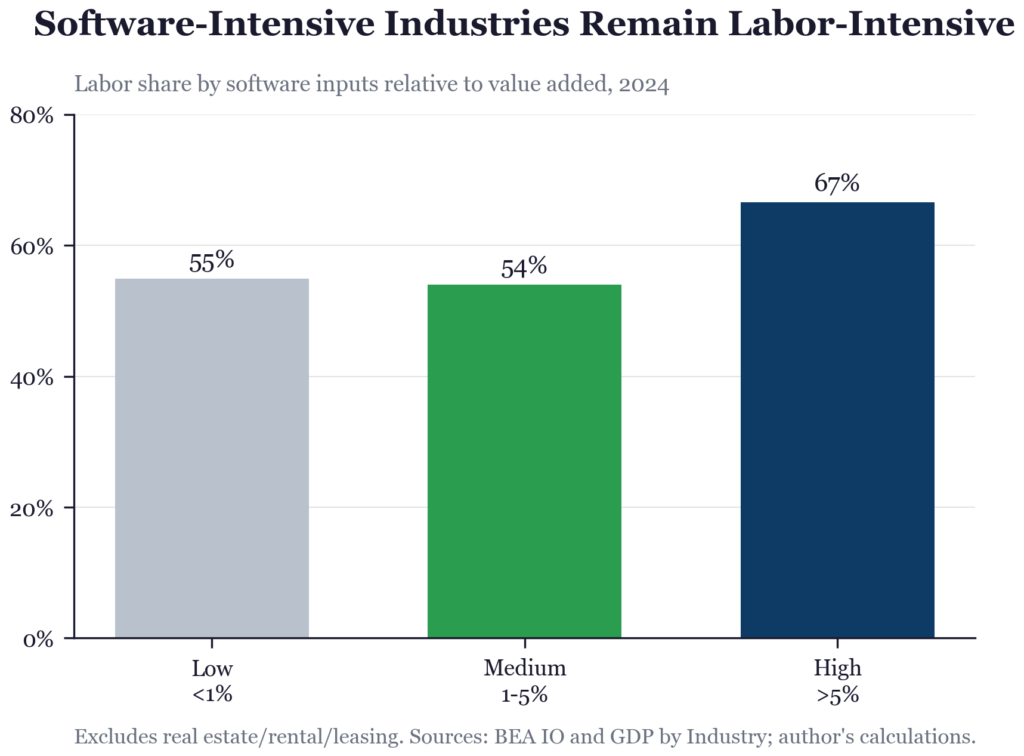
Start with software, which serves as a useful microcosm. Software-intensive industries have already undergone decades of automation through digital tools. If automation were going to drive human labor out of a sector entirely, this is where you would expect to see it first. The chart below groups industries according to how much software they purchase relative to value added: low, medium, and high software intensity. The result is striking.

The most software-intensive industries do not merely retain human labor. They actually devote a larger share of income to labor compensation—about 67%—than the least software-intensive industries, which devote roughly 55%. In other words, the industries that automated the most heavily also remained highly labor-intensive.

The same pattern appears in employment projections. The Bureau of Labor Statistics (BLS) projects total U.S. employment to increase by 5.2 million jobs between 2024 and 2034. Employment for software developers—a profession directly exposed to AI tools—is projected to grow 17.9%. BLS could ultimately prove wrong. Forecasting always carries uncertainty. Still, the evidence so far points strongly toward scale effects dominating in software-intensive industries. Automation reduced costs, output expanded, and labor demand remained robust.

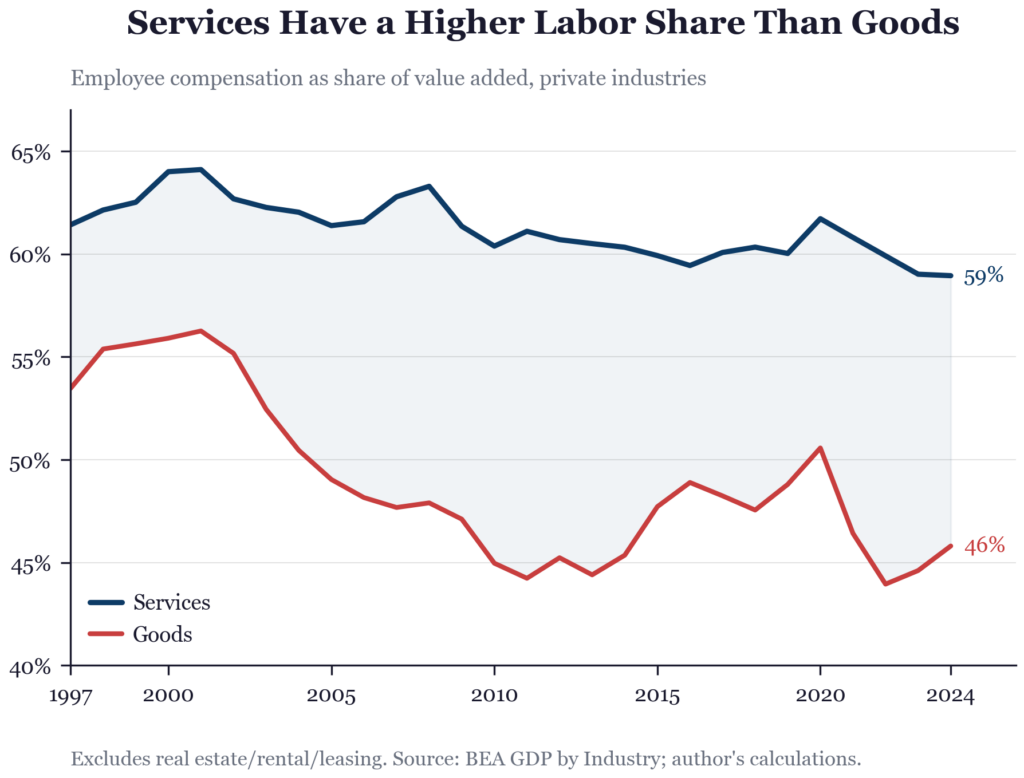
Software may be an extreme case, but versions of this pattern appear across the broader economy and over much longer periods. Take the shift from goods to services. In 1929, most consumer spending went toward physical goods. Today, roughly two-thirds of consumer spending flows toward services. As manufacturing became dramatically more efficient, consumers did not respond by purchasing infinite refrigerators and toasters. Instead, spending shifted toward health care, education, restaurants, entertainment, travel, and personal services.

That is the “saved dollar” in action at the economy-wide level. Goods became cheaper. The substitution effect largely won within goods-producing industries. Employment growth in manufacturing did not continue indefinitely. But the freed-up purchasing power migrated elsewhere, and the scale effect emerged across sectors instead.

From a macroeconomic perspective, output expanded overall. Consumers simply redirected spending toward new categories of consumption. But migration alone does not help workers unless the destination sectors still contain substantial human labor. Did they?

Again, the answer appears to be yes.

Services consistently devote a larger share of value added to employee compensation than goods-producing industries do. Spending did not merely migrate. It migrated toward sectors where more of each dollar ends up in someone’s paycheck.

So yes, one could argue that this still resembles the horse story in one respect. The relative importance of goods production declined as productivity increased. The point, though, is that large, diverse economies contain adjustment margins that horses never had. There are escape valves.

Comparative advantage keeps reappearing. When automation makes some activities extremely cheap, spending tends to shift toward the activities that remain relatively expensive. And the activities that remain expensive are often the ones that are hardest to automate. Those are precisely the areas where humans continue to hold a comparative advantage—that is, where human labor remains relatively more productive or valuable than machine substitutes. The saved dollar therefore tends to drift toward areas where humans are still worth paying.

That is not technological optimism. It is simply the logic of comparative advantage.

James Bessen documents this dynamic sector by sector. In early textile manufacturing, power looms sharply reduced labor required per yard of cloth. But cloth became so much cheaper that demand exploded, and total textile employment increased for decades. Similar patterns appeared in steel and automobile production. Eventually, demand saturated. Prices stopped falling rapidly enough to offset labor-saving automation, and employment in those sectors declined.

The key question for AI, then, is not whether automation can destroy jobs. Of course it can. The real question is: Which sectors are in which phase? Where might AI-generated savings flow today?

Health care already accounts for roughly 18% of U.S. GDP, and that share continues to rise. Elder care will likely expand further as populations age. Personalized services, human-intensive care work, and new categories of consumption may absorb growing shares of spending.

Joel Mokyr, Chris Vickers, and Nicolas Ziebarth make this historical argument well in a Journal of Economic Perspectives article. Across prior waves of technological change, new tasks emerged, comparative advantage persisted, and entirely new categories of work appeared that earlier generations could not have anticipated.

Horses had no equivalent adjustment path. They did not move into elder care.

Will Humans Become a Luxury Good?

The saved dollar migrated toward human-intensive sectors last time. The strongest argument for why this time could be different comes from economist Philip Trammell’s paper, “Is Labor a Luxury in the Long Run?

His answer is: probably not. Even if richer consumers initially spend more on human-intensive goods and services—live music, handmade products, personal care, bespoke experiences—four long-run forces may steadily erode that demand.

  1. AI-generated variety keeps expanding. New AI-produced goods compete for every dollar that might otherwise land on a human-made product or service.
  2. Human experiences carry opportunity costs. Time spent at a live concert is time not spent consuming some potentially superior AI-generated alternative.
  3. Labor competes with other scarce goods for consumers’ willingness-to-pay premiums. Beachfront property, status goods, intellectual property, and research-intensive products may all absorb spending that might otherwise flow toward human labor.
  4. Capital goods become cheaper over time. If investment opportunities continue expanding, the share of economic activity devoted to capital accumulation could grow indefinitely.

Trammell’s Coca-Cola analogy captures the intuition cleanly. Original Coke once held roughly 50% of the soda market. Then came Diet Coke, Cherry Coke, Pepsi Max, energy drinks, flavored sparkling water, and endless other varieties. Even with enormous brand loyalty and supply constraints, Coke’s market share fell below 20%.

The implication for AI is straightforward. Even if consumers initially prefer human-made goods, that preference may weaken as AI continuously generates new substitutes and varieties. Human labor does not need to become worthless. Its share can erode through dilution.

That is a serious argument, and I take it seriously. Still, notice what the argument requires. It is not enough for AI-generated variety merely to expand. That will almost certainly happen. The stronger claim is that AI-generated substitutes must expand broadly and rapidly enough to pull spending away from every human-intensive category simultaneously.

The real question is not whether AI competes with some human-produced goods. Of course it will. The question is whether any human-intensive islands survive. Does anyone still spend money on something with a person inside it?

The arithmetic quickly becomes more demanding than many “humans become horses” narratives imply. Suppose AI eventually captures 85% of economic activity. Software, accounting, logistics, medicine, law, management, and much of media production become almost fully automated. Human labor largely disappears from those sectors.

Now suppose the remaining 15% of spending flows toward activities that still contain at least 30% human labor: elder care, live entertainment, skilled trades, therapy, surgery, in-person education, luxury craftsmanship, status goods, and other relational or trust-intensive services.

The aggregate labor share would still equal at least:

S ? 0.15 × 0.30 = 0.045

That leaves labor with at least a 4.5% share of economic output. That may not sound comforting, but remember what this calculation is doing. It is merely establishing a lower bound under extremely aggressive automation assumptions. It is not utopia. It is not full employment. But it is also not zero. And a falling labor share does not necessarily imply falling labor demand if total output grows rapidly enough.

Alex Imas offers another reason to doubt the “humans disappear” story. As AI drives down the cost of commodities, real incomes rise. Historically, richer consumers tend to shift spending toward what Imas calls “relational goods”—goods and services whose value depends partly on human connection, scarcity, or social meaning.

That idea connects to a large economics literature on structural change. Over time, economies tend to shift from agriculture to manufacturing to services as incomes rise. The key debate is why. Do consumers simply buy more of whatever becomes cheaper? Or do rising incomes fundamentally change what people want?

Diego Comin, Danial Lashkari, and Marti Mestieri decompose those effects and conclude that income effects account for more than 75% of the long-run shift toward services. That distinction matters enormously here. If structural change were driven mainly by falling prices, then AI-generated abundance might pull spending overwhelmingly toward AI-produced goods. But if structural change is driven mainly by rising incomes and evolving preferences, then richer consumers may continue demanding more human-intensive experiences and services. Historically, that is exactly what has happened.

Experimental evidence points the same way. In one set of experiments, subjects learned that other people would be excluded from purchasing an otherwise identical product. Willingness to pay roughly doubled. The exclusivity itself created value.

Importantly, the exclusivity premium was stronger for human-made goods than AI-generated ones. Human-created artwork gained roughly 44% in value from exclusivity, compared with about 21% for AI-generated artwork. AI-made goods feel infinitely replicable. Human-made goods feel scarce, even when they technically are not. People value what other people cannot easily obtain. That impulse does not disappear as societies grow wealthier. If anything, it intensifies.

Perhaps AI-generated variety eventually overwhelms even those preferences. Maybe. Still, the structural-change evidence consistently suggests that income effects dominate price effects by roughly three to one. When basic goods become cheaper, humans do not announce that they are finally satisfied and stop developing new wants. They invent new forms of distinction, identity, taste, and status competition. The open question is where those new desires land. So far, the evidence points toward humans retaining an important role.

One final clarification matters here, because popular AI discussions often conflate two distinct claims. A falling labor share is not the same thing as falling labor demand. Labor’s share of national income can decline even while total employment and total wages continue rising, provided the overall economy grows fast enough. In that world, AI appears to “take over” a larger share of production while human workers still earn more in absolute terms because the economic pie itself expands dramatically.

That may well describe the phase we are currently entering. We already observe the basic pattern. Higher-income households consume more services, and service sectors remain relatively labor-intensive. Could that eventually reverse? Of course. But at the moment, this is the evidence we actually have.

The Horse Story Ends Here

Walking through all these layers—from tasks, where we are only beginning to see meaningful substitution, up through firms, sectors, and the macroeconomy—leaves me fairly skeptical of the “humans become horses” outcome. I know I have concealed that conclusion masterfully until now.

AI will absolutely perform many tasks. It will reorganize jobs, sometimes painfully. Some sectors may lose most of their human labor. Spending will often chase automation and lower prices. All of that can happen without driving human labor demand to zero. Because at every stage of the process, there is still a saved dollar looking for somewhere to land. And the same question keeps reappearing: Where does it go next?

For the horse outcome to occur, that saved dollar must eventually fail to find any activity with meaningful human labor embodied in it. Not some activities. All activities.

That is a very specific future. It is logically possible. But it requires substitution to dominate simultaneously across tasks, firms, sectors, and final consumption patterns, with no surviving human-intensive islands anywhere in the economy. The evidence we currently have—structural change, revealed preferences, comparative advantage, and experimental results—keeps pointing the other way.

Horses lost because the economy stopped needing horsepower. Humans are not just horsepower.


The post Why Humans Are (Probably) Not Headed for the Glue Factory appeared first on Truth on the Market.


Source link