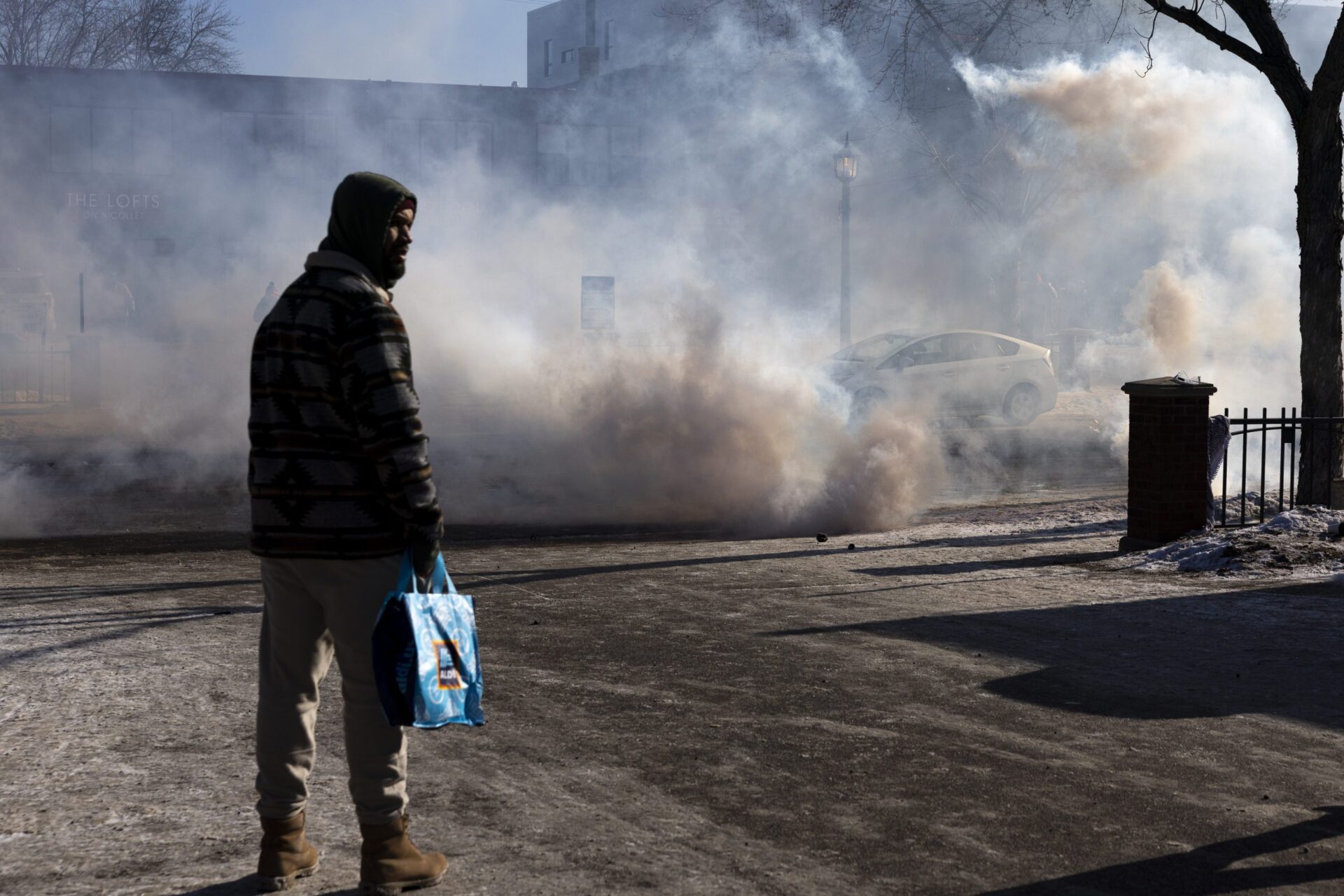
A man looks on at the scene where Alex Pretti was fatally shot by a federal agent near the intersection of 26th Street and Nicollet Avenue on Saturday, Jan. 24, 2026, in Minneapolis, Minn. Credit: Ellen Schmidt/MinnPost/CatchLight Local/Report for America
Operation Metro Surge disrupted the bitterly cold winter of 2025 and 2026 with violence, trauma and isolation Minnesotans are still working to overcome. A state with a rich social safety net that has long welcomed immigrants from around the world and embraced their cultures, Minnesota became the nation’s hub for violent federal immigration arrests and intense community backlash.
Thousands of federal agents took to the streets, more than 4,000 people accused of immigration violations were taken from their homes, and organizers enlisted at least 40,000 people who tried to help those being targeted.
These photos seek to provide a visual record of a historic time in Minnesota that has yet to reach its conclusion. MinnPost agreed not to use the names and faces of Lucy and some of the other sources in this story because of the risks they face in being targeted for arrest.
Targeted people stayed inside
Resistance networks formed in support of people like Lucy, a Minneapolis mom who came to the U.S. from Mexico more than two decades ago. Along with her husband and two elementary-aged children, she began staying inside as much as possible in November out of fear that ICE would separate the family.
“Lucy,” an undocumented Minneapolis resident who has been in Minnesota for 20 years, sits in her kitchen on Wednesday, Dec. 31, 2025. She spent Christmas in her apartment with her husband and two children as they couldn’t leave for their normal celebrations due to fear of deportation.Lucy speaking in an interview at her home.
“Si eres Latino, te agarran, (aunque) no hayas hecho nada.”
Lucy
“If you are Latino, they grab you even though you haven’t done anything,” she said of the federal agents.
Lucy
The family’s garden-level apartment is cozy, filled with kids’ toys and family photos. In hiding, they passed the time putting together puzzles.
And trying not to worry.
But Lucy still worried that, if she and her husband used their car to drive to work, ICE would find them by tracking their license plates. She worried about her kids getting dropped off from school on the bus. She worried about being seen while taking out the trash, so she started doing so in the middle of the night. She worried about being able to pay rent, and about all the other families in situations just like hers.
Lucy holds her two children’s hands.
Rapid responders tracked ICE
While people like Lucy stayed inside, others not fearful of detention or deportation formed unprecedented community support networks.
“green bean” grips the steering wheel as she begins her rapid response patrolling shift outside the Bishop Henry Whipple Federal Building on Thursday, Dec. 11, 2025. In addition to a full time job, she spent hours a day trailing ICE vehicles in order to alert potentially targeted communities that danger was nearby via Signal chats.
green bean wasn’t a radical leftist political junkie, she was a scientist with a doctorate and a big heart. But when ICE began raiding targeted people’s homes in the fall of 2025, she found an organization, Minnesota 50501, that she could work with to fight back against the government and build community resistance. Minnesota 50501, a nonprofit organization made up of volunteers who gather to protest, was one of many organizations that built a connected community of resistance when ICE started arresting their community.
green bean spent dozens of hours each week driving around the Twin Cities, shadowing ICE and following Signal chats. She hoped to catch raids as they started, acting as an early alert system for people targeted by immigration enforcement.
At the, at the beginning of Metro Surge, I thought that laws mattered, like I thought that they did. I thought that the federal government would have to follow them.
green bean, a rapid responder who requested to go by a nickname for safety reasons
A bystander blows a whistle as federal agents attempt to detain two people in South Minneapolis in mid-December.
“green bean” stands for a portrait during a rapid response patrolling shift amid blizzard conditions in late December.
Kaleb Lutterman looks into his 3D printer at his home in early December. Lutterman has printed thousands of whistles to hand out to the community as Immigration and Customs Enforcement conducts raids in the Twin Cities. The whistles are intended to notify the surrounding area if ICE is spotted.
Kaleb Lutterman holds zines with whistles attached in early December. Lutterman has printed thousands of whistles to hand out to the community as Immigration and Customs Enforcement conducts raids in the Twin Cities. The whistles are intended to notify the surrounding area if ICE is spotted.
A vehicle with Immigration and Customs enforcement agents inside drives through a Minneapolis neighborhood in early December. Rapid responder “green bean” spotted seven vehicles that were parked in the neighborhood on a stake out. The vehicles left the area.
Most rapid responders like green bean preferred to keep their identities anonymous. ICE followed many of them to their homes, arrested them and assaulted them, she said. Just this week, federal prosecutors charged 15 people in connection with alleged efforts to oppose ICE months ago.
Volunteer networks also produced free whistles, personal protection equipment and training resources in the hopes of recruiting new supporters to oppose the immigration enforcement campaign.
It was rapid response networks that mobilized to identify an incident where ICE attempted to detain a person in their vehicle at the intersection of Pillsbury Avenue South and West 29th Street on Monday, Dec. 15, 2025. Up the street from the cultural hub Karmel Mall, protesters surrounded a small group of federal agents as they detained two people from their vehicle, which was parked in the middle of the street.
Community members blew whistles and endured chemical irritants while shouting “she’s pregnant” as an ICE agent knelt on a woman in the snow. ICE arrests in Minnesota started long before the enforcement actions were known as Operation Metro Surge, and the response network was brewing alongside its rise.
A federal agent looks through his weapon during a raid near the intersection of Pillsbury Avenue South and West 29th Street on Monday, Dec. 15, 2025Protests ensued at Pillsbury Avenue South and West 29th Street as a federal agent has a woman, who bystanders shouted was pregnant, facedown in the snow.Sound from the raid and protest at Pillsbury Avenue South and West 29th Street in Minneapolis on Dec. 15, 2025.Bystanders shout and record as federal agents target arrest a person at Pillsbury Avenue South and West 29th Street.
As awareness of the raids grew through citizen and traditional journalism, protests became commonplace, especially in the Lake Street East corridor, home to many immigrant-owned businesses. People made time to be together and keep each other safe, whether in the streets or on a remote meeting.
Protesters chant as they make way down Lake Street during an anti-ICE protest in mid-December. Thousands took to the streets in south Minneapolis to denounce Immigration and Customs Enforcement as the federal agency continues its “Operation Metro Surge” in the state.
Employees cheer and wave the Mexican flag outside Pineda Tacos, a business often targeted by ICE, as anti-ICE protesters pass.
A woman waves from a business on East Lake Street as protesters denounce immigration enforcement outside her window.
Rev. Susie Hayward, a reverend at Creekside United Church of Christ, leads an online healing session for volunteers resisting immigration enforcement in late December. Hayward leads the sessions at least twice a week to help people unwind from the stress of watching their neighbors being taken. “There’s this lovely way in which faith communities across religious lines are showing up to make sure people can practice their faiths,” she said.
Violence erupted
Blood covers the deployed air bag in the vehicle of Renee Good after an ICE agent fatally shot her while she was observing immigration enforcement actions on Jan. 7.
Minnesota changed forever on January 7, 2026. That’s when a federal agent fatally shot Renee Good while she was observing their actions with her wife from her vehicle. The following photos capture the chaotic day, where ICE also made arrests outside a Minneapolis high school, and tens of thousands took to the streets to mourn.
A Minneapolis police officer stands guard while emergency medical technicians administer CPR to Renee Good minutes after a federal agent fatally shot her while observing immigration enforcement actions.Sound from the scene of Renee Good’s killing and the following protests.
Border Patrol agents occupy Portland Avenue at the site of Renee Good’s death.
A Border Patrol agent sprays a protester with pepper spray at close range while protesters block an alleyway to prevent federal agents from leaving the scene where their colleague fatally shot Renee Good.
Former Border Patrol leader Gregory Bovino looks on as protests erupt at the site where a federal agent fatally shot Renee Good.
ICE agents check a man’s documentation in South Minneapolis on the morning Renee Good was killed by a federal agent.
Protesters flee after federal agents deployed tear gas when they attempted to stop ICE from leaving the scene of Renee Good’s killing.Federal agents tackle two people on school grounds at Roosevelt High School later in the day after a federal agent killed Renee Good three miles away.
Bystanders embrace after a standoff with ICE at Roosevelt High School.
Protesters gather to mourn Renee Good at the site of her death on the evening of January 7.
A person stands vigil for Renee Good on the night she died.
Sound from the vigil where tens of thousands gathered the night Renee Good died.A candle is raised among tens of thousands during a vigil the night that a federal agent killed Renee Good.Young protesters chant at the site of Renee Good’s death the day after a federal agent fatally shot her.
The new normal
Whistles, horns and screaming community members became commonplace in the days after Good’s killing. U.S. citizens of color began carrying their passports in case ICE stopped them. Protests were a daily occurrence, as were pockets of joy created within the community as their own form of resistance.
Minnesotans responded by adjusting their sense of normal, too. The Singing Resistance group tried to change the chaotic soundscape that had overtaken the Twin Cities, sending its volunteers out to march the streets and sing. Miguel Lopez, a restaurant owner, worked endless hours doing take-out only business to allow his at-risk employees to stay home. Jessica Herod, owner of Olu’s Beginnings, moved her desk within view of the parking lot so she could work while keeping a watchful eye in case ICE arrived.
Community members sing along East Lake Street as part of a singing, walking vigil amid ongoing immigration enforcement operations in mid-January. Organizers said they hoped to change the soundscape of south Minneapolis.Sound from singers as they marched along East Lake Street.
Miguel Lopez, owner of Homi Restaurant, works in the St. Paul restaurant’s kitchen in mid-January. The 16-year-old Mexican restaurant is operating on a skeleton crew because his staff is afraid to come into work due to federal immigration enforcement operations, leading to endless workdays for Lopez that are marred by checking security cameras and readying his passport to take the trash out.
Jessica Herod, owner of Olu’s Beginnings, moved her workspace to the front desk so she could watch for ICE in the parking lot at the childcare center in late January. The Minneapolis daycare, where 75% of the children enrolled depend on federal funding, struggled after the Trump administration suspended $467 million in annual payments to Minnesota that enable low-income parents to access child care.
Marchers pass the Gay 90’s during a protest to denounce immigration enforcement operations in late January. Tens of thousands marched through downtown Minneapolis, hundreds of businesses closed and many people called out of work as unions, community leaders and interfaith organizations called for a statewide economic blackout.Shen Falcon, left, and Kathy Zina, dance during a daytime party held by Latinos in Comunidad at Mercado Central in mid-January. The party invited community members together to experience joy and support the Latine marketplace as the businesses were affected by Operation Metro Surge.
An observer blows a whistle out their car window as ICE detains people on Franklin and Chicago Avenues on Jan. 8.
Jama Abdi, a friend of the owner at New Cedar Restaurant, hands a free Somali tea to Gustavo Vizcaya in mid-January in the Cedar Riverside neighborhood. Vizcaya, a volunteer with the Twin Cities branch of the Party for Socialism and Liberation, and a group were hanging up flyers to promote a statewide economic shutdown to protest federal immigration operations when Abdi invited them in for a meal.
Federal agents arrest a bystander after detaining one allegedly undocumented man near the intersection of Franklin and Chicago Avenues.A couple lays on the frozen lake Bde Maka Ska as the sun sets. Immigration and Customs Enforcement has been conducting Operation Metro Surge in Minnesota for 41 days.
Another observer killed
Just three weeks after ICE fatally shot Renee Good, federal agents fatally shot Alex Pretti while he was observing immigration enforcement actions in the Eat Street section of Nicollet Avenue. The community anger and grief was immediate. An entire section of the neighborhood became the site of protest, while Minnesota law enforcement officers took over crowd control after ICE left. Clouds of tear gas floated above the trees while fires were lit in dumpsters. It briefly became an autonomous zone.
Protesters flee tear gas and projectiles during an uprising following the fatal shooting of Alex Pretti near the intersection of 26th Street and Nicollet Avenue on Saturday, Jan. 24, 2026.
A federal agent wears protective equipment during protests at the site of Alex Pretti’s killing.
A protester is pepper sprayed at short range while being detained at the scene where Alex Pretti was fatally shot.
A dumpster is aflame at the site where Alex Pretti was killed as protesters fill the scene.
Bystanders sage the area near the scene where Alex Pretti was fatally shot by federal agents.
Smoke and chemical irritants rise above trees and buildings during protests at the site where Alex Pretti was fatally shot by federal agents.A person prays at a memorial for Alex Pretti on the night he was killed.Sound from the memorial that arose the night Alex Pretti died.Community gathers at a memorial for Alex Pretti over the spot where he was fatally shot by federal agents.
As danger remained, people stayed inside
Lucy and her family remained inside, wondering when it would all end.
Like many other immigrants, she came looking for work. Though her two children were born here, most of her family is still in Mexico.
The windows are covered with blinds and blankets in the home of “Lucy” in mid-February as ICE continues Operation Metro Surge.
“Entramos a un país que no es de nosotros. Eso lo sabemos. Pero, pues, todos sabemos – todas las personas sabemos – que si haces mal aquí en este país, vas a pagar por lo mal. Pero yo digo, no es malo trabajar.”
Lucy
“It’s true, we entered a country that’s not ours. We know that. But everyone knows, everyone knows, that if you do something bad here in this country, you’ll pay for it. But what I say is, it’s not bad to work.”
Lucy, English translation by Cleo Krejci
S, an international student from Myanmar, who requested his name be withheld due to safety concerns, works at his apartment in mid-February. S, a computer graphics and design student, said he scans iceout.org every morning before class. “It’s scary and stressful. Every time I have to go out, I have to check the route for ICE to not be arrested and to be safe,” he said.“Lucy’s” two children laid out some of the things keeping them busy while stuck inside, including puzzles and toys in mid-February. The family has mostly been in hiding since November.
Raids, grief continue
Throughout it all, raids continued and neighbors stayed vigilant amid the violent actions of federal agents. Observers and protesters continued to show up as ICE worked to detain those accused of immigration violations, while the community of resistance continued to support, mourn and memorialize its neighbors.
A federal immigration agent maces a bystander after detaining a man and his child near 35th Street and Chicago Avenue in late January.
A bystander looks into an alley blocked by federal immigration agents while they detain a man and his child near 35th Street and Chicago Avenue in late January.
A window is broken at a house that was involved in the shooting of Julio Cesar Sosa-Celis by an Immigration and Customs Enforcement agent in mid-January.Art featuring photos of Renee Good and Alex Pretti are hung outside Pretti’s memorial in mid-February as the community continues to honor them.Audio from an anti-ICE protest.
A federal immigration agent kicks a chemical irritant canister toward protesters as community members respond after agents crashed into a civilian vehicle near 34th Street and Park Avenue.
A person is seen from a car window in South Minneapolis in late January as Operation Metro Surge continues.
Federal immigration agents detain a man and his child while blocking the alley outside their home near 35th Street and Chicago Avenue in late January. A GoFundMe campaign identified the father as Elvis Joel Tipan Echeverria and his daughter, 2-year-old Chloe Renata Tipan Villacis, who were sent to a detention facility in Texas.
Post-it notes with handwritten messages are hung at Alex Pretti’s memorial in mid-Febuary as a memorial remains at the site of his death on Nicollet Avenue.
Humberto Flores and his son Daniel Flores, 2, place flowers at Alex Pretti’s memorial in mid-February.
As spring emerged, detainments of targeted people tapered off. Protests became less frequent, although still present. Mutual aid happened in the background. Memorials, big and small, remained throughout the city for immigrants arrested by ICE, and for Renee Good and Alex Pretti. People were still released from detention at the Whipple federal building, although the constant sightings of ICE at work were no longer present.
A Haven Watch volunteer hands a just-released detainee rose at the Whipple building on Valentine’s Day in front of a small group of protesters.
A tree is marked with a Hamm’s beer box and a cardboard sign painted with ”ICE stole our neighbor here” in south Minneapolis.
Volunteer Amanda Humpage, center, who has a child attending a St. Paul Public School, organizes food items as part of a mutual aid distribution program at a public high school in February. The public school distributes donated food and essentials to dozens of families as immigration enforcement operations have inhibited many from accessing their basic needs due to fear of detainment.
An Indigenous activist is arrested by Hennepin County Sheriffs at the Bishop Henry Whipple Federal Building in March. Law enforcement declared an unlawful assembly and arrested dozens of protesters who gathered to denounce immigration enforcement operations.The snow melts underneath a memorial for Renee Good along Portland Avenue near the site of Good’s death.
Windows cracked
As of mid-June, a lot has changed for Lucy. Her kids go outside to play in the summer sunshine. She goes to work in her own car and takes her trash outside during the daytime. And although the fear has lessened, that doesn’t mean it’s gone away.
Things are not the same, she said — “ya no es lo mismo.”
And she said the world feels like it’s changed forever. What does she want for the future? For things to just go back to the way they were before ICE came to Minnesota.
Lucy checks on her plant in the window at her home in mid-June. She’s been able to get her plants more sunlight as ICE has reduced the amount of detainments following Operation Metro Surge.Lucy speaking in an interview at her home.
“Normalidad. Que todo regresara como era antes, sin miedo.”
Lucy
Lucy stands for a portrait in the hallway of her home in mid-June. She is starting to go outside more, and she’s been traveling to and from work without the assistance of volunteers.
“Normality. To go back to how it was before, without fear.”
Lucy, English translation by Cleo Krejci
A tricycle is in the hallway at Lucy’s home in mid-June. She said her kids have been able to play outside for about three weeks.
This story includes translation and interviews by Cleo Krejci, with reporting by Trevor Mitchell, Matthew Blake and Shadi Bushra, and photo editing by CatchLight photo editor Angela Jimenez.This work was made with support from CatchLight Local and Report for America.
Regular readers of this blog will know that most of what I do here is explain, analyse, and argue about macroeconomics, monetary policy, and increasingly artificial intelligence. That work is public and free – and I intend to keep it that way.
But over the past year, we have increasingly been asked – through PAICE, the consultancy I co-founded – to bring that kind of thinking directly into organisations. Investment committees, boards, executive teams, and strategy sessions.
So we have formalised that offering under the name Expert Briefings.
What is an Expert Briefing?
It is not a standard presentation. It is a tailored, interactive session where your organisation gets focused access to specialist knowledge on the topics that matter most to you right now. We start from your industry, your risk exposure, and your questions – and work from there.
At PAICE, we cover three interconnected areas:
Macroeconomics, monetary policy, and financial markets – global growth, inflation, central bank policy and communication, interest rates, currencies, commodities, and financial imbalances. The question we always come back to: what does any of this actually mean for your business, your investments, and your risk picture?
Geopolitics and business risk – trade conflicts, energy markets, security policy, and geopolitical shifts. And critically: the concrete implications for companies and investors who have to make decisions in an uncertain world.
Artificial intelligence and technology – the latest developments in AI, what they mean for your specific sector, and how you position yourself strategically when the pace of change is this fast.
These three areas can be addressed individually or in combination, depending on what your organisation needs.
Who is this for?
The organisations we work with range from pension funds and asset managers who need regular macro and market input for investment committees, to CEOs, CFOs, and boards who want an independent external perspective on economics, monetary policy, technology, and geopolitics. Exporters and multinationals dealing with currency risk and trade policy. Banks building internal analytical capacity. Technology companies navigating AI regulation and competitive dynamics.
The common thread is that they want direct access to expertise – not a consultant’s slide deck, but a genuine conversation with someone who has spent decades thinking about these questions.
Formats
We try to be flexible about how this works in practice. Some organisations want a regular monthly or quarterly cadence to stay continuously updated. Others prefer an on-demand retainer – a standing arrangement that allows them to call on a briefing when the need arises, without going through a full procurement process each time. And sometimes the need is simply a one-off session for a strategy day or board meeting.
For topics that genuinely benefit from multiple perspectives, we can also convene an expert panel – two or more specialists combining, for instance, macroeconomics with AI and technology, or geopolitics with energy markets.
Who delivers the briefings?
The briefings are anchored by me. I spent fifteen years as Head of Emerging Markets Research at Danske Bank, including co-authoring the 2006 “Geyser Crisis” report that identified the risks building in the Icelandic banking system ahead of the 2008 collapse. Today I serve as co-founder, co-owner, and Head of Analysis at PAICE, where our work sits at the intersection of macroeconomic analysis, monetary policy, AI, and data.
For broader panels and cross-disciplinary sessions, I draw on PAICE’s network of specialists across macroeconomics, monetary policy, financial markets, artificial intelligence, technology, and geopolitics.
Getting in touch
If any of this sounds relevant for your organisation, we are happy to have an initial conversation about what might make sense.
To provide the best experiences, we use technologies like cookies to store and/or access device information. Consenting to these technologies will allow us to process data such as browsing behavior or unique IDs on this site. Not consenting or withdrawing consent, may adversely affect certain features and functions.
Functional
Always active
The technical storage or access is strictly necessary for the legitimate purpose of enabling the use of a specific service explicitly requested by the subscriber or user, or for the sole purpose of carrying out the transmission of a communication over an electronic communications network.
Preferences
The technical storage or access is necessary for the legitimate purpose of storing preferences that are not requested by the subscriber or user.
Statistics
The technical storage or access that is used exclusively for statistical purposes.The technical storage or access that is used exclusively for anonymous statistical purposes. Without a subpoena, voluntary compliance on the part of your Internet Service Provider, or additional records from a third party, information stored or retrieved for this purpose alone cannot usually be used to identify you.
Marketing
The technical storage or access is required to create user profiles to send advertising, or to track the user on a website or across several websites for similar marketing purposes.