This Is Probably The Best & Safest Type Of Lawn Mower To Buy If You Have A Hilly Yard


Whether you love mowing the lawn every week or categorically loathe the job, most homeowners can agree that cutting grass can get pretty complicated if your yard has hills. In fact, cutting grass on a hillside can be pretty dangerous, particularly if you’re working in even slightly damp conditions. So which style of mower is the best for cutting grass on a hill or an incline? 

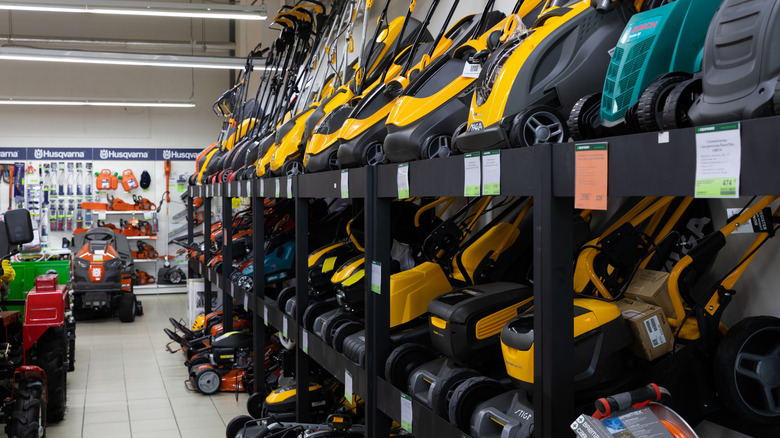
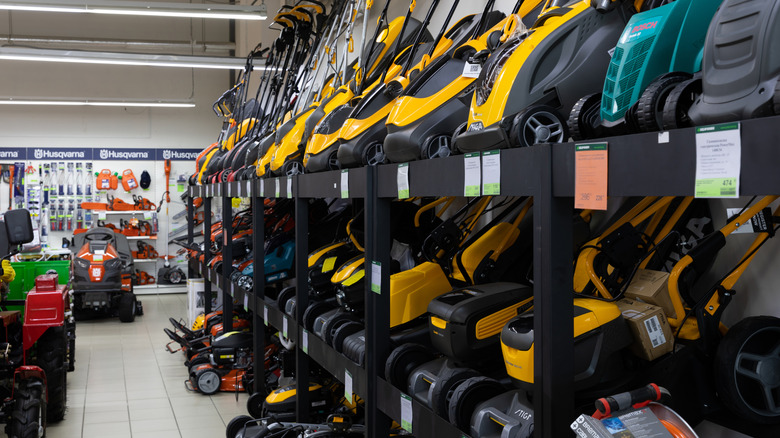
While there have been incredible advances in the riding mower sector when it comes to hill safety, a walk-behind mower is often still the safer bet. The reasoning for that is pretty obvious, as even walk-behind push mowers that are self-propelled provide users with far more control over the mower itself. 

That is because they are smaller and require merely directional force to move instead of pedal maneuvering and steering. Even the most reliable riding mowers — including those with zero-turn wheel designs and auto shutoff features — are also still top-heavy enough that they can roll over if you hit a hillside the wrong way. That risk still exists with a walk-behind mower, but it is greatly diminished given the control they provide. 

Is there a right way to mow grass on a hill?

There are methods of mowing grass on a hill with a riding mower that have been deemed safer than others. With a riding mower, cutting the grass in a vertical pattern up and down the hill instead of moving horizontally across it is the better play due to the risk of rollover. However, if you are using a reliable walk-behind mower, you will want to mow horizontally across the hill instead. The idea is that, should the mower slip, it will continue horizontally across the slope rather than being pulled by gravity back on top of you. 

Of course, you should only be mowing in dry conditions with either machine to prevent slippage. You should also wear shoes with proper grip and check that the tires on your mower have solid traction, as the potential for slipping and falling behind the mower are increased on steeper inclines.

Some hills may simply be too steep to safely approach with any sort of traditional mower. As the Occupational Safety and Health Administration (OSHA) notes, a riding mower is likely okay if the hill’s incline is under 15 degrees. However, be sure to check the owner’s manual of your particular mower for more detailed information on the capacity it has for slopes. If a mower is simply not possible, there are safer options to consider, including a string trimmer or a brush cutter.


Source link

Leave a Reply

Subscribe to Our Newsletter

Get our latest articles delivered straight to your inbox. No spam, we promise.

Recent Reviews


Testing desks is something of a subjective game. Much like office chairs, the tests are based on comfort, reliability and ease of setup rather than things you can test in electronics such as wattage and battery usage. I still tested each one rigorously and will continue to test them for longevity in the coming months.

I tested these desks by asking three people to try each one. Each of them used the desk for at least 16 hours and then gave me their impressions. The three people were 6 feet, 1 inch tall; 5 feet, 8 inches tall; and 5 feet, 4 inches tall respectively, to give me a good cross-section of average user height.

A busted up box containing a desk

James Bricknell/CNET

Setup time and package quality

Building desks can often be difficult and time-consuming. For each desk, I timed how long it took to unpack and assemble, and I noted whether the manual was easy to follow. I followed the instructions as closely as possible so that each build was performed as if I had never built one before. I also thoroughly checked the packaging, to make sure it wasn’t damaged, and if it was secure enough to carry the desk it had in it. Any damage was noted, and images were sent to the manufacturers for review.

Structural integrity

Modern desks need to be able to hold a good amount of weight. If you’re at a writing desk you might only have a small laptop, but if you’re using a gaming desk, it likely has two monitors and a giant gaming PC as well. For each desk, I checked the maximum load specification, and I tried to match that with the materials we actually use on our desks.

I used:

  • A heavy gaming PC tower
  • Two 27-inch gaming monitors on a dual monitor arm
  • A MacBook Pro
  • Two different keyboards and assorted mice and trackpads
  • My Oculus Quest 2
  • My phone stand and USB hub
  • A podcasting mic and headphones

Depending on the length and weight capacity of the desk, I mix and match these items, then check for any bowing of the top or inconsistencies in how the desk felt as I worked.

Giant black standing desk with rainbow lights

James Bricknell/CNET

The wibble-wobbles

This is a bit of a throwback from when my dad used to make furniture. Anything my dad built would be critiqued by my mum, and if it didn’t pass muster, she would say, “It’s a bit wibbly-wobbly, isn’t it, dear?” Once I’ve built each desk and loaded it for normal use, I would check it for the wibble-wobbles. This means rocking it from side to side and forward and backward to check that all the screws, bolts and fixtures kept everything rigid.


Source link