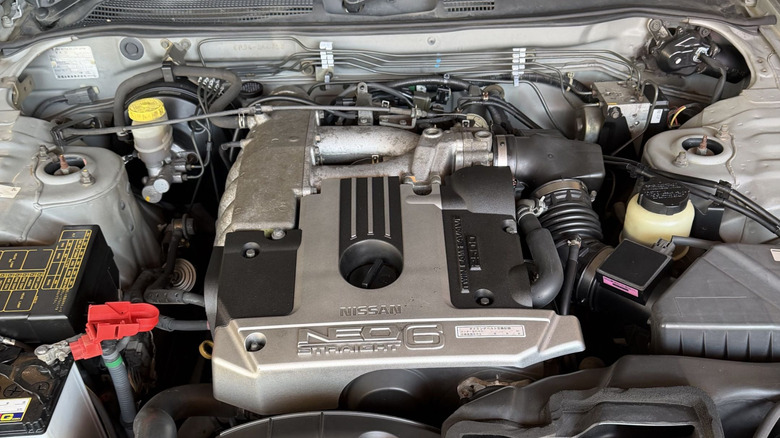

Inline six engines, also commonly known as straight sixes, are widely regarded in the enthusiast community as some of the smoothest and simplest engine layouts, a fact inherent to their design. But while their smoothness was never in question, what about their reliability?
Granted every single block design is always going to have its good, bad, and ugly designs. On one hand, you have the AMC and Jeep straight six, Toyota 2JZ, and Jaguar XK6 — all unquestionably amazing engines. On the other, you have terrible sixes like the Mercedes M104, Triumph TR6 family, and… this is a trigger word, I apologize — the Land Rover Ingenium. That’s a pretty wide breadth of reliability to cover, so where’s the middle ground? Is the straight six a good configuration in general or not?
Personally, I think so, and I have the physics and mechanical knowledge to back it up. My name’s Maddie, and I’m a straight six addict. I’ve driven and worked on these engines beginning with my very first car, my mom’s 2001 Jeep Cherokee. I now have a ’96 Cherokee, a car I’ve owned for 16 years, and an R34 Skyline — again, both with straight sixes. Each car behaves quite differently as well; my Jeep’s six is a deep-breathing gas engine LARPing as a diesel. My Skyline’s revs to 7k RPM with vigor and aplomb.
On paper, these engines are worlds apart. But in terms of reliability, not so much — in fact, despite their differences, both are well over 100k miles and still strong engines. Moreover, as an enthusiast and former tech, I’ve seen and worked on many in excess of 500k or more miles. Here’s how you can get your six’s odometer that high, too.
The secret to the straight six is in its construction
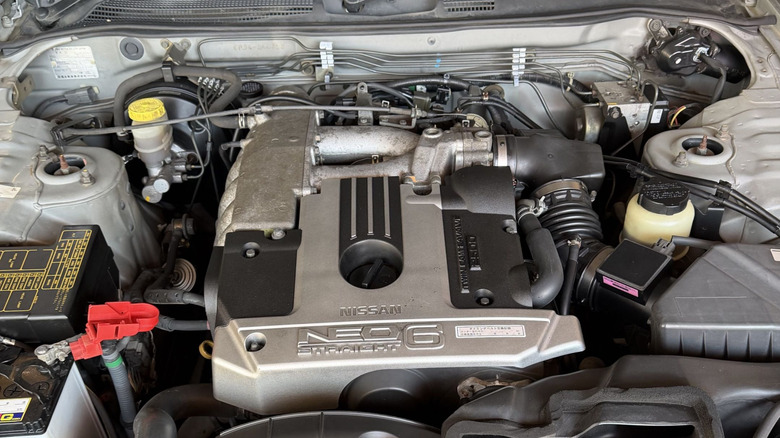
The nice thing about straight sixes is how smooth they are, and that’s because the engines have inherently near-perfect balance characteristics. Think of them like two inline threes stuck together end to end. Each piston has a corresponding opposite in the other “block,” and both of these pistons cancel each other out. That means there’s a net-zero vertical and lateral force exerted on the block. It also means you don’t need stuff like counterweights to help offset these forces, which keeps the block’s internals relatively simple. No split crankpins, balance shaft, and so on.
That said, straight six engines aren’t exactly perfect. For one, they take up a lot of room in the engine bay, which is why BMW always cants its engines to the side. It means you necessarily have a big, long nose; or otherwise have to jam your engine under the windshield like on the AMC Pacer — its engine bay was originally supposed to have a Wankel rotary before GM cancelled the project at the last moment.
In some ways, this actually helps a lot with maintenance. Because you have a long, thin engine, theoretically you have plenty of space on either side for working. My Jeep was an excellent learning tool for procedures like changing spark plugs because of this very reason. Conversely, my Skyline’s engine is so long that to get at the timing belt, I have to remove the radiator to get enough clearance to do the crank pulley. So there is a trade-off in some respects, but for the most part, older straight sixes are dead-simple, and simplicity generally equals reliability.
How can you make straight-sixes last longer?
Read these three words like Gospel: Do the maintenance. Seriously, that’s it. Just do the maintenance, and don’t skimp out on parts. My Skyline’s water pump cost like $400 to import an OEM part, but I could’ve gotten a sketchy knockoff for about ¼ that price. I’m someone who enjoys daily driving her classic cars, so guess which pump I bought? This goes for everything, too — you get what you pay for with these engines.
Straight sixes tend to be creatures of extremes these days. You either have the old workhorses from the 20th century or the fancy twin-turbo BMW units of today, and not much in between. Yes, it’s a given that the latter are more expensive and difficult to work on, but the fact remains that you also need to do the maintenance with both.
In short, my Cherokee’s engine lasted well beyond 200,000 miles and counting because I do the maintenance, don’t drive hard when the engine’s cold, and I don’t ask the engine to operate outside its design parameters. It really is that straightforward. Don’t stray from the recommended intervals, especially with high-mileage engines, and practice good driving habits. This means driving sympathetically — don’t lug your engine, don’t idle for long periods when it’s cold, don’t overstrain it by revving it, and so on. It really is miraculous what these engines can do when drivers don’t abuse them to within inches of their lives.
Some of the longest-lasting engines are sixes. I mean, there’s a reason why most trucks still use straight sixes. It’s a simple and durable block construction, but it’s not idiot-proof. If you bear that in mind, you’re golden.

Stephan is the sports journalist for the Maple Grove Report.