
Why Does The US Military Use Red Light At Night?


Humans don’t see particularly well at night, especially compared to many animals. In fact, according to one study published by Science Daily, frogs may have the best nocturnal vision, as they can differentiate color in lighting conditions where humans would only see darkness. However, despite the limitations of the human eye, military operations aren’t restricted to daytime hours. Darkness can be used as a tactical advantage, though some illumination is required. The trick is, how do you provide enough light for soldiers to operate without giving away their position?

Red lights are used by the military because it allows soldiers to see better in the dark without compromising natural night vision. Better still, red light isn’t as perceptible over long distances, making it a challenge for enemy forces to spot it. This is much different than night vision goggles first used in the military as far back as the 1930’s, which relied on bulky equipment.

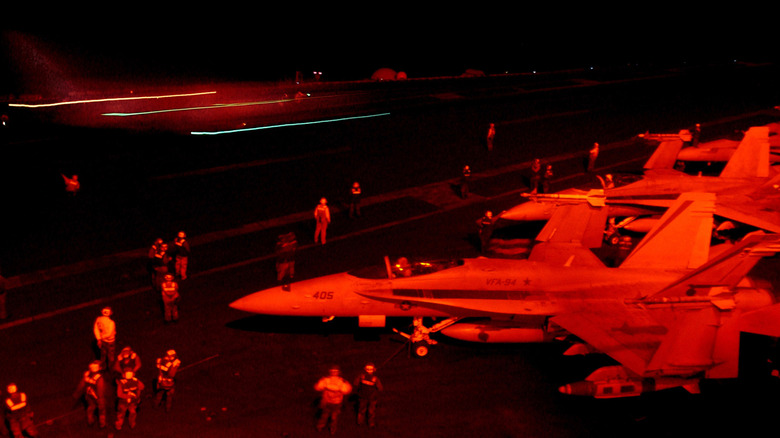
There are a variety of situations these red lights come in handy, such as when ground troops are navigating in the dark and need to verify their position. In addition, naval vessels are illuminated in red both inside and out at times. This allows the crew enough visibility to monitor their instruments and those working the flight deck can see to do their jobs without turning the vessel into a bright beacon that’s easy to spot with the naked eye.

Why the color red doesn’t diminish night vision
When trying to see in nighttime conditions, your eyes are working hard to provide the most information by widening your pupils, which allows as much light in as possible. The retina then takes this light and utilizing special receptors (rods and cones), converts it into signals your brain processes into sight.

Colors are measured in wavelength, and in terms of visible light, red has the longest wavelength at 700 nanometers (nm). Human eyes can usually distinguish colors between 380 to 700 nm. When exposed to a dark environment for several minutes, your body releases rhodopsin, which is a chemical that helps human eyes see better at night. The problem is, this chemical quickly vanishes when exposed to brighter light even for brief moments.

However, red light doesn’t cause rhodopsin to decay, which is what allows soldiers or sailors to continue to maintain optimal night vision. In addition, red light may not just be advantageous for the military, but also could potentially have additional health benefits. According to one study, aging vision was significantly improved following daily exposure to red light.

Red lights are even used on submarines

Considering one of the reasons the military uses red light is to be less perceptible to enemy forces, you might wonder why they’re also utilized on a submarine. After all, these vessels are designed to travel underwater and are sealed shut, making even bright lights on the interior impossible for anyone outside the sub to see. However, red light actually helps solve a critical problem that effects the health of the entire crew: differentiating day from night. And this becomes critical when considering just how long a military submarine can stay underwater, which is months.

Your body has its own built-in clock, referred to as a circadian rhythm, to identify when it’s time to be awake and asleep. With no external cues such as the sun or moon, human circadian rhythms can become disrupted, leading to sleep problems, among others. Military submarines can use brighter white lights during the day but then switch to red lights at night, helping to preserve some semblance of a natural day and night cycle.


Source link

Leave a Reply

Subscribe to Our Newsletter

Get our latest articles delivered straight to your inbox. No spam, we promise.

Recent Reviews


Google Pixel 10a

Kerry Wan/ZDNET

Follow ZDNET: Add us as a preferred source on Google.


ZDNET’s key takeaways

  • Android 17 is here, along with the June Pixel Drop.
  • The OS is rolling out to Pixel devices first.
  • Users are getting upgraded productivity, security, and more.

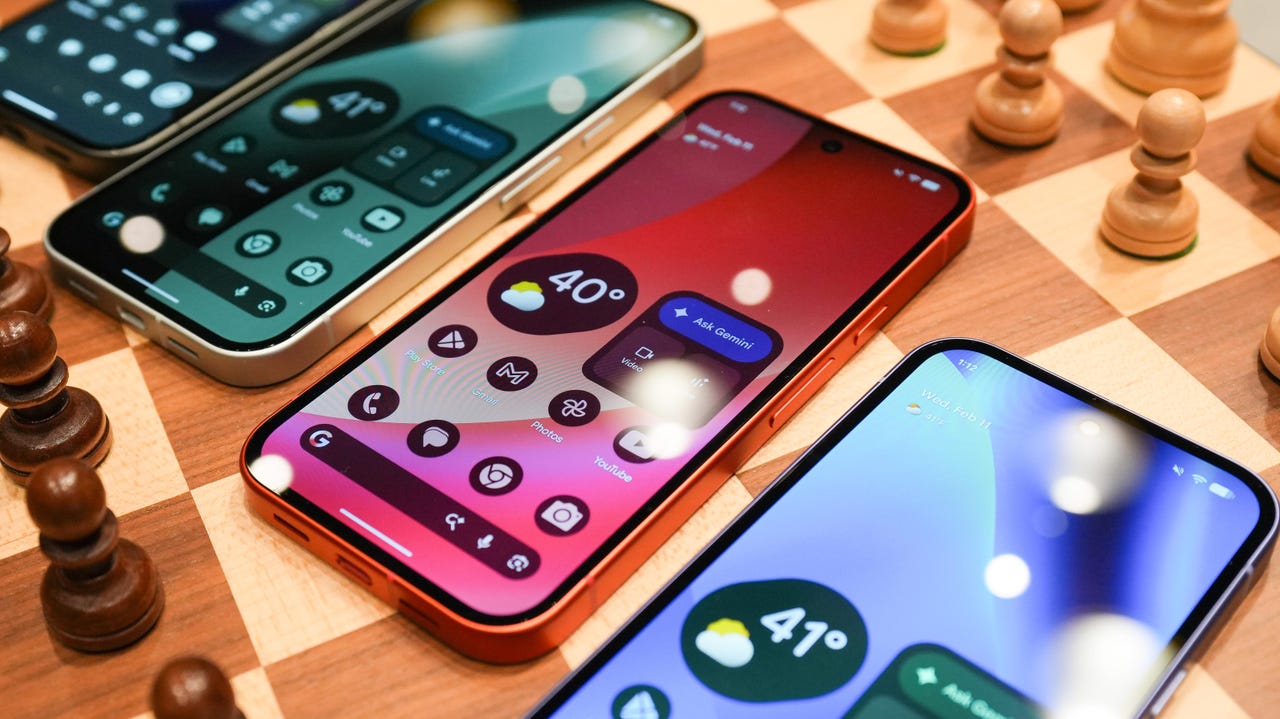
Android 17 is officially here, and it’s a doubly good day for Pixel users, as it’s bringing the June Pixel Drop with it.

Google has rolled out its annual OS update and its latest collection of Pixel-exclusive features at the same time, and the updates pack not only some practical features that will make an impact on how you use your phone daily, but also security protections, some new translation tricks, and more. Pixel Watches — the 2 and later — are included, too, with a potentially life-saving feature addition.

Also: I’m a devoted iPhone user but Android 17 is tempting me with its new video and social features

Here’s a look at what’s new in Android 17, which starts rolling out today to Pixel phones first and then to other devices “throughout 2026,” along with what’s new in the June 2026 Pixel Drop.

What’s new in Android 17?

Since many manufacturers now offer longer update windows, usually 4 to 7 years, a wide range of devices are eligible. The updated OS starts rolling out today to Pixel 6 phones and newer. Samsung’s Galaxy S23 series and newer will get it as One UI 9, along with the Flip 5 and newer, Galaxy A24 and newer, and Tab S9 series. OnePlus will bring Android 17 to the OnePlus 11 and newer.

1. App Bubbles

Perhaps the most useful feature is Bubbles, which lets you turn any app into a floating bubble on your main screen. All you have to do is long-press an app, and it becomes an easy-to-access bubble. If you consistently switch back and forth between apps or need to access a certain app often, like a map or airline app while you’re on a trip, you can now find what you need more quickly.

Pixel Folds are getting a special Bubble Bar at the bottom of the screen that lets you organize, move, and access your recent bubbles from one dedicated space.

2. Additional security

Android 17 is also bringing boosted security. 

To start, you can now grant an app temporary access to your exact location and share only specific contacts. 

Additionally, an enhanced “Mark as lost” feature, located in Find Hub, lets you lock a missing phone with your biometrics, so even if a thief has your passcode, they can’t access anything on your device or turn off tracking. 

Improvements to Live Threat Detection block more suspicious apps and scams, Google explained, and enhanced Advanced Protection mode helps keep you safe from sophisticated threats. Lastly, Google is reducing the number of times someone can attempt to guess your PIN and adding longer wait times between failed attempts.

Also: How to clear your Android phone cache – the 30-second routine every user should be doing

3. Screen reactions and more

Also new is Screen Reactions, which lets you take a selfie video overlaid on a screen recording in lieu of a green screen; a 50/50 gaming mode with a dynamic pad for foldables; and built-in parental controls beyond Pixel devices, so you can set screen time limits and content filtering with a PIN, even if you don’t link your Google Account.

What’s in the June Pixel Drop?

Beyond Android 17, Pixel users are getting several Pixel-specific upgrades in the June Pixel Drop.

1. Custom greetings for Take a Message

Introduced in 2025, Take a Message expands on the Pixel call screening feature and gives you a real-time transcript of what the caller is saying, along with AI-generated follow-up steps. Now, Take a Message has custom greetings, letting you record a personalized outgoing message instead of the default voice.

2. New AI models

Two new AI models are making their way to Android phones. The first is Gemini Omni, a new way to create and edit videos. Gemini Omni lets you type in a prompt and get a custom, high-quality video. This is available on all devices with the Gemini app for Gemini Pro users only.

Also: Everything we saw at Google I/O: Gemini 3.5, Android XR glasses, Spark, and more

Also on the way is Lyria 3, which lets you create original tracks using text prompts or images as inspiration. You can prompt Gemini with the style, vocals, and tempo you want. This is coming to all Android 17 Pixel phones and Folds.

3. Voice Translate for the Pixel 10a

One of the Pixel 10 series’ exclusive features is Voice Translate, which provides a real-time translation on phone calls in the speaker’s voice. ZDNET’s Sabrina Ortiz tried the feature last fall, noting how quickly the feature worked and how well it copied her voice. Voice Translate is getting a small expansion, coming to the Pixel 10a.

Also: iOS 27 envy? 4 features you can already use on an Android phone (including Samsung models)

4. Android Quick Share expansion and more

Pixel users are also getting an expansion of Android Quick Share compatibility with AirDrop, coming to the Pixel 9a and Pixel 8a, and an expansion of Magic Cue to more apps, coming to the Pixel 10 series.

What’s new for Pixel Watches?

Pixel Watches are only getting one new feature, but it’s a potentially big one. Core detection features, including Car Crash Detection, Fall Detection, and Loss of Pulse Detection, are getting emergency sharing. If a severe event is detected, Google explains, your Pixel will call emergency services and notify your chosen contacts. You can toggle emergency contacts on or off for each type of event.

Also: This silent Android feature scans your photos for ‘sensitive content’ – how to uninstall it

Fall Detection is coming to the Pixel Watch, plus the 2, 3, and 4, while Car Crash Detection is coming to the Pixel Watch 2, 3, and 4. Loss of Pulse Detection is only coming to the last two generations, the Pixel Watch 3 and 4.


Source link