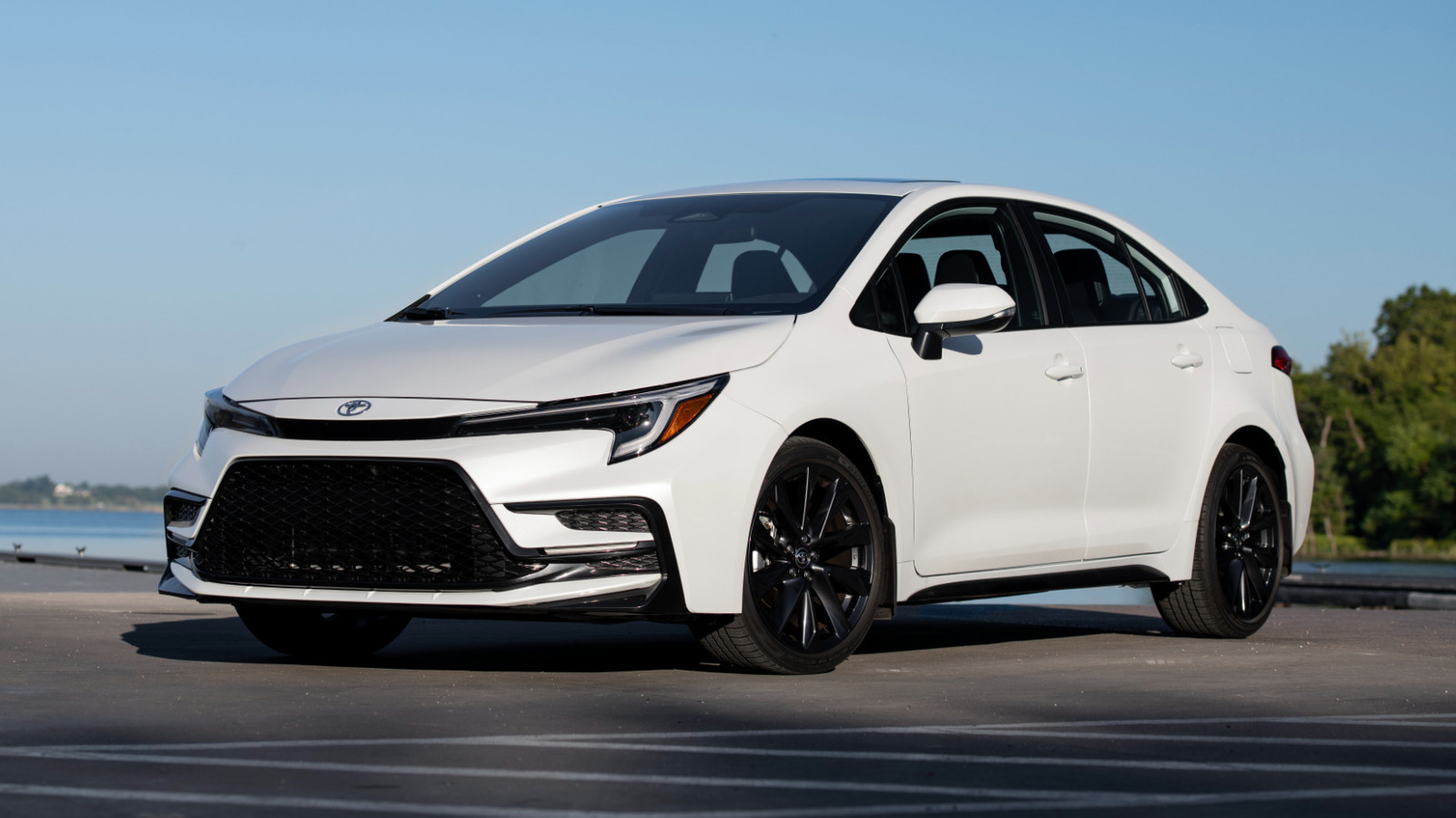

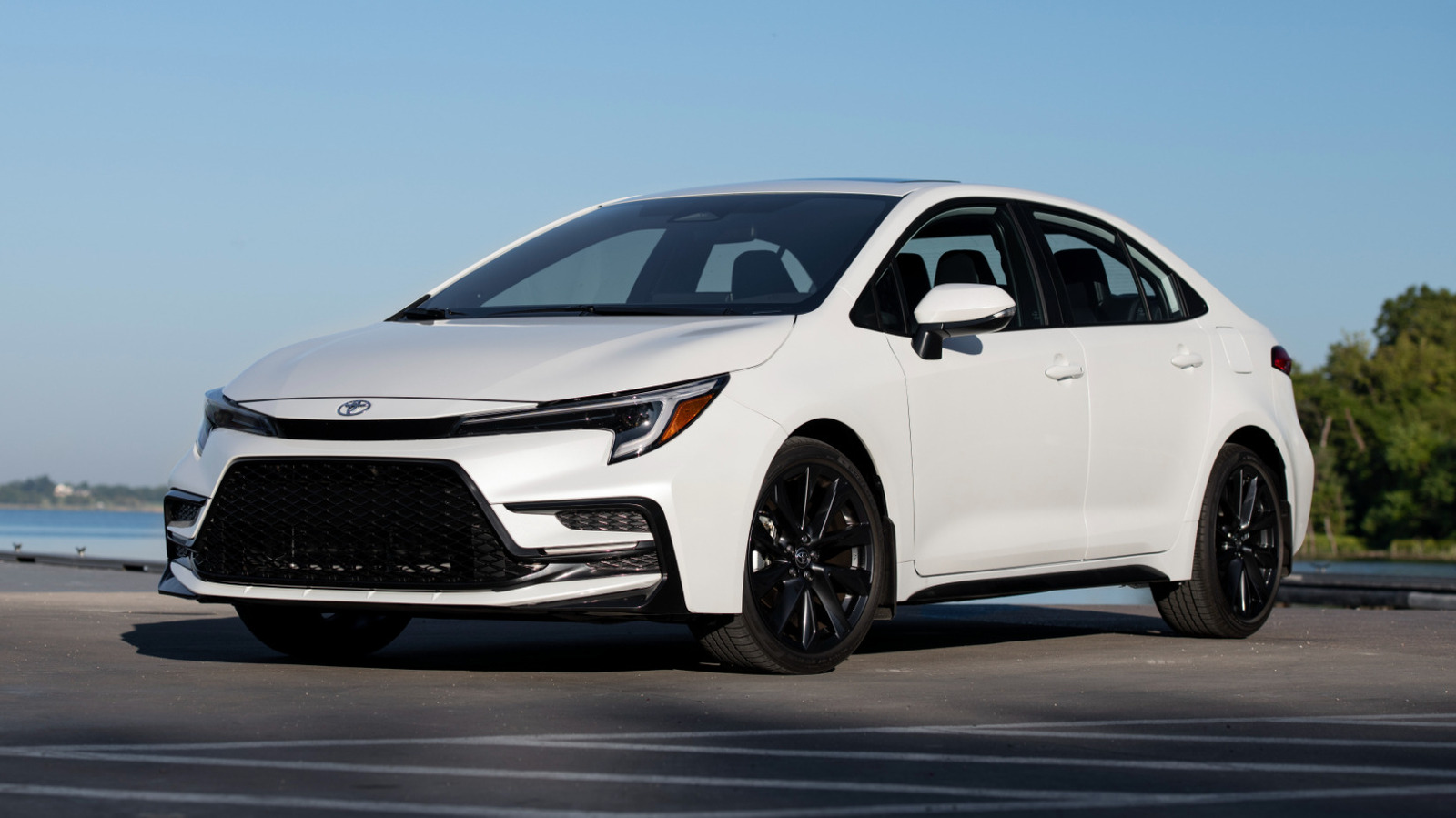
It’s no surprise that people love the Toyota Corolla. Toyota has produced this compact car since the 1960s, and it has sold over 50 million units in that time. As of this writing, Car and Driver lists it as the twelfth best-selling vehicle in the United States in 2026, and in a market dominated by SUVs and pickup trucks, it’s the only one of two compact cars to crack that top dozen. When you combine the fact that Toyota is renowned for its consistent production of incredibly reliable vehicles with the Corolla’s very reasonable starting price of $23,125 (plus a $1,295 delivery, processing, and handling fee), there’s very little reason as to why it shouldn’t be as popular as it is.
Looking at the ratings from experts and customers alike compiled by the likes of Consumer Reports and J.D. Power, they typically concur with these positive opinions. However, the Toyota Corolla isn’t the compact car on the market that gets the absolute highest of marks. We’re going to look at four different compact car models from different companies that receive better ratings than the Corolla. Sometimes, the overall scores will be higher, but in others where the overall scores are quite similar, there are models that outpace the Toyota in areas like reliability or performance. So, if you’re considering getting yourself a Toyota Corolla for your compact car needs, there’s a chance these other options better fit your particular needs.
Honda Civic Hybrid
The one compact car that the Toyota Corolla slightly trails in 2026 sales is the Honda Civic. Only about 1,000 units sold separate the two, and fun fact, their spots in that ranking flipped in the midst of this article being written. Effectively, the two models are neck-and-neck. That equivalency is apparent in their ratings too. According to Consumer Reports, the 2026 Corolla and Civic have the exact same overall score. The Corolla slightly outpaces the Civic in reliability, while the Civic has the edge in owner satisfaction. When you get to the hybrid version of the Honda Civic though, it’s a different story.
Out of every compact car rated by the publication, the 2026 Honda Civic Hybrid has the overall highest rating by Consumer Reports. That comes with an excellent road test score from its in-house experts and quite high owners’ satisfaction score from actual customers. The ratings determined by J.D. Power are a little trickier to parse, as it doesn’t distinguish between the traditional and hybrid models of the Civic, but it ties for first amongst compact cars, sharing an 85 out of 100 overall average with the 2026 Nissan Sentra. If the ratings correlate between the two publications, the Civic Hybrid is even higher than that 85 on its own. If not, it still gets to be number one regardless.
The starting price for a 2026 Civic Hybrid is $29,395 (plus a $1,195 destination and handling fee). That’s a bit more than your standard 2026 Corolla or one with a hybrid powertrain (starting at $24,975 plus a $1,295 delivery, processing, and handling fee), but you’re getting something people generally prefer slightly more.
Subaru Impreza
To stay with the Japanese automakers, another compact car you see getting better scores from experts and owners than the Toyota Corolla is the 2026 Subaru Impreza. This hatchback may not be nearly as popular as the previous two mentioned vehicles, as it doesn’t even crack Car and Driver’s top 25 best-selling vehicles in 2026 so far, but that doesn’t mean people don’t like it any less.
Based on J.D. Power’s ratings, the Impreza earned an 84 out of 100 overall score, just one point behind the top-rated Honda Civic. While drivers surveyed by the publication found their driving experience on the high end of average, they did determine that the car’s quality, reliability, and resale value were all excellent. The dealership experience even managed to get a 91 rating, 15 points higher than the Corolla.
On the Consumer Reports side, the 2026 Impreza doesn’t quite reach the overall heights of the Honda Civic Hybrid among small cars, but it does outperform the Toyota Corolla on the whole. Owner satisfaction is what the publication has calculated as the Impreza’s greatest strength over the Corolla, but it also has higher ratings for its road testing and reliability as well.
A 2026 Subaru Impreza starts at $26,595 (plus a destination and delivery fee of $1,195). That may be a few thousand dollars more than the starting price of a Toyota Corolla, but if the owners and experts are to be believed, you are not sacrificing any semblance of quality with that moderately higher price. Unlike the Corolla or the Civic, the Subaru Impreza doesn’t have a hybrid powertrain option.
Hyundai Elantra
Moving from Japanese automakers to those from South Korea, we arrive at the 2026 Hyundai Elantra. While not quite as popular as the Toyota Corolla — only just cracking Car and Driver’s top 25 best-selling vehicles in the United States in 2026 so far at spot 24 — the overall reception to this compact car alternative exceeds it, whether we are talking about the standard gas-powered model or one with a hybrid powertrain.
The Hyundai Elantra Hybrid actually ties the top overall score of the Honda Civic Hybrid awarded by Consumer Reports among compact cars. The standard Hybrid doesn’t quite reach the top of the mountain there, but it still outpaces the Corolla, though the Toyota does have a better reliability rating from the publication. On the J.D. Power side of things, the 2026 Elantra finishes third overall among compact cars with a score of 83 out of 100, situating nicely between the Subaru Impreza and Toyota Corolla, with those surveyed labeling its quality and reliability, their driving experience, and its resale value all as great on average.
Another appealing factor with the Hyundai Elantra is that it’s actually one of the less expensive alternatives to the Corolla. With a starting price of $22,625 (plus a $1,245 freight fee) for the base SE trim, you’d be saving about $550 compared to the base Corolla. That may not seem like much in the grand scheme of car buying, but saving any money on something that is generally liked more is rarely a negative. However, the Elantra Hybrid starts at $25,450 (plus a $1,245 freight fee), which is $425 more than the base Corolla Hybrid, so savings aren’t necessarily guaranteed.
Kia K4
For the final compact car on the list, we move over to another South Korean brand. That would be the 2026 Kia K4. This is only the second model year for this car, but it’s already established itself as something owners and experts are enjoying quite a lot, making SlashGear’s list of the best debut vehicles for its first model year. When compared to the Toyota Corolla, the gap in appreciation isn’t quite as noticeable as it is with the other vehicles on this list, but there are certainly areas where the K4 pulls ahead.
According to those surveyed by J.D. Power, the K4 ties the Subaru Impreza with an overall average score of 84 out of 100 for the second-best compact car on the market. It received great scores in every category except for dealership experience, which was determined to be fairly average. When you move over to Consumer Reports, the Kia K4 and Toyota Corolla actually earned the exact same overall score. When you look into the details though, there are important differences. Yes, the Corolla does earn a higher reliability score, but the K4 earned higher expert road test and owner satisfaction scores than the Toyota. Depending on what you value in a vehicle, you could certainly perceive the K4 as the better liked model.
The 2026 Kia K4 is also a cheaper model than a new Corolla. It has a starting price of $22,290 (plus a $1,245 destination fee), making it the least expensive model on this list. At worst, it’s comparable to the Corolla. At best, it’s the better reviewed of the two. Either way, you’re saving money on quality.
Methodology
Determining how a fellow compact car was better rated than the Toyota Corolla came down to a couple of different factors. Firstly, we’re looking specifically at compact cars. There are other small vehicles, such as sports cars, but these are really their own class of vehicle. Comparing them would be apples and oranges. Secondly, these are the ratings of the latest 2026 models of these vehicles.
Consumer Reports and J.D. Power are the two best sources for these kinds of ratings. With both, you get consensus opinions on these vehicles from thousands of verified owners who are honestly reflecting on their actual experiences with these cars. Consumer Reports has the added benefit of having its own in-house experts perform their own tests with these vehicles as well. While overall average scores were the most important determining factor for how a car could make this list, a car having higher ratings in specific areas — such as reliability or owner satisfaction — would also be considered if the overall scores were very close together or the same. After all of that, these four compact cars could be selected.

Stephan is the sports journalist for the Maple Grove Report.