

For a lender, a cross-border payment notice is not correspondence. It is the document a court will read back to you if the borrower disputes the debt. And the moment that notice crosses a language line, its legal meaning stops being something you control and starts being something an AI model decides on your behalf, silently.
Consider what happened in Kilic Insaat v. Turkmenistan, an investment-treaty arbitration heard at ICSID. The English and Russian texts of the same treaty diverged on one point: one version made recourse to local courts optional, the other made it mandatory. The tribunal declined jurisdiction entirely. As a recent analysis of language clauses in cross-border contracts notes, the arbitration was killed before it began, over a difference between two language versions of a single clause. The dispute was not lost on the merits. It was lost on translation.
That is the risk hidden inside every notice, demand letter, and contract a recovery team sends across a border. Below are five places in a cross-border payment notice where independent AI models quietly read the legal meaning differently, and what each divergence costs the lender who never sees it.

Why the translated notice is the instrument, not a copy of it
A demand notice is often a statutory precondition to recovery, not a courtesy. Under Section 138 of the Negotiable Instruments Act, for example, a demand notice must be issued within a defined window before a cheque-bounce complaint can proceed. If you are unsure how tightly the format is governed, Legodesk’s own breakdown of what a demand notice is and its legal implications in India is a useful reference. Miss the wording, and the precondition itself can fail.
When the recipient reads a different language, the version in their hands is the version that governs the interaction. If a model shifted the deadline, softened the demand, or renamed the party, the enforceable meaning shifted with it. Teams that run legal notice automation in debt recovery inherit this at scale: one silent term-level error, repeated across an entire portfolio.
Five places where AI models quietly split on a payment notice
- The amount, the currency, and the separators. Numerals feel like the safe part of a notice. They are not. Peer-reviewed behavioural testing of machine translation systems on numbers found that decimal and thousands separators are routinely mistranslated when conventions differ between languages: the comma and period that mark thousands and decimals in English are swapped in German, and models frequently leave a separator untranslated entirely. A demand for 1,00,000 rendered against the wrong convention is a demand for a different sum. In internal engine testing, one model hallucinated numerical dates outright in Romance-language output. On a payment notice, the number is the claim.
- The statutory deadline and the limitation window. “Within fifteen days” and “after fifteen days” are one preposition apart and a world apart in enforceability. Deadlines in a notice are operative, not descriptive. A model that renders a permissive deadline as a mandatory one, or the reverse, changes when the recipient’s obligation crystallises and when your right to escalate begins.
- The words that carry legal effect. This is where model disagreement stops being theoretical. When a GDPR clause was run through 22 independent AI models on MachineTranslation.com, an AI translation platform developed by Tomedes, 43% of them chose the wrong German legal term, an error of legal meaning, not grammar. The term “data protection officer” produced only 63% agreement across engines: the majority favoured one rendering, but a substantial minority split across two others. The platform’s breakdown of how a majority-model check catches contradictory legal wording shows the pattern term by term. Phrases like “without prejudice,” “final demand,” and “shall” behave the same way. A single model picks one reading and shows you nothing. The disagreement it resolved on your behalf is invisible.
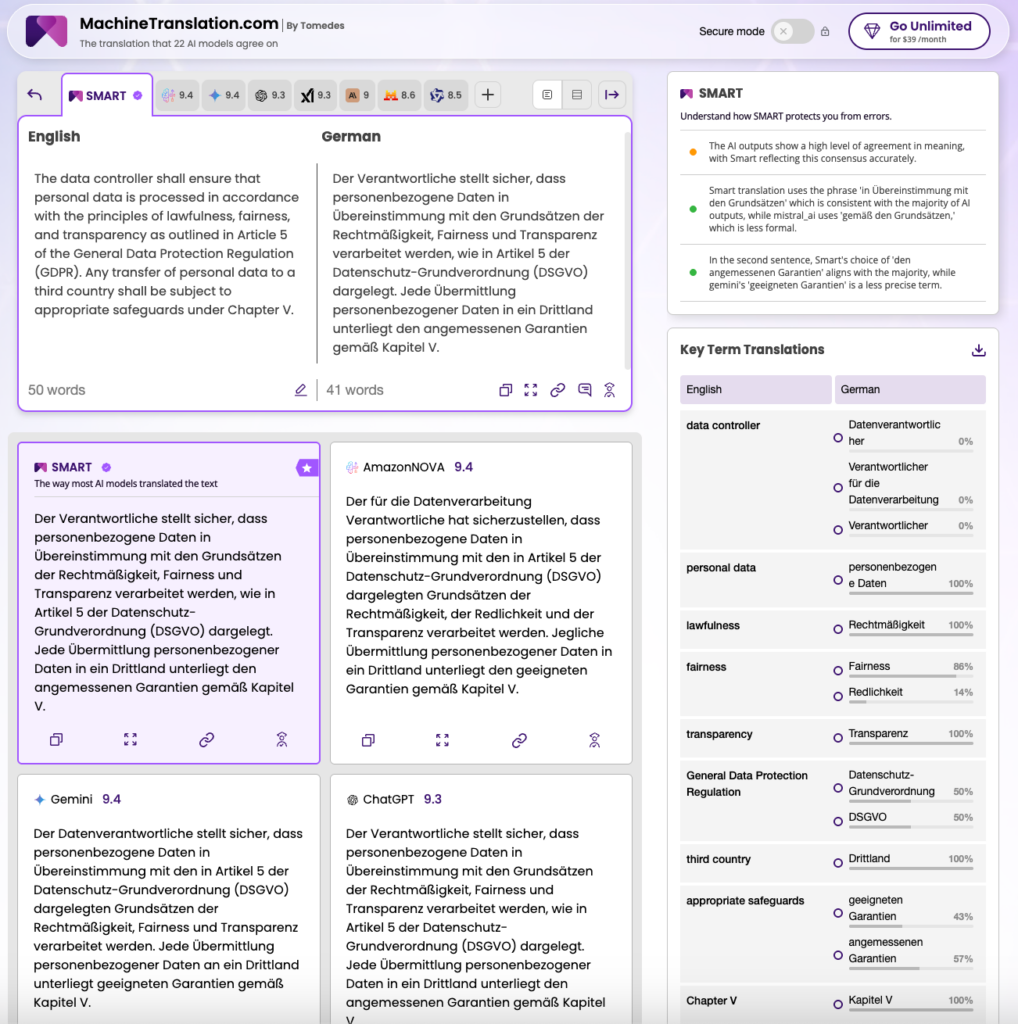
- The party and the role. Guarantor or co-borrower. Drawer or drawee. Principal debtor or surety. These designations decide who owes what, and they rely on formal register that general AI translation tends to strip out. In internal contract testing, one model failed to hold the formal tone required for German corporate filings, and another misread honorifics that signal legal role in some Asian languages at a 12% error rate. A notice addressed to the wrong legal role is a notice served on the wrong person.
- The governing-law and jurisdiction clause. The Kilic Insaat divergence lived in exactly this kind of clause. Whether a recipient “may” or “must” approach a local court, whether a filing is “permitted” or “required,” determines where and whether you can enforce. It is the last clause anyone re-reads and the first one a mistranslation quietly rewrites.
The pattern underneath every item on this list
Each failure above shares one property: a single AI model resolves the ambiguity silently and hands you fluent, confident output with no signal that anything was uncertain. Industry testing shows how often this happens. Intento’s 2025 State of Translation Automation, which evaluated 46 machine translation engines and large language models across eleven language pairs, found that baseline systems averaged ten to fifteen errors per text, and that no single engine topped every language pair. The “best” model is not a fixed thing. It changes with the pair, the domain, and the clause.
That is the argument for not trusting one model. The alternative is to run many and look at where they converge. When 22 models translate the same clause independently and you take the rendering the majority agree on, the divergences a single engine would have hidden become visible, and error risk drops by up to 90% against relying on any one engine, according to the platform’s internal benchmarks. Disagreement stops being a silent liability and becomes a flag you can act on before the recipient does.
A term-by-term triage for any notice that crosses a language line
- Isolate the operative clauses. In a payment notice, that means the amount, the deadline, the demand language, the party roles, and the governing law. These carry legal effect; the rest is context.
- Check convergence, not fluency. For each operative clause, the question is not “does this read well” but “do independent models agree on this term.” Where they split, you have located your risk.
- Escalate the split clauses to human review. For the subset that carries liability, a professional legal translator confirms the reading before dispatch. For court-bound documents, certified legal translation with jurisdictional review closes the gap that no automated step should be asked to close alone.
- Keep the agreement level as an audit trail. If a dispute arises, “22 independent models agreed on this rendering and a certified human confirmed it” is a defensible record. “One AI translated it” is not.
This is the same discipline recovery teams already apply when they let AI triage which accounts to pursue and reserve human judgment for the matters that carry real exposure. The language line deserves the same treatment. Bulk handling helps: notice packs and underlying contracts up to 70MB can run through the model check with their original layout preserved, so formatting on a filed exhibit never breaks.
The takeaway for recovery teams
For a lender sending one notice, a mistranslated clause is a bad day. For a lender automating hundreds, it is a systemic exposure that compounds with volume. The fix is not to translate less or slower. It is to stop treating a translated legal notice as a message to be sent and start treating it as an instrument to be verified: operative clause by operative clause, with the model disagreement made visible and the high-stakes splits signed off by a human before anything reaches a debtor, a court, or a regulator.
Four models can read one payment notice three different ways. The only safe assumption is that you will not see which three until it is too late, unless you build the check in first.
“On a legal notice, the dangerous errors are the ones that read perfectly. A single model gives you fluent output and hides the fact that it just made a legal decision on your behalf. Running 22 models against the same clause turns that hidden decision into something you can see and verify before it ships.”
Rachelle Garcia, AI Lead, Tomedes, a translation company.
Conclusion
The five failure points above are not five separate problems. They are one problem wearing five faces: an AI model that resolves legal ambiguity without telling you it did. A payment notice is where that habit does the most damage, because the notice is not a description of the debt. It is the legal act that creates your right to pursue it.
Recovery teams already accept this principle everywhere else in the workflow. You verify the borrower’s identity, the outstanding amount, and the statutory timeline before a notice goes out. The translated wording deserves the same scrutiny, because it carries the same consequences. Treat the language line as a control point, not a formatting step: flag the operative clauses, check whether independent models converge on them, and route the splits to a human before dispatch. Build that check in once and it protects every notice you send after it. Skip it and you inherit the one error you will only discover when a debtor’s counsel points it out.

Stephan is the sports journalist for the Maple Grove Report.