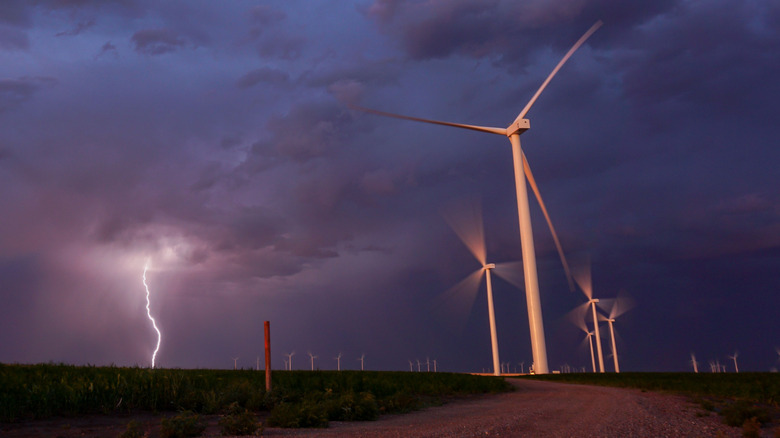

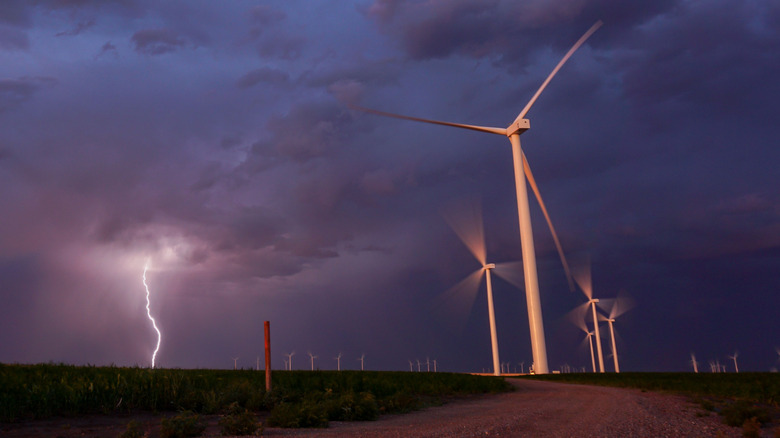
Severe weather can wreak havoc on man-made structures, but those big wind turbines out there continue standing like nothing ever happened. If that doesn’t sound odd enough, another strange behavior these giants display is that they actually start spinning slower in strong winds. That may seem wasteful, especially since more wind should mean the fans spin faster and make more juice, so why throw all of it away?
Wind turbines follow what engineers call a power curve – a map of how much electricity the turbine is able to produce at any given speed. A gentle breeze (around 6 to 9 mph) is usually enough to get the blades turning. Increased wind speed improves production, but only up to a point; after that, it hits a ceiling. That’s where the cut-out speed comes into play, which is usually around 55 mph (although it varies between turbines). Once wind speed reaches this threshold, the turbine’s anemometer — which measures wind speed – will shut the turbine down. The blades will stop and twist themselves flat so that they slice through the gusts rather than capture them. The principle is quite similar to what windpumps that pump water from underground automatically do during storms.
Wind turbines are, of course, made to withstand much faster winds. International safety standards, specifically IEC 61400, require most modern turbines to be able to endure sustained winds as strong as 112 mph and gusts as fierce as 156 mph.
Shape and flexibility matters, too
Another major factor that allows wind turbines to withstand storms is the construction. The blades, all of which are hollow, contain spar caps running down the inside. These are built to stop the tip of the turbine from swinging around beyond a limit when a blade flexes way back in a gust. A pair of internal panels called shear webs then connects one spar cap in the blade to another. These panels carry the sideways loads that build up as the blade bends.
Each blade skin is molded from fiberglass. Pricey carbon fiber has also started working its way into more modern designs, especially for parts that endure the most strain, like the spar caps. The main issue is that it is significantly more expensive than fiberglass per pound, but it offers some real benefits to offset the cost, notably allowing for up to a 25% reduction in blade mass and improving the blades’ ability to handle repeated stress.
Regardless of the material, wind turbines take advantage of their flexibility. Good blades are designed to bend instead of snapping, and even the tower itself flexes with strong gusts. They’re built to lean rather than fight against the wind. That said, sometimes all the protections are insufficient, and a direct hit from a storm can still wreck turbines. It’ll take quite a storm, though, given that most are rated to survive anything up to a Category 3 hurricane.

Stephan is the sports journalist for the Maple Grove Report.