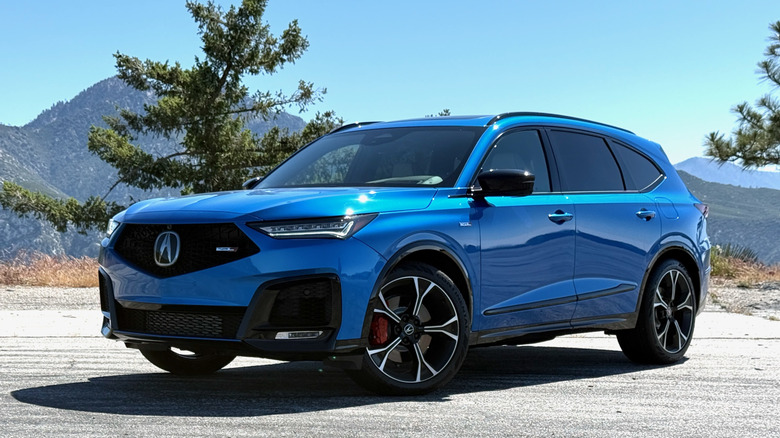
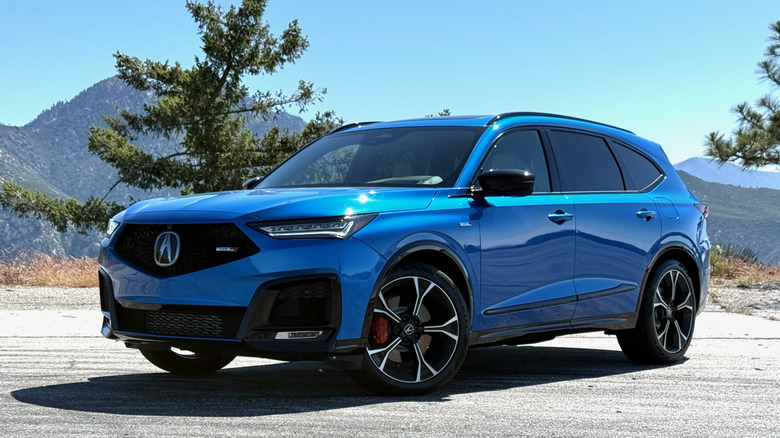
A More Fitting Flagship Than NSX Ever Was


Driving the MDX Type S around Los Angeles for a week, I had a realization. With the NSX long gone from their lineup (the last NSX was built nearly four years ago), the MDX has been the flagship vehicle for Acura for quite some time. The NSX was fantastic, and totally wouldn’t fit in Acura’s lineup today. The MDX, however, is their biggest SUV and their most expensive vehicle, with added performance coming via the Type S trim, and it reps the brand in a big way. 

Smaller Acura vehicles like the Integra Type S offer compact-hatchback performance and an ambitious entry point for brand enthusiasts, but the three-row MDX is a much better seller. The MDX typically sells double the number of units in a given year than the entry-level Integra, so no matter how much we enthusiasts love the Integra, it’s the MDX that holds up the brand name.
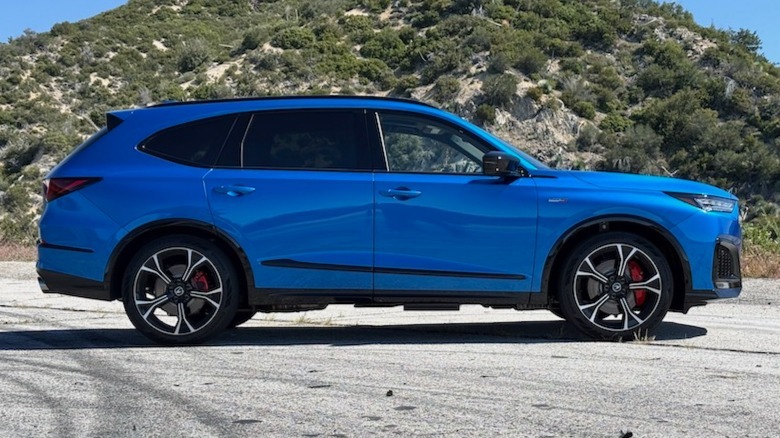
The MDX, while it certainly isn’t a brand-defining flagship like the NSX, or a speedy hatchback with decades of name cachet, has the weight of lofty expectations resting on its shoulders. Along with entertaining driving dynamics, the MDX needs to be fairly premium. It represents the storied luxury brand, offering the latest tech they can muster up in the most family-friendly package. Thankfully, it’s big enough and strong enough to carry the load of a demanding luxury market, and it even goes a bit further by being genuinely fun to drive.

Some pep in its step
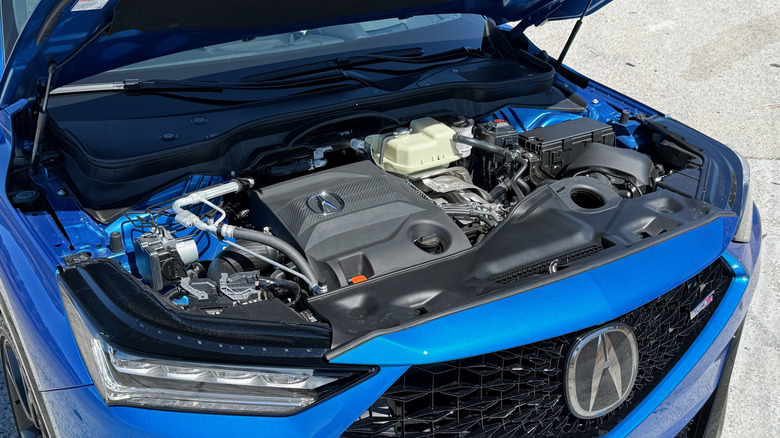
The standard MDX is powered by a naturally-aspirated SOHC 3.5-liter V6 that makes 290 horsepower and 267 lb-ft of torque. It’s adequate, but not exactly the entertaining choice. The Type S gets its own unique engine, with some spicy turbocharging thrown into the mix. 

Specifically, the MDX Type S gets a turbocharged 3.0-liter V6 (yep, it’s technically smaller displacement) that produces 355 hp and 354 lb-ft of torque, paired with a 10-speed automatic transmission. While that might not be impressive compared to some of the luxury SUV V8 models out there, it’s certainly adequate for all your family-hauling needs and much more.
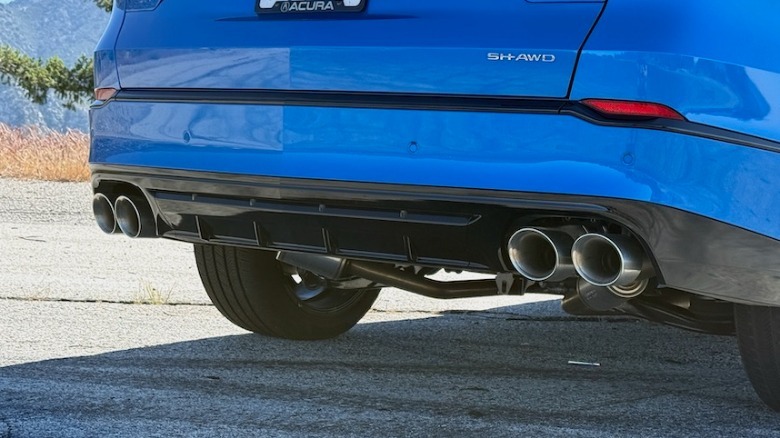
Slam your right foot to the floor and the Type S heads forward in a hurry, with snappy upshifts from the 10-speed and a bit of growl from the boosted V6 and the quad pipes. It’s not aggressive or rowdy, but it’s powerful enough to feel purposeful on the right stretch of road — it’s a big upgrade in entertainment over the standard model. Fuel economy drops between the two engines, with the standard MDX getting an EPA estimate of 22 mpg combined, and the Type S returning an estimate of 19 mpg combined (much less when you’re driving for a bit of fun), but that loss in efficiency is worth the added smiles per mile in my mind. I found myself going a few extra miles in the MDX for no reason at all, just to enjoy the drive, and that’s high praise for a three-row SUV — even if it did cost me a bit at the pump.

Smooth maneuvers
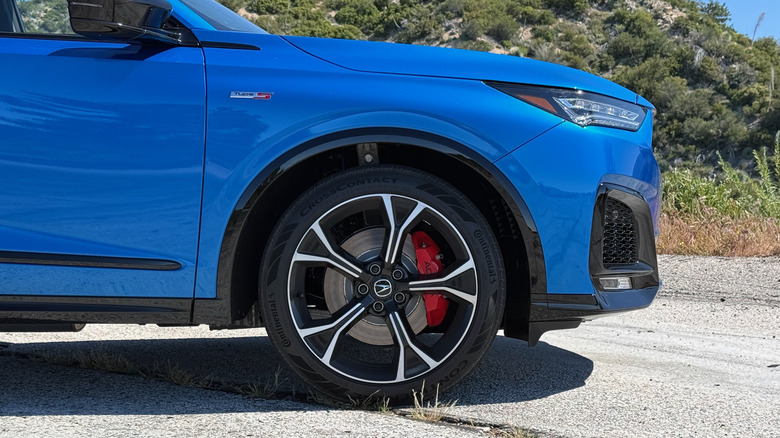
One of the MDX Type S’ other high-performance personality traits is its excellent suspension. The double-wishbone front and multi-link rear suspension, paired with the Type S’ adaptive air suspension, make for an impressive ride and better-than-you-might-expect handling capabilities. Steering isn’t exactly razor sharp, but it’s well-weighted enough for a vehicle of this size and it feels reasonably responsive. The big SUV changes direction quickly, and while I wouldn’t call it sports-car nimble, the MDX Type S is fearlessly stable.

With a curb weight of 4,776 lbs, the MDX would have every right to wallow a bit through corners, but it doesn’t. It remains flat, tracks extremely well, and the steering feels properly weighted. Few SUVs in this price range are as entertaining to drive at speed, and the MDX provides that entertainment without sacrificing comfort. 

On the highway, in the city, and on beaten-up back roads, it has an excellent ride quality to go along with its enthusiastic demeanor. Send any lengthy road trip my way, and I’d be happy to drive the miles behind the wheel of an MDX Type S. Mix in some curvy back roads, and I’ll be even happier.

An interior that doesn’t disappoint

The overall experience in the MDX is one of simple luxury. There aren’t a lot of ostentatious bits or overwhelming design details, just simple, easy-to-use features and a well-built cabin. The seats are comfortable, but, at least for the driver and front passenger, they’re well bolstered enough to provide stability on a winding mountain pass. Spend your winters taking the kids to the local ski lifts? You’ll enjoy the journey without being tossed from your seat in a corner.

Comfort features like the Type S’ standard heated and ventilated seats work quickly — excellent news for your impatient teenagers or your impatient self. More than just some small air bladders slightly pressing against your back, the seat massagers dig in a little bit, no doubt helping to relieve stress on your upcoming road trip or your stop-and-go daily commute.

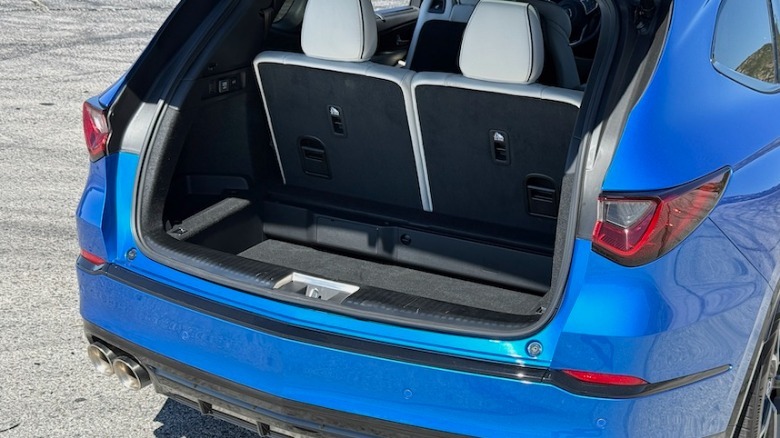
In the mid-size three-row class, there aren’t too many SUVs that offer massive space in the back, and the MDX doesn’t buck that trend. Space is at a premium in the third row, and I wouldn’t want to be stuck back there as an adult for any significant period of time, but it should be enough for the kids. Rhe second row is certainly spacious enough for an average adult. The trunk is a similarly average-sized space, offering 18.1 cubic feet of storage behind the rear seats, as well as a handy drop-down floor for groceries.

The tech scratches all the itches

Two screens are in charge of the interface for all the MDX’s tech. There’s a 10.2-inch digital gauge cluster, and a 12.3-inch center touchscreen for all the various infotainment tasks. Neither screen is particularly high-resolution or sharp, especially if you compare them to the screens currently gracing dashboards in high-class German luxury SUVs, but the Acura’s screens are relatively easy to use. Figuring out the various controls happens in a hurry, as does connecting your smartphone. During my week of driving the MDX, wireless Apple CarPlay booted up quickly every time I started the SUV and never dropped out.

While it doesn’t quite provide the volume and intensity I’d expect from something with such a high component count, the 31-speaker Bang & Olufsen “Ultra” sound system is properly impressive. Audiophiles will be pleased, and it’s a big upgrade over the standard 9- and 12-speaker stereos offered in the lower trims of the MDX.

Acura calls its set of driver safety aids AcuraWatch, and most of the features in that set come standard on every MDX. Adaptive cruise control, forward collision warning, lane-keep assist, blind-spot monitoring, and road-departure mitigation are all part of the deal. The Type S gets some added tech as part of the upgraded AcuraWatch 360, like a lane-change assist, blind-spot intervention with steering avoidance, and a forward cross traffic warning. All these systems, basic ones included, are great additions and made the driving experience better, but they were a bit conservative for my taste. Adaptive cruise control, for instance, left a pretty lengthy gap between the MDX and the car ahead — one that had other cars sneaking in front of me on a regular basis.

It’ll cost more to go fast
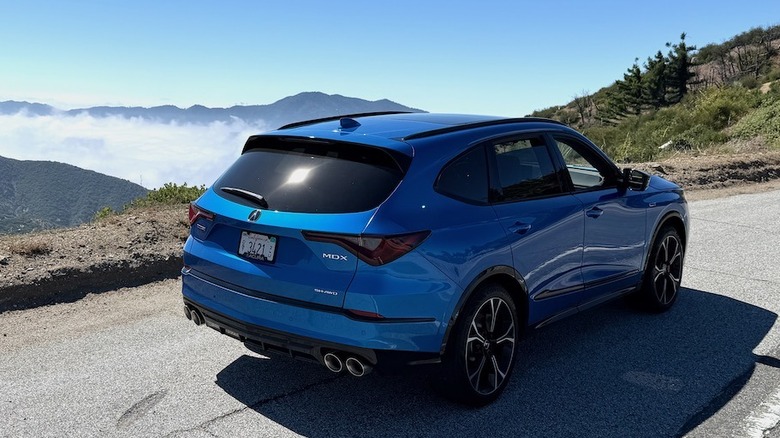
Your basic, run-of-the-mill version of the MDX has a starting price of $53,250 (including $1,450 destination fee). It comes standard with front-wheel drive, and some pretty basic amenities: it’s a nice place to be, but not really the flagship vehicle you’ll see on the front page of all the brochures. 

Heated seats, leatherette upholstery, tri-zone climate control, an 11-speaker stereo, and wireless smartphone connectivity are all part of the basic package. For $58,650, the Technology Package gets closer to the Type S and adds features like a 19-speaker Bang & Olufsen stereo, front and rear parking sensors, and premium leather upholstery. All-wheel drive is a $2,200 add-on for base and Technology Package models.
In the middle of the lineup, there’s the MDX A-Spec, the MDX with Advance Package, and the A-Spec with Advance Package, all of which offer increasing levels of equipment like a 360-degree camera, head-up display, extra USB ports, and upgraded upholstery via materials like Ultrasuede and Milano leather. 

At the very top of the heap, though, the MDX Type S I drove around for a week — with the spicy engine and the Advance Package and Double Apex Blue paint — has an MSRP of $77,300 (plus $600 for the blue paint). And while that’s a considerable price tag, it’s worth noting that it’s only $700 more than last year’s model. There are some accessories available for the Type S, but it’s mostly a come-as-you-are deal. So, is it worth it?

2026 Acura MDX Type S verdict
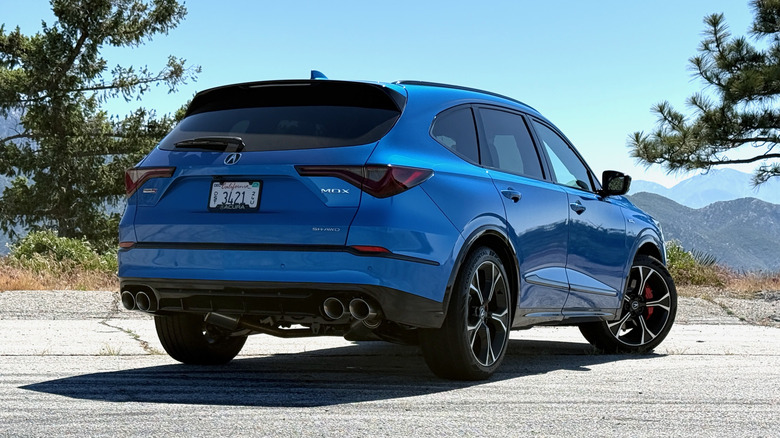
At nearly $80k, the MDX Type S is in an interesting space: it straddles the line between a few different vehicles. In terms of performance SUVs it’s a bit of a bargain, but if you want the most luxury bang for your buck, it’s a bit costly. The Lexus TX, for example, offers similar luxury for a similar price to the MDX Type S, but the Lexus doesn’t feel quite as sporting. 

The new Kia Telluride is just about as luxurious as the MDX, especially on top trim levels, but it’s significantly less pricey. The Telluride lacks the performance punch of the Type S, too, even if it is more spacious.
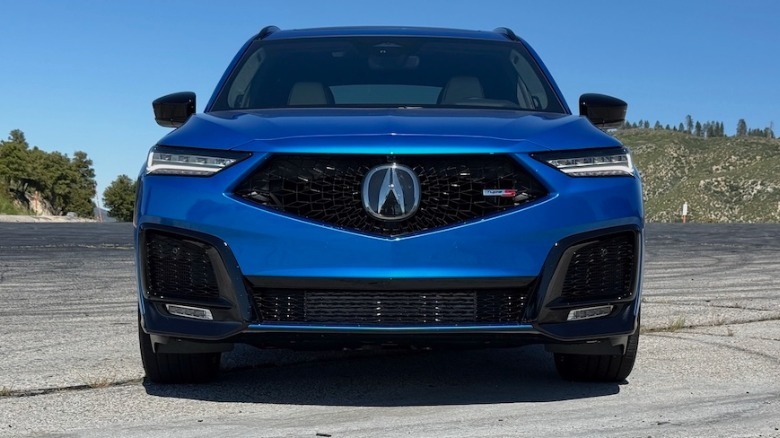
One of the best pound-for-pound rivals for the MDX is the Genesis GV80, which has an immaculate interior, but a very snug (optional) third row of seating. German rivals like the BMW X5 and the Mercedes-Benz GLE are also worth checking out, though their performance variants get pricey in a hurry. Whatever you put it up against, the MDX Type S has a strong showing. It represents the Acura brand well, giving shoppers a place for all their stuff and a healthy splash of entertainment along the way.


Source link

Leave a Reply

Subscribe to Our Newsletter

Get our latest articles delivered straight to your inbox. No spam, we promise.

Recent Reviews


The Paradox of Preppers Who Want Stock Tips

I’ve had some rather paradoxical conversations in recent weeks. One second, I’m standing there talking to people about prepping—buying water, hand-crank radios, and whatnot. Then two minutes later, they’re asking me, “Lars, which shares should I buy?” There’s something deeply contradictory about that, isn’t there?

This captures the strange moment we find ourselves in. Drones are flying over Copenhagen, jet fighters are scrambling over Danish airspace, and yet many Danish investors have made substantial money on their shares in recent years. The disconnect between our anxieties and our investment behaviours has never been more pronounced.

We’re facing what I’d characterise as three dark clouds hanging over the investment landscape. These aren’t merely theoretical concerns—they’re real, measurable risks that could fundamentally alter the investment environment we’ve grown accustomed to over the past decade.

Three Dark Clouds Over the Financial Markets

The Sovereign Debt Crisis: My Greatest Concern

Let me be absolutely clear: the sovereign debt crisis is my greatest concern. The United States has public debt exceeding 100% of GDP. Britain faces similar challenges. We’re seeing massive deficits—in America, it’s somewhere between 6 and 8% of GDP this year, depending on how you calculate it. France has major problems. Japan has major problems. Italy has major problems.

The American federal government’s interest payments will soon reach 5% of GDP. That’s more than the Americans spend on defence. Think about that for a moment—roughly a quarter of all federal tax revenues will go to servicing debt. If interest rates rise, you can see how this becomes extremely difficult to manage.

Here’s the crucial calculation: if interest rates are higher than nominal GDP growth, you get an explosive development in debt as a percentage of GDP. Let’s say the American economy grows at 2% in real terms with 2% inflation—that’s 4% nominal GDP growth. If the interest rate on government debt is 5%, the debt burden will simply grow and grow and grow.

Donald Trump has talked extensively about growing out of the debt problems with all his brilliant ideas that will boost growth. Unfortunately, there’s little evidence this is happening. We got labour market figures last week that further confirm the American labour market is cooling, and GDP growth in the first half of the year is below one and a half percent annualised. The economy isn’t booming.

But there’s another way to get nominal growth up—create inflation. Every Danish homeowner who owned property in the 1970s can tell you this story. The high inflation of the 1970s ate away homeowners’ debt. And if you’re a government that creates inflation, perhaps by ringing up the central bank and saying “print some money,” well, that solves one problem whilst creating another.

The temptation to let the printing press run becomes greater and greater if you don’t want to make difficult decisions. We’ve seen Donald Trump at war with the Federal Reserve. He’s talked about firing Lisa Cook, who sits on the Federal Reserve Board—though last week the American Supreme Court told him, “You can’t do that, Donald. You need to argue your case better.” That’s been kicked to the corner for now. But the pressure is there. He’s said he won’t reappoint Jerome Powell when his term expires next year. He’s appointed Stephen Rennenkampf to the FOMC, the leading monetary policy body at the Federal Reserve. Rennenkampf, you’ll recall, voted for a half-percentage-point rate cut rather than the quarter-point cut we got at the last FOMC meeting. These are all signs of politicisation.

Geopolitical Uncertainty: The Highest in 35 Years

The geopolitical situation must be described as unstable and frightening—probably the highest level of uncertainty in at least 30 to 35 years. We’ve had the drones over Copenhagen, the entire situation in Europe, and recently there’s been speculation about whether the Chinese might make moves regarding a possible invasion of Taiwan. We have the conflict in the Middle East—Iran, Israel, Gaza—which creates concerns.

As I write this, we’re not far from Forum Copenhagen where we recently had a major European summit. I must be honest there was a lot of police around. Many helicopters in the air. We’ve heard a jet fighter or two. I have children asking about all this. What’s all this about? It’s rather uncomfortable on a practical level.

When this starts affecting air traffic, potentially sea transport, our supply chains, company earnings, and economic development, it becomes negative for markets. So far, markets have taken it remarkably calmly, but the threat is there.

We’ve agreed in Europe that we need to increase our defence spending because there’s a genuine threat from Putin’s Russia. There’s much talk about why there wasn’t drone defence around Copenhagen Airport and other Danish airports. Because there hasn’t been a need for it – it was completely unthinkable just a few years ago, but suddenly it’s something we must consider.

Drone defence isn’t free. I don’t know what it costs to send an F-16 fighter jet up to fire missiles at drones over Copenhagen Airport, but it’s not cheap. And whilst I hope it doesn’t come to that, it’s a stark illustration that we need to spend more on defence in Denmark and Europe in general.

If we already have weak public finances in Europe (much less so in Denmark), this pushes the problem further. We need more money, which pushes interest rates up. More government bonds need to be issued, and governments must pay those interest costs. If doubts arise about their willingness to pay, inflation expectations start rising too.

The Ukrainians are currently having some success pressuring the Russian economy by hitting oil refineries, oil storage, and other targets that push up petrol prices. Russian petrol prices have risen 40% this year. Petrol rationing has been introduced in many parts of Russia. We’re seeing images from Russia of kilometre-long queues because of rationing. It’s hitting the Russian economy.

There are probably quite a few Russians who are thoroughly fed up with this. We’re talking about Russian losses on the front over the past three years approaching a million men dead or wounded. So it’s not certain the war is quite as popular as some might wish. Perhaps someone would like to remove Putin. And let’s say that happens, and there’s a positive regime change in Russia. The geopolitical situation would change immediately, and perhaps we could reduce our fear that we need to spend 3-4-5% of GDP on defence. That picture changes if we’re facing a different Russia.

The Tech Concentration Risk

If we look at how the global equity market is constructed, somewhere between 70 and 80 percent of the global equity market – perhaps even more – consists of American shares. And a very large portion of that is just six or seven tech shares that dominate to an enormous degree.

So in reality, when you think you’re buying the whole world, you’re perhaps getting massive exposure to Nvidia, for example, or Tesla, or Microsoft. You’re exposing yourself enormously to American technology shares. And then you haven’t spread your risk—you think you have, but you haven’t really done so.

If these shares are overvalued – and it’s my personal opinion that they appear to be – then you haven’t spread your risk. You’ve actually taken on relatively high risk.

Let me give you an example of the timing problem. If we look at the situation in 1998 and examine the American stock market, we can see that American technology shares were extremely expensive at some point. If we look forward five years, we can see that was correct, and technology shares actually fell significantly during that period.

But here’s the problem: we need to find indicators that get us in and out of markets at the right time. I’ve done this exercise many times. Could we find indicators, such as price-earnings ratios—the share price relative to company earnings? Could we say that if price-earnings rises above a certain level, we should sell, and when it falls below another level, we should buy?

If we do this in connection with the tech bubble in the late 1990s, you’ll see it’s nearly impossible to find an indicator that would have got you out of the market at the right time and back in at the right time in real-time. The problem is that most indicators were already telling you to leave the market from 1995-1996. But if you left the market then, you’d have missed the entire upswing, and you’d be sitting there waiting for the market to come back down to where you started.

The best would be to stay in the market, even though it’s become too expensive, and then exit at the top. But if you don’t have an indicator for that, it’s useless. And so whilst I can sit here and say I think tech shares are really, really expensive now, and they’ve become very concentrated, that makes it very difficult to act on.

Governance as an Investment Strategy

When I talk about governance, it’s really about what we want when there’s uncertainty—trust. Something we can rely on. Perhaps in 2018 or 2019 or 2020, Russian shares looked very attractive. They were cheap, and there were some good stories. But there was also a dictator in Russia. A dictator who could suddenly just invade a neighbouring country and essentially confiscate all businesses. Hardly anyone would want to have invested in Russian shares today.

This governance theme has been really important in recent years. Countries where there’s respect for property rights, where there’s press freedom, where there’s a low level of corruption, where agreements are honoured, where the legal system ensures agreements are honoured—these are countries that have performed relatively better than those where we think, “Hmm, perhaps there’ll be a military dictatorship tomorrow, or the military dictator might confiscate some businesses.”

We can think of countries like Turkey, Russia, China. We’ve seen very clearly that this theme has dominated the pricing of Chinese shares. President Xi might decide to confiscate a business or introduce capital controls. And some of the things we’ve talked about regarding Donald Trump—that’s what we could broadly call governance. Because Donald Trump has said, “I didn’t write the rulebook. It doesn’t apply to me.” And something happens there.

Donald Trump constantly tests these checks and balances. He’s done it in trade, with the central bank, with defence, with states’ autonomy. He’s sent the National Guard into various states. He constantly tests this. And something we’ve talked about in various forms—whether we believe in these checks and balances—that there’s no problem, he can’t do anything. But he tests it. And he tests it extensively.

The countries that score highly on governance include lovely, peaceful, beautiful Denmark. If we look at various measures of economic and political freedom, all the Nordic countries, but especially Denmark, score very highly on economic freedom. We have relatively low levels of regulation, which might surprise some people. We have well-protected property rights. What pulls us down when we talk about economic freedom is that we have high tax levels in Denmark. But overall, we have relatively unregulated product markets, relatively unregulated labour markets.

Other countries could be Ireland, Singapore, Switzerland, the Netherlands—they typically score highly on these measures. These are countries where we’d also feel safe if we flew there. We won’t just be arrested on the street for nothing. That’s a large part of European countries, but not all of them.

There are also countries that have clearly moved in the right direction. If we look at all countries in Central and Eastern Europe, 35-36 years ago we had communist dictatorships in Poland, in the Baltics, for example. And we must say they’ve moved enormously regarding these governance questions, becoming free, democratic nations with respect for property rights.

If we look at emerging markets over the past five years, it’s been very clear that the emerging markets with most respect for institutions, property rights, contractual freedom, and free trade are the ones that have performed well. That could be Poland, the Baltics. But countries that have moved away from this—Russia, China, Turkey—have taken proper beatings in the stock market.

Chile and Uruguay are countries in the emerging markets world that belong at the top of the class. Botswana is interesting—I believe Botswana gained independence in 1966 and has been a democracy since independence. It’s actually the only country in Africa that can boast of this. It’s had enormous economic and political stability, democracy, and well-protected property rights. It’s a fantastic success story that we don’t talk much about.

The All-Weather Portfolio

What we need to consider is what’s sometimes called an all-weather portfolio – an investment portfolio that performs well in different weather conditions. When the economy is doing well, when it’s doing poorly, when there’s inflation, deflation, stable inflation, high growth, volatile growth. How do you manage?

It’s about spreading risk, of course. It’s also about having shares or assets that can handle these scenarios. My encouragement to investors sitting out there having made really good money on their shares would be: perhaps you should sit down and say you haven’t spread your risk. You thought you had because you just bought the S&P 500 index. But now you’ve become enormously exposed to basically five or eight American tech shares.

Perhaps you should reduce that exposure, buy some bonds, buy some commodities. It could be gold. It could be gold mining shares. It could be different types of bonds. It could be focusing on inflation risk—buying inflation-indexed bonds to remove some of that inflation risk. Spread the risk.

Saying “I have five different shares” isn’t enough if you’ve bought five different shares within the same sector—you haven’t spread the risk. You need different countries, different assets, bonds, shares. In reality, what you should do if you’re sitting there thinking you’re a bit worried things have become expensive, or you’re considering spreading risk, is to spread it across many more assets.

For the average Dane (or anybody else globally), the most significant exposure in their portfolio is the property or flat they own. It’s interesting that whilst we sit here with drones over Copenhagen, uncertainty, trade wars, and all sorts of things worrying us, Copenhagen property prices are up 20% over the past year. That tells a story about how the property market and stock market are insurance – partial insurance – against high inflation.

Where it’s not insurance is if central banks do something about inflation. If they say inflation is rising too much and we need to kill it by raising interest rates sharply, then the property market dies, the stock market dies. So we can’t just say we shouldn’t worry and should buy shares and bonds. What I’m trying to say is that when we start getting high inflation expectations, some of these markets begin to behave differently than we’re used to.

My Final Message: Don’t Panic, But Do Check Your Risk

My main message is: don’t panic. Use these crisis considerations to sit down calmly. Whether you’re an institutional investor, pension fund, or individual investor, sit down and ask: how am I actually exposed? Have I really achieved the risk diversification I think I have?

Because there are people who don’t need risk diversification. But sit down and do a crisis check, a risk diversification check on your portfolio. Don’t do anything desperate. Don’t think you know which crisis share or weapons share will rise. Don’t try to beat the market, but sit down and consider whether you have the risk diversification you think you have.

If you think you’ve spread your risk by just buying a global equity index, my message is: you haven’t spread your risk. You might feel like you have, and it’s actually performed really well. But this crisis might be a good reason to take that check. And don’t rush it. You never get anything good from that.

I’d like to be in a situation where I’d want to buy weapons shares because I’m worried—yes, there’s that too. I’m probably in the worried camp relative to how the market is. But if I’m constructing a portfolio, I need to create one where I don’t constantly have to time things correctly.

If your portfolio has risen 30% annually for the past three years, perhaps it might be good to spread some risk, get some bonds, get some commodities. That’s not investment advice in the sense that I don’t know what individuals have as exposure. I don’t know individual private economics, but this is what economic and financial theory textbooks say: spread your risk, consider the correlation between assets.

Sometimes you think, “I’m in this and I’m in that—they’re completely different things.” But if you see that nine out of ten days these two assets move in the same direction, you’ve essentially bought the same thing. So consider that. I think this is a healthy opportunity to do a reality check on your portfolio.

This article is based on the latest episode (“Investering i en krisetid) of my podcast “Makropuls” (in Danish). See links to the podcast here (Spotify and Apple podcast). The podcast is produced in cooperation with Howden Denmark.


Source link