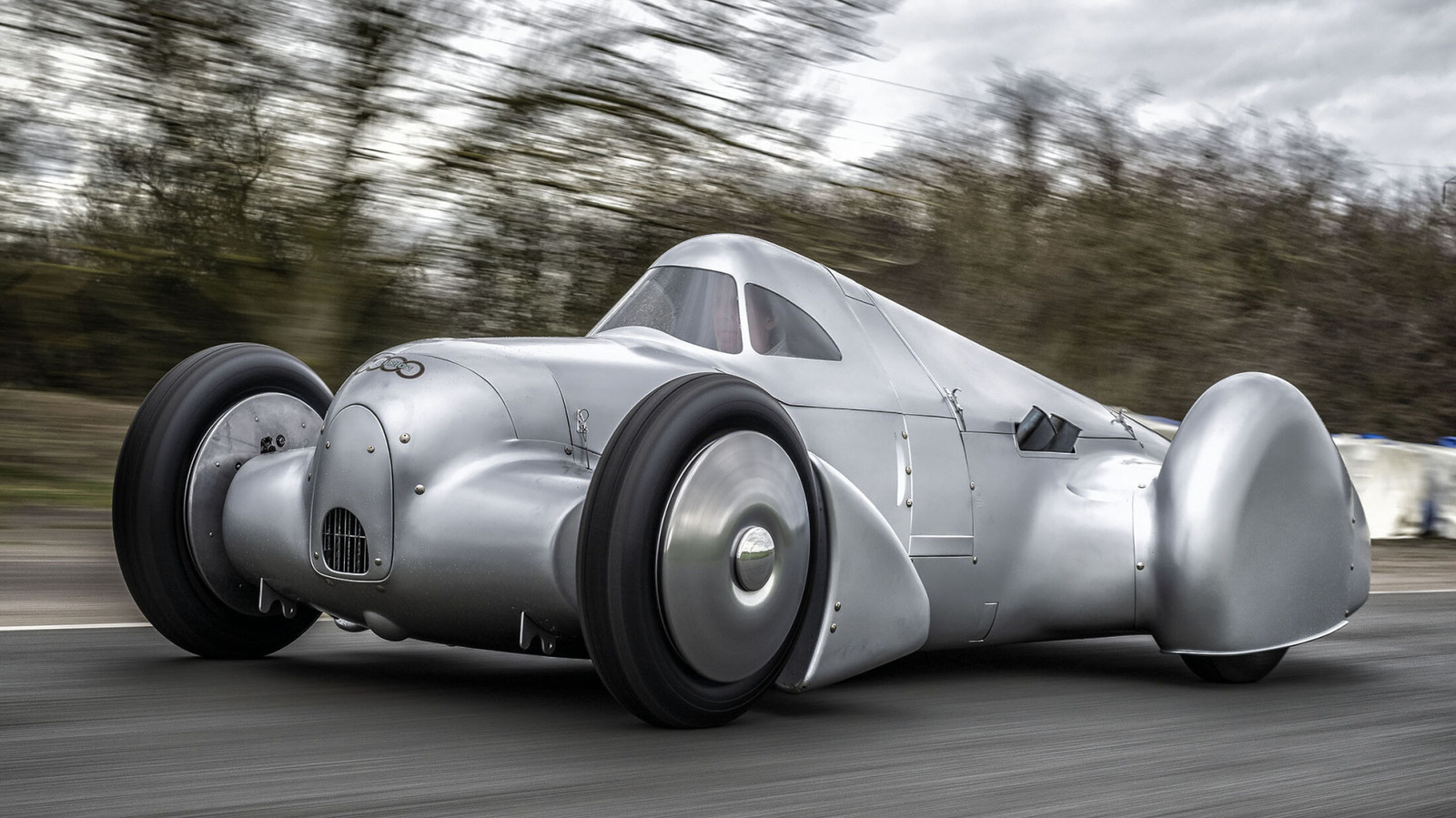
Audi Revives A 1930s Design For Beastly New V16-Engined Supercar


Audi has recently unveiled a new supercar with a V16 engine, but it is far from a “new” car. Instead, Audi has recreated one of the most renowned cars from its past life as the German brand Auto Union, which began with the merger of the DKW, Horch, Wanderer, and Audi brands. Its logo is made up of the four interlocking circles that represent the merged brands, the same cool vintage car logo used on today’s Audis, a brand you might not realize is owned by Volkswagen

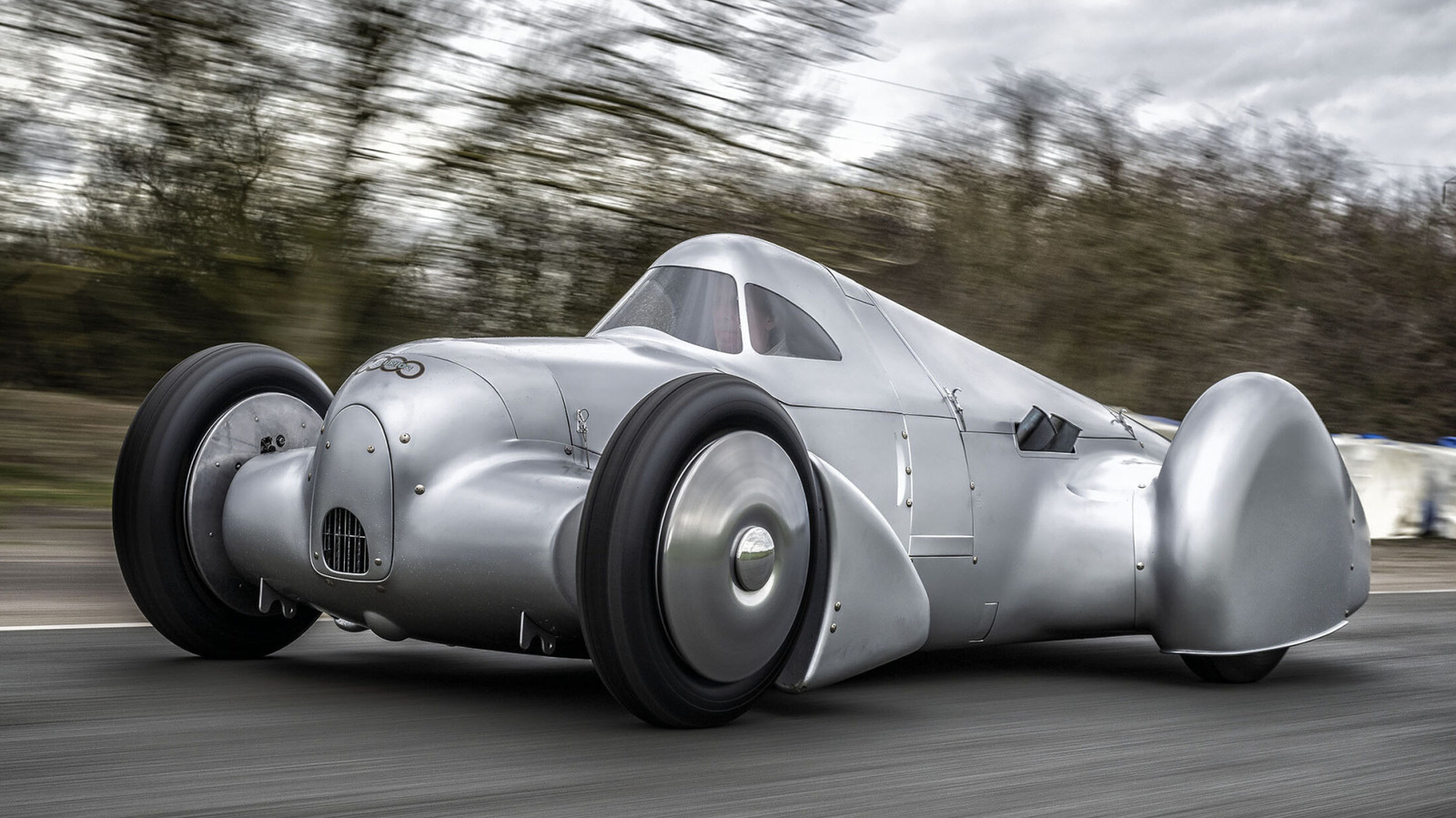
Seen above is the Auto Union Lucca, a car originally designed in the 1930s to set speed records on both tracks and the superhighways that were being built at the time. The Auto Union Lucca went out for a run on the autostrada near Lucca, Italy on February 15, 1935. There, it set a record average speed for the flying mile of 199.005 mph (320.267 km/h), while the car also hit a top speed of 203.173 mph (326.975 km/). 

This new version of the Lucca was created by the British firm Crosthwaite & Gardiner over three years, based on historical documents and photographic evidence. Every part of the Lucca was made by hand by these specialists, so this is likely a project you should not try at home. During the build, the completed body underwent wind tunnel testing, which showed that the Lucca has a 0.43 drag coefficient, spectacular for the 1930s and still decent even by today’s measurements. The closed bodywork led the press of the day to call it “Rennlimousine,” or “racing sedan.”  

What should you know about the Lucca’s V16 engine?

The V16 engine that sits in a mid-engine position behind the Lucca’s driver is not the same version as the one that powered it during its original record run. Instead of the 5.0-liter engine that was used on that day in February 1935, the 6.0-liter engine from the later 1936 Auto Union Type C was used. This was done to improve engine reliability, as the 5.0-liter engine could have suffered from heat-related problems during its demonstration runs. As it is, the more dependable 6.0-liter version of the V16 has no visual differences from the failure-prone 5.0-liter engine. The car’s ventilation system was also upgraded.

The Lucca’s engine is fitted with a supercharger that compresses the intake air before sending it to the car’s 16 cylinders. It runs on a fuel blend of 40% premium unleaded, 50% methanol, and 10% toluene. While earlier versions of this engine started out with 343 horsepower, the current 6.0-liter version has an output of 520 PS or 512.886 horsepower at 4,500 rpm. The curb weight of the entire car is 2,116 pounds, while measuring 66.9 inches wide, 47.2 inches high, and 179.9 inches long.

As a vehicle built with a single specific objective in mind, the Auto Union Lucca compares well with the later 1984-87 Audi Sport Quattro as a one of the most intense homologation special cars in history. While the Lucca was meant to be the apex speed-record predator, the Sport Quattro fulfilled its role as the ultimate rally weapon.

What else should you know about the Lucca’s speed record run?

The Auto Union Lucca’s run near its namesake town, where its recreation was initially shown, was not the first place where the 16-cylinder Auto Union was slated to show its capabilities. It was originally intended to take place in Gyón, Hungary, but a combination of bad weather plus a mechanical failure put an end to the run. The next location for the Lucca’s speed record attempt was supposed to happen farther south, near Milan, Italy. Snow on the roads there caused another cancellation. Finally, a wide, straight, grippy, and flat location about five kilometers long was found on the Italian autostrada between Florence and Viareggio. This would be the place, a significant distance south of Milan and very close to Lucca, that would give this special-purpose car its name.

After a day devoted to testing various setups on the car, it was time for the Auto Union Lucca to show its capabilities. With the legendary driver Hans Stuck in control, and many thousands of onlookers watching the event, the Lucca set its two records. An average of two runs in opposite directions led to the Lucca claiming a flying-start mile record, while it took the top-speed record on the way back. The Lucca would now be known as the “fastest road racing car in the world.” 

There is a way that you can see the Auto Union Lucca in action this summer. It will make its first public appearance while moving at this year’s Goodwood Festival of Speed, held from July 9 to 12, 2026.


Source link

Leave a Reply

Subscribe to Our Newsletter

Get our latest articles delivered straight to your inbox. No spam, we promise.

Recent Reviews


The Windows Insider Program is about to get much easier

Ed Bott / Elyse Betters Picaro / ZDNET

Follow ZDNET: Add us as a preferred source on Google.


ZDNET’s key takeaways

  • Microsoft is making the Insider Program less complicated.
  • Beta channel will be a more reliable preview of the next retail release.
  • Other changes will allow testers to quickly enable/disable new features.

Last month, Microsoft took official notice of its customers’ many complaints about Windows 11. Pavan Davaluri, the executive vice president who runs the Windows and Devices group, promised sweeping changes to Windows 11. Today, the company announced the first of those changes in a post authored by Alec Oot, who’s been the principal group product manager for the Windows Insider Program since January 2024.

Those changes will streamline the Insider program, which has lost sight of its original goals in the past few years. (For a brief history of the program and what had gone wrong, see my post from last November: “The Windows Insider Program is a confusing mess.”)

Also: If Microsoft really wants to fix Windows 11, it should do these four things ASAP

If you’re currently participating in the Windows Insider Program, these are meaningful changes. Here’s what you can expect.

Simplifying the Insider channel lineup

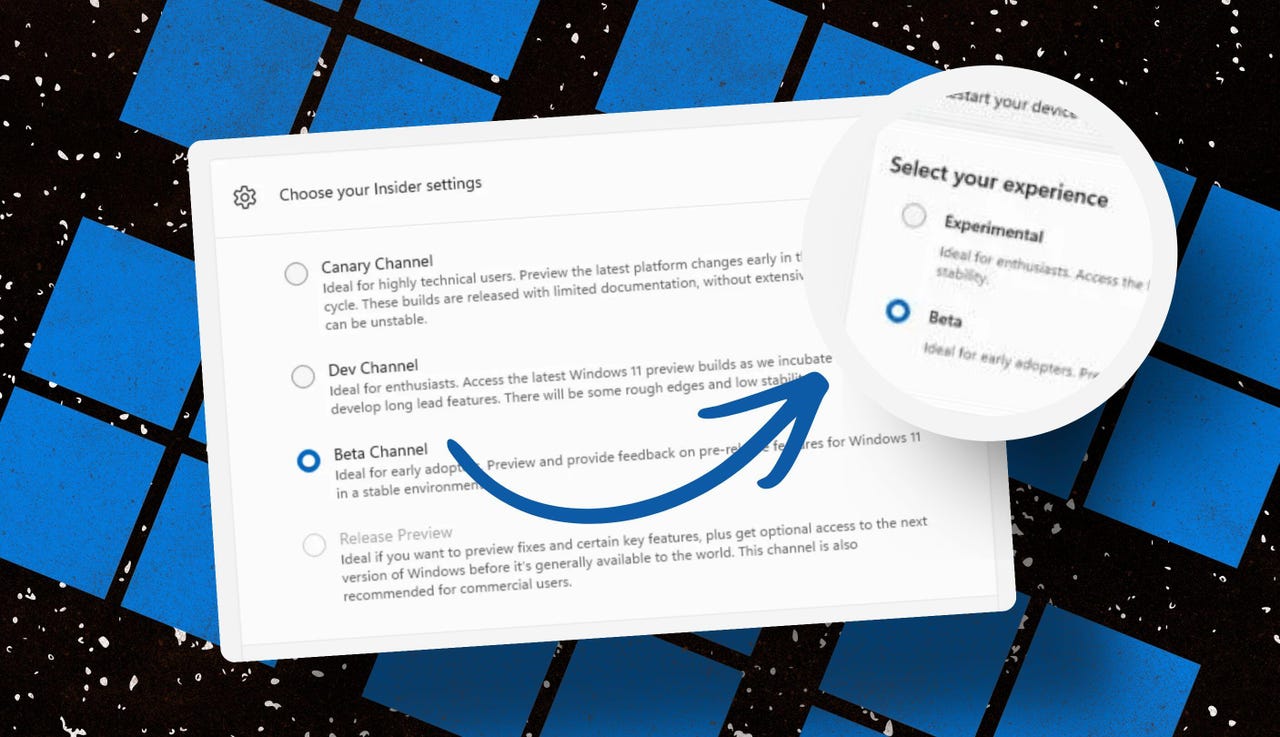
Throughout the Windows 11 era, signing up for the Insider program has required choosing one of four channels using a dialog in Windows Settings. Here’s what those options look like today on one of my test PCs.

insider-program-channels-lineup-old

The current Insider channel lineup is confusing, to say the least.

Screenshot by Ed Bott/ZDNET

Which channel should you choose? As the company admitted in today’s post, “the channel structure became confusing. It was not clear what channel to pick based on what you wanted to get out of the program.”

The new lineup consists of two primary channels: Experimental and Beta. The Release Preview channel will still be available, primarily for the benefit of corporate customers who want early access to production builds a few days before their official release. That option will be available under the Advanced Options section.

windows-insider-channel-lineup-new

This simplified lineup is easier to follow. Beta is the upcoming retail release, Experimental is for the adventurous.

Screenshot courtesy of Microsoft

Here’s Microsoft’s official description of what’s in each channel now, with the company’s emphasis retained:

  • Experimental replaces what were previously the Dev and Canary channels. The name is deliberate: you’re getting early access to features under active development, with the understanding that what you see may change, get delayed, or not ship at all. We’ve heard your feedback that you want to access and contribute to features early in development and this is the channel to do that.
  • Beta is a refresh of the previous Beta Channel and previews what we plan to ship in the coming weeks. The big change: we’re ending gradual feature rollouts in Beta. When we announce a feature in a Beta update and you take that update, you will have that feature. You may occasionally see small differences within a feature as we test variations, but the feature itself will always be on your device.

These changes will apply to the Windows Insider Program for Business as well.

Offering a choice of platforms

For those testers who want to tinker with the bleeding edge of Windows development, a few additional options will be available in the Experimental channel. These advanced options will allow you to choose from a platform that’s aligned to a currently supported retail build. Currently, that’s Windows 11 version 25H2 or 26H1, with the latter being exclusively for new hardware arriving soon with Snapdragon X2 Arm chips.

Also: Microsoft account vs. local account: How to choose

There will also be a Future Platforms option, which represents a preview build that is not aligned to a retail version of Windows. According to today’s announcement, this option is “aimed at users who are looking to be at the forefront of platform development. Insiders looking for the earliest access to features should remain on a version aligned to a retail build.”

windows-insider-advanced-options-new

The Future Platforms option is the equivalent of the current Canary channel

Screenshot courtesy of Microsoft

Minimizing the chaos of Controlled Feature Rollout

Last month, I urged Microsoft to stop using its Controlled Feature Rollout technology, especially for builds in the Beta channel. Apparently, someone in Redmond was listening.

One of the most common questions we receive from Insiders is “why don’t I have access to a feature that’s been announced in a WIP blog?” This is usually due to a technology called Controlled Feature Rollout (CFR), a gradual process of rolling out new features to ensure quality before releasing to wider audiences. These gradual rollouts are an industry standard that help us measure impact before releasing more broadly. But they also make your experience unpredictable and often mean you don’t get the new features that motivated many of you to join the Insider program to begin with.

Moving forward, Insider builds in the Beta channel will no longer suffer from this gradual rollout of features. Meanwhile, the company says, “Insiders in the Experimental channel will have a new ability to enable or disable specific features via the new Feature Flags page on the Windows Insider Program settings page.”

windows-insider-feature-flags

Builds in the Experimental channel will include the option to turn new features on or off.

Screenshot courtesy of Microsoft

Not every feature will be available from this list, but the intent is to add those flags for “visible new features” that are announced as part of a new Insider build.

Making it easier to change channels

The final change announced today is one I didn’t see coming. Historically, leaving the Windows Insider Program or downgrading a channel (from Dev to Beta, for example) has required a full wipe and reinstall. That’s a major hurdle and a big impediment to anyone who doesn’t have the time or technical skills to do that sort of migration.

Also: Why Microsoft is forcing Windows 11 25H2 update on all eligible PCs

Beginning with the new channel lineup, it should be easier to change channels or leave the program without jumping through a bunch of hoops.

To make this a more streamlined and consistent experience, we’re making some behind the scenes changes to enable Insider builds to use an in-place upgrade (IPU) to hop between versions. This will allow in most cases Insiders to move between Experimental, Beta, and Release Preview on the same Windows core version, or leave the program without a clean install. An IPU takes a bit more time than your normal update but migrates your apps, settings, and data in-place.

If you’ve chosen one of the future platforms from the Experimental channel, those options don’t apply. To move back to a supported retail platform, you’ll need to do a clean install.

Also: Apple, Google, and Microsoft join Anthropic’s Project Glasswing to defend world’s most critical software

The upshot of all these changes should make things a lot clearer for anyone trying to figure out what’s coming in the next big feature update. Beta channel updates, for example, should offer a more accurate preview of what’s coming in the next big feature update, so over the next month or two we should get a better picture of what’s coming in the 26H2 release, due in October.

When can we start to see those changes rolling out to the general public? Stay tuned.


Source link