ChatGPT Helped Plan FSU Shooting, Florida Officials Say


In April 2025, a man opened fire on Florida State University’s campus, killing two adults and injuring six others. The shooter faces charges of murder and attempted murder. Now, Florida officials are investigating OpenAI, the creator of the chatbot ChatGPT, to determine whether the company should be criminally held responsible as well. 

Florida Attorney General James Uthmeier said in an announcement on April 9 that officials “learned that ChatGPT may likely have been used to assist the murderer” in the shooting. 

“As big tech rolls out these technologies, they should not, they cannot, put our safety and security at risk,” Uthmeier added.

On Tuesday, Uthmeier launched a criminal investigation into OpenAI and ChatGPT. 

AI Atlas

(Disclosure: Ziff Davis, CNET’s parent company, filed a lawsuit against OpenAI in 2025, alleging it infringed Ziff Davis copyrights in training and operating its AI systems.)

Although ChatGPT and other chatbots have been involved in lawsuits over alleged involvement in deaths and harm, this marks the first time that ChatGPT and OpenAI are the subject of a criminal investigation.  

An OpenAI representative didn’t immediately respond to a request for comment.

“Last year’s mass shooting at Florida State University was a tragedy, but ChatGPT is not responsible for this terrible crime,” a spokesperson for the company told NPR.

The spokesperson said that ChatGPT “provided factual responses to questions with information that could be found broadly across public sources on the internet, and it did not encourage or promote illegal or harmful activity.”

Alleged advice on gun type, ammo, time and place

A criminal investigation is conducted by law enforcement and public officials to determine who is criminally liable for a crime. During an April 21 press conference, Uthmeier said that officials determined the criminal investigation was necessary after discovering that “ChatGPT offered significant advice to the shooter before he committed such heinous crimes.” 

“The communication between ChatGPT and the shooter revealed that the chatbot advised the shooter on what type of gun to use, on which ammo went with which gun, on whether or not a gun would be useful in short range,” Uthmeier said during the press conference, adding that the chatbot also allegedly gave advice on what time of day and what area of campus would result in the shooter coming into contact with more people. 

“My prosecutors have looked at this, and they’ve told me, if it was a person on the other end of that screen, we would be charging them with murder,” Uthmeier said. 

Sam Altman, a white man with graying dark hair, sits in front of a microphone.

OpenAI CEO Sam Altman testifies before a US Senate committee in May 2025.

Photo by Demetrius Freeman/The Washington Post via Getty Images

What’s next?

Florida law states that the “aider and abettor” is as criminally responsible for a crime as the perpetrator. However, because ChatGPT is not a person, Uthmeier said that this is “uncharted territory,” but Florida officials still want to determine if OpenAI has any culpability in the crime.   

Uthmeier said that the Office of Statewide Prosecution has subpoenaed OpenAI for multiple policies, employee information and information relating to the Florida State University shooting.

Other lawsuits

Although this is the first time ChatGPT and OpenAI have been the focus of a criminal investigation, the company and others that have developed chatbots are no strangers to lawsuits. 

The parents of a 23-year-old man who died by suicide in July of 2025 sued OpenAI late that year in a wrongful death lawsuit, claiming the chatbot worsened his depression and pressured him into suicide.

In October 2025, OpenAI announced that ChatGPT was updated “to better recognize and support people in moments of distress.”

Google’s Gemini was recently named in a similar lawsuit after the family of a 36-year-old man who died by suicide said the chatbot coached him through it. 

In response to the lawsuit, Google said, in part, that “Gemini is designed to not encourage real-world violence or suggest self-harm,” later adding: “In this instance, Gemini clarified that it was AI and referred the individual to a crisis hotline many times.”

Artificial Intelligence chatbot stock photo

Pew Research Center surveyed 1,458 US teens in 2025 and found that 64% of them used a chatbot.

Andriy Onufriyenko / Moment / Getty Images

Both lawsuits are still unresolved. 

In response to Florida’s probe, lawyers representing one of the victims of the FSU shooting said they plan to “file suit against ChatGPT, and its ownership structure, very soon, and will seek to hold them accountable for the untimely and senseless death of our client.”

A spokesperson for OpenAI told WCTV: “Our hearts go out to everyone affected by this devastating tragedy. After learning of the incident in late April 2025, we identified a ChatGPT account believed to be associated with the suspect, proactively shared this information with law enforcement and cooperated with authorities. We build ChatGPT to understand people’s intent and respond in a safe and appropriate way, and we continue improving our technology.”

If you or someone you know is in immediate danger, call 911. If you’re struggling with negative thoughts or suicidal feelings, resources are available to help. In the US, call the National Suicide Prevention Lifeline at 988. 


Source link

Leave a Reply

Subscribe to Our Newsletter

Get our latest articles delivered straight to your inbox. No spam, we promise.

Recent Reviews


The Windows Insider Program is about to get much easier

Ed Bott / Elyse Betters Picaro / ZDNET

Follow ZDNET: Add us as a preferred source on Google.


ZDNET’s key takeaways

  • Microsoft is making the Insider Program less complicated.
  • Beta channel will be a more reliable preview of the next retail release.
  • Other changes will allow testers to quickly enable/disable new features.

Last month, Microsoft took official notice of its customers’ many complaints about Windows 11. Pavan Davaluri, the executive vice president who runs the Windows and Devices group, promised sweeping changes to Windows 11. Today, the company announced the first of those changes in a post authored by Alec Oot, who’s been the principal group product manager for the Windows Insider Program since January 2024.

Those changes will streamline the Insider program, which has lost sight of its original goals in the past few years. (For a brief history of the program and what had gone wrong, see my post from last November: “The Windows Insider Program is a confusing mess.”)

Also: If Microsoft really wants to fix Windows 11, it should do these four things ASAP

If you’re currently participating in the Windows Insider Program, these are meaningful changes. Here’s what you can expect.

Simplifying the Insider channel lineup

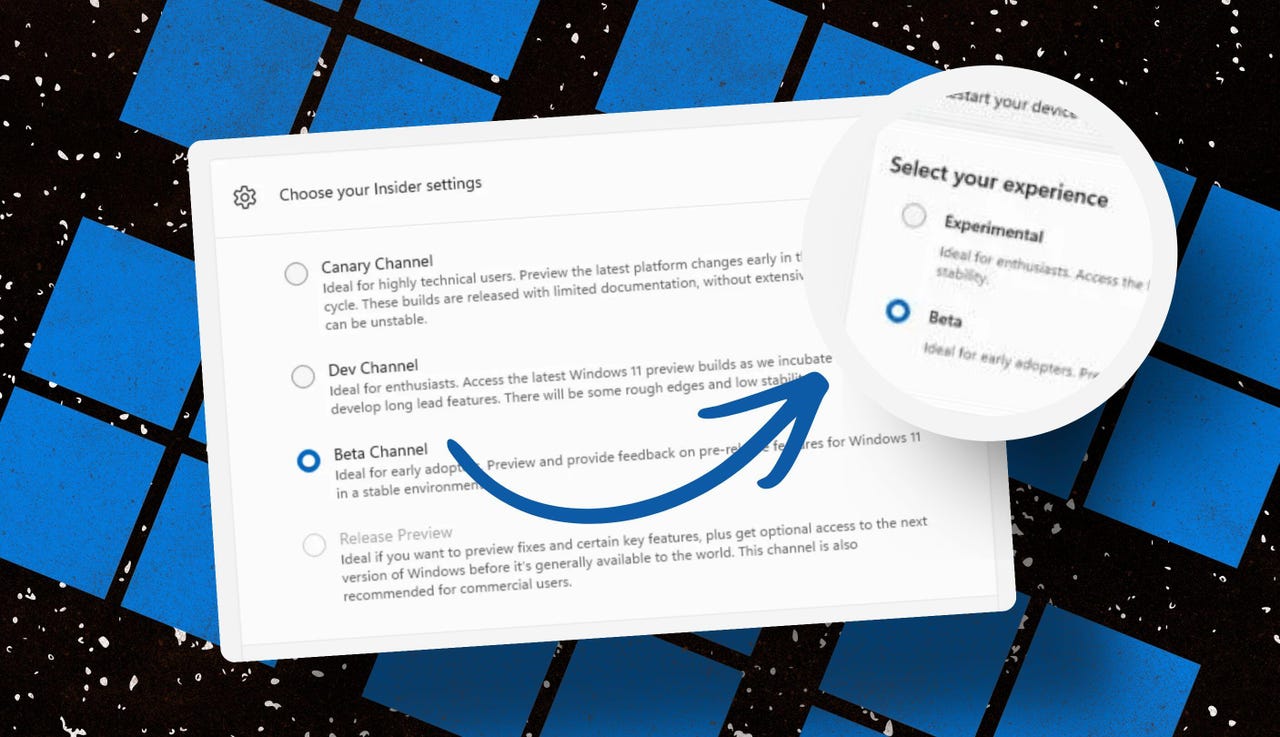
Throughout the Windows 11 era, signing up for the Insider program has required choosing one of four channels using a dialog in Windows Settings. Here’s what those options look like today on one of my test PCs.

insider-program-channels-lineup-old

The current Insider channel lineup is confusing, to say the least.

Screenshot by Ed Bott/ZDNET

Which channel should you choose? As the company admitted in today’s post, “the channel structure became confusing. It was not clear what channel to pick based on what you wanted to get out of the program.”

The new lineup consists of two primary channels: Experimental and Beta. The Release Preview channel will still be available, primarily for the benefit of corporate customers who want early access to production builds a few days before their official release. That option will be available under the Advanced Options section.

windows-insider-channel-lineup-new

This simplified lineup is easier to follow. Beta is the upcoming retail release, Experimental is for the adventurous.

Screenshot courtesy of Microsoft

Here’s Microsoft’s official description of what’s in each channel now, with the company’s emphasis retained:

  • Experimental replaces what were previously the Dev and Canary channels. The name is deliberate: you’re getting early access to features under active development, with the understanding that what you see may change, get delayed, or not ship at all. We’ve heard your feedback that you want to access and contribute to features early in development and this is the channel to do that.
  • Beta is a refresh of the previous Beta Channel and previews what we plan to ship in the coming weeks. The big change: we’re ending gradual feature rollouts in Beta. When we announce a feature in a Beta update and you take that update, you will have that feature. You may occasionally see small differences within a feature as we test variations, but the feature itself will always be on your device.

These changes will apply to the Windows Insider Program for Business as well.

Offering a choice of platforms

For those testers who want to tinker with the bleeding edge of Windows development, a few additional options will be available in the Experimental channel. These advanced options will allow you to choose from a platform that’s aligned to a currently supported retail build. Currently, that’s Windows 11 version 25H2 or 26H1, with the latter being exclusively for new hardware arriving soon with Snapdragon X2 Arm chips.

Also: Microsoft account vs. local account: How to choose

There will also be a Future Platforms option, which represents a preview build that is not aligned to a retail version of Windows. According to today’s announcement, this option is “aimed at users who are looking to be at the forefront of platform development. Insiders looking for the earliest access to features should remain on a version aligned to a retail build.”

windows-insider-advanced-options-new

The Future Platforms option is the equivalent of the current Canary channel

Screenshot courtesy of Microsoft

Minimizing the chaos of Controlled Feature Rollout

Last month, I urged Microsoft to stop using its Controlled Feature Rollout technology, especially for builds in the Beta channel. Apparently, someone in Redmond was listening.

One of the most common questions we receive from Insiders is “why don’t I have access to a feature that’s been announced in a WIP blog?” This is usually due to a technology called Controlled Feature Rollout (CFR), a gradual process of rolling out new features to ensure quality before releasing to wider audiences. These gradual rollouts are an industry standard that help us measure impact before releasing more broadly. But they also make your experience unpredictable and often mean you don’t get the new features that motivated many of you to join the Insider program to begin with.

Moving forward, Insider builds in the Beta channel will no longer suffer from this gradual rollout of features. Meanwhile, the company says, “Insiders in the Experimental channel will have a new ability to enable or disable specific features via the new Feature Flags page on the Windows Insider Program settings page.”

windows-insider-feature-flags

Builds in the Experimental channel will include the option to turn new features on or off.

Screenshot courtesy of Microsoft

Not every feature will be available from this list, but the intent is to add those flags for “visible new features” that are announced as part of a new Insider build.

Making it easier to change channels

The final change announced today is one I didn’t see coming. Historically, leaving the Windows Insider Program or downgrading a channel (from Dev to Beta, for example) has required a full wipe and reinstall. That’s a major hurdle and a big impediment to anyone who doesn’t have the time or technical skills to do that sort of migration.

Also: Why Microsoft is forcing Windows 11 25H2 update on all eligible PCs

Beginning with the new channel lineup, it should be easier to change channels or leave the program without jumping through a bunch of hoops.

To make this a more streamlined and consistent experience, we’re making some behind the scenes changes to enable Insider builds to use an in-place upgrade (IPU) to hop between versions. This will allow in most cases Insiders to move between Experimental, Beta, and Release Preview on the same Windows core version, or leave the program without a clean install. An IPU takes a bit more time than your normal update but migrates your apps, settings, and data in-place.

If you’ve chosen one of the future platforms from the Experimental channel, those options don’t apply. To move back to a supported retail platform, you’ll need to do a clean install.

Also: Apple, Google, and Microsoft join Anthropic’s Project Glasswing to defend world’s most critical software

The upshot of all these changes should make things a lot clearer for anyone trying to figure out what’s coming in the next big feature update. Beta channel updates, for example, should offer a more accurate preview of what’s coming in the next big feature update, so over the next month or two we should get a better picture of what’s coming in the 26H2 release, due in October.

When can we start to see those changes rolling out to the general public? Stay tuned.


Source link