
Chevrolet Built A 400 HP Family Car All The Way Back In 1964


For some muscle car fans, the Johnson administration years mark the apex of Detroit brawn, before a wave of emissions controls washed over the automotive sector. In 1964, Chevrolet was doing something that almost feels unthinkable today: Offering a 400-hp engine in what was, for all intents and purposes, an ordinary family car. This wasn’t a sleek coupe or a stripped-down, limited-edition sports package — it was part of GM’s mainstream lineup, spanning sedans and wagons. We’re talking about the 1964 Chevrolet Bel Air station wagon — the 5th-generation specifically — a veritable “lead sled” if there ever was one. 

At the center of it all was the rare and special 409 cubic-inch V8, an engine born of stock car racing and refined through early ’60s drag-strip sprints. Sure, the Bel Air wasn’t among the most powerful muscle cars ever, but it’s striking that something so brutish was meant to cart children and groceries around. Even more remarkable is how accessible it was. Chevrolet didn’t confine the 409 to nimble coupes or performance trims — it could be ordered in full-size models like the Bel Air, Impala, and Biscayne. The result? A brief window into a time when automakers embraced comfort and maximalism, dropping big racing hardware into suburban shuttles. If we take a step back and look at the power offered by those massive big-block 409 W-engines, paired with an unassuming wagon body, it could almost be considered a sleeper — a wolf in sheep’s clothing.

A true sleeper

Surely some owners with a heavy foot took advantage of the Bel Air’s peak engine horsepower from time to time. But with a curb weight of 4,043 pounds — before a full passenger load of up to six — we can only imagine the terror of a white-knuckled emergency stop with those old drum brakes. Given the car’s heft, it makes sense that GM engineers would want to offer a beefy V8 to move such a behemoth, even if the 409 version is a bit overkill. This grocery-getter had legitimate muscle-car credentials, with its L31 motor putting out 425 lb-ft of torque to get it off the line, paired with a 4-speed synchro-mesh transmission. 

When the pedal hit the metal, the butterflies on a large aluminum 4-barrel carburetor would open wide, feeding the high-compression 11.0:1 motor. Unlike the weaker 300 or 340-hp versions, the 409 option came with what GM called a “special” camshaft, tough-surface crankshaft bearings, and reinforced pistons to withstand the violence. All of this worked in sync to deliver surprisingly quick acceleration for the era. It is estimated that the car could hit 0-60 in around 6.4 seconds, with a quarter-mile drag time of 14.8 seconds. Sure, it couldn’t hang with a Corvette of the same model year — which had a 0-60 time of 5.6 seconds — but it was a family car, after all. Today, surviving examples of these Bel Air sleeper wagons are rare, relatively costly, and collectible — rightly so! 


Source link

Leave a Reply

Subscribe to Our Newsletter

Get our latest articles delivered straight to your inbox. No spam, we promise.

Recent Reviews


Payments are at the heart of any accounting and bookkeeping firm. But what happens when your clients don’t pay on time? The cost isn’t just financial. There’s often an emotional toll, a drain on time, and a real barrier to growth.

We surveyed 800 small-to-medium business (SMB) decision-makers across Australia and New Zealand to better understand the state of late payments today, and the findings are powerful.

The GoCardless Pursuing Payments 2025 report uncovers the true impact of late payments and what you can do to break the cycle.

1. The pursuit of payments is still a time drain for many businesses

Over a quarter of small businesses report spending up to an hour every single week just chasing down late payments.

Think about that – a full hour of every work week, gone. That’s an hour that could be spent onboarding new clients, innovating, or simply focusing on what you do best. Instead, it’s lost to the frustrating and awkward task of debt collection.

Unfortunately, the problem isn’t getting any better. Nearly half of SMBs are waiting longer for payments now than they were just 12 months ago (48% in Australia and 51% in New Zealand). And with rising living costs, it’s no surprise that 59% are worried this trend will only get worse.

2. Late payments take a financial and emotional toll

While the time sink is bad enough, the financial and emotional impact can be far-reaching.

41% of Australian SMBs and 35% of New Zealand SMBs report that their payments are, on average, more than 14 days overdue. And these delayed payments inflict a substantial financial hit with 15% of SMBs in both countries losing up to $1,000 every month.

Our research also showed the heavy emotional cost. Chasing money creates tension with customers, causes stress, and makes business owners feel anxious and frustrated. It’s a vicious cycle that can distract from your day-to-day business and core purpose.

3. Bad cash flow is bad for growth

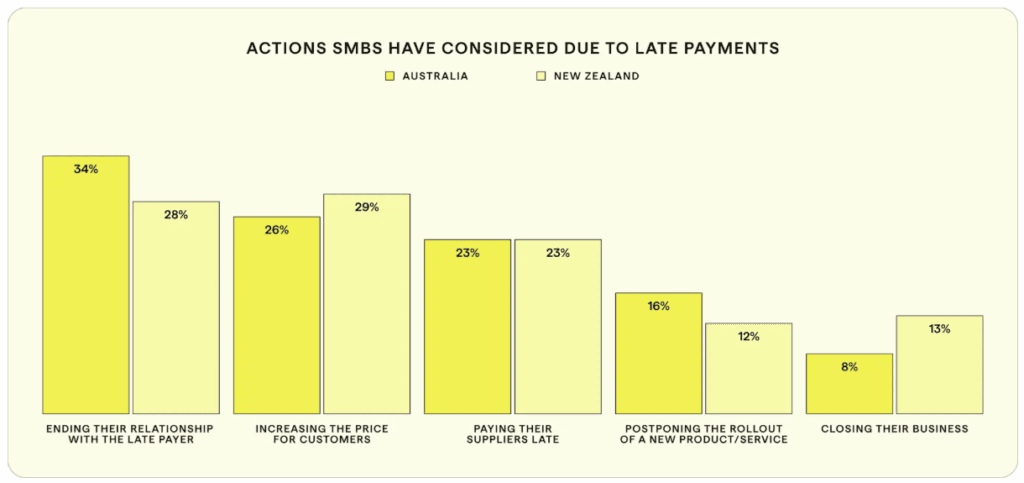
Delayed payments often mean poor cash flow and can result in businesses having to put a hold on future plans. Here are a few growth-stunting actions Australia and New Zealand SMBs have been forced to take due to late payments:

  • Ending their relationship with the late payer
  • Increasing the price for their customers
  • Being late paying their suppliers
  • Postponing the rollout of a new product or service
  • Closing their business

4. Late payments don’t have to be inevitable

So, what’s the solution? The good news is that SMBs are hungry for change. Two-thirds of the businesses we surveyed said they’re interested in using new technology to get a handle on late payments.

That’s where technology comes in. By adopting modern methods like bank payments with GoCardless (think, payments that are made from one bank account directly to another, including BECS Direct Debit and PayTo) you can create, schedule and collect payments for your client invoices on their due date – all from your existing Xero setup.

It’s time to put a stop to the endless admin, reduce costly payment failures, and get paid up to 47% faster. Connect GoCardless to Xero to automate invoice payments, and take back control of your business’s cash flow and growth. 

Was this article helpful?

YesNo


Source link