Consumer Reports’ Pick For Best Car In 2000 Is Now An Incredibly Affordable Model


Time waits for no one, not even vehicles. What was once a cutting-edge, top-of-the-line ride can quickly become just another way to get around. Case in point, the 2000 Mercedes-Benz E-320, which was the talk of the town at the turn of the millennium. At the time of its release, Consumer Reports even regarded the then-$50,000 ride as the best car the publication tested that year. More than 25 years on, however, not only has the 2000 E-320 been usurped by newer Mercedes-Benz models in the minds of car enthusiasts, but it has gone from a high-end luxury purchase to a relatively affordable ride.

If you desire a 2000 Mercedes-Benz E-320, you’re in luck, as it has become one of the luxury vehicles you can get for less than a 2026 Honda Civic. Looking at Hagerty, the value for such a ride in good condition, meaning few noticeable flaws and in fine, running shape, is in the neighborhood of $9,500 as of April 2026. That’s on the high end, too, seeing as JD Power puts the average retail price today at around $3,600. Listings on Car Gurus fall between those two numbers, with most examples for sale ranging from around $4,000 to $6,000, with outliers on either end.

In any case, with diligent searching, it’s entirely possible to score a 2000 Mercedes-Benz E-320 for under $10,000 these days, which is a nice discount from its $50,000 MSRP. The question to ask, though, is whether it’s worth buying a nearly 30-year-old car, even at such a low price.

Is buying a used 2000 Mercedes-Benz E-320 even worth it?

Ultimately, there are two ways to look at the notion of buying an E-320 from 2000. On the plus side, it’s a great price, especially considering what you get. Many owners on Cars.com praise its 3.2-liter V6 engine for offering a reasonable balance between power and fuel efficiency, its smooth ride, and longevity. There are plenty of owner reports of the E-320 reaching hundreds of thousands of miles on the odometer and still going strong.

At the same time, it could be more of a headache than it’s worth. While it’s cheap and not one of the used Mercedes-Benz models to avoid at all costs, it’s still a decades-old vehicle that will have been subject to plenty of wear and tear. Consumer Reports‘ findings also indicate that Mercedes-Benz is one of the pricier luxury car brands to maintain over time, which may add to the long-term costs. Not to mention, the E-320 gets around 21 mpg combined, 18 mpg city, and 27 mpg highway, which isn’t undrivable but is certainly low by modern midsized sedan standards. Depending on the price of gas, the cost of these trips to the pump can quickly add up.

Price-wise, at least, the 2000 Mercedes-Benz E-320 has experienced something of a financial fall from grace. Now, it’s a modestly-priced yet still rather beloved piece of history that, while affordable, may not be the best purchase for everyone.


Source link

Leave a Reply

Subscribe to Our Newsletter

Get our latest articles delivered straight to your inbox. No spam, we promise.

Recent Reviews


Payments are at the heart of any accounting and bookkeeping firm. But what happens when your clients don’t pay on time? The cost isn’t just financial. There’s often an emotional toll, a drain on time, and a real barrier to growth.

We surveyed 800 small-to-medium business (SMB) decision-makers across Australia and New Zealand to better understand the state of late payments today, and the findings are powerful.

The GoCardless Pursuing Payments 2025 report uncovers the true impact of late payments and what you can do to break the cycle.

1. The pursuit of payments is still a time drain for many businesses

Over a quarter of small businesses report spending up to an hour every single week just chasing down late payments.

Think about that – a full hour of every work week, gone. That’s an hour that could be spent onboarding new clients, innovating, or simply focusing on what you do best. Instead, it’s lost to the frustrating and awkward task of debt collection.

Unfortunately, the problem isn’t getting any better. Nearly half of SMBs are waiting longer for payments now than they were just 12 months ago (48% in Australia and 51% in New Zealand). And with rising living costs, it’s no surprise that 59% are worried this trend will only get worse.

2. Late payments take a financial and emotional toll

While the time sink is bad enough, the financial and emotional impact can be far-reaching.

41% of Australian SMBs and 35% of New Zealand SMBs report that their payments are, on average, more than 14 days overdue. And these delayed payments inflict a substantial financial hit with 15% of SMBs in both countries losing up to $1,000 every month.

Our research also showed the heavy emotional cost. Chasing money creates tension with customers, causes stress, and makes business owners feel anxious and frustrated. It’s a vicious cycle that can distract from your day-to-day business and core purpose.

3. Bad cash flow is bad for growth

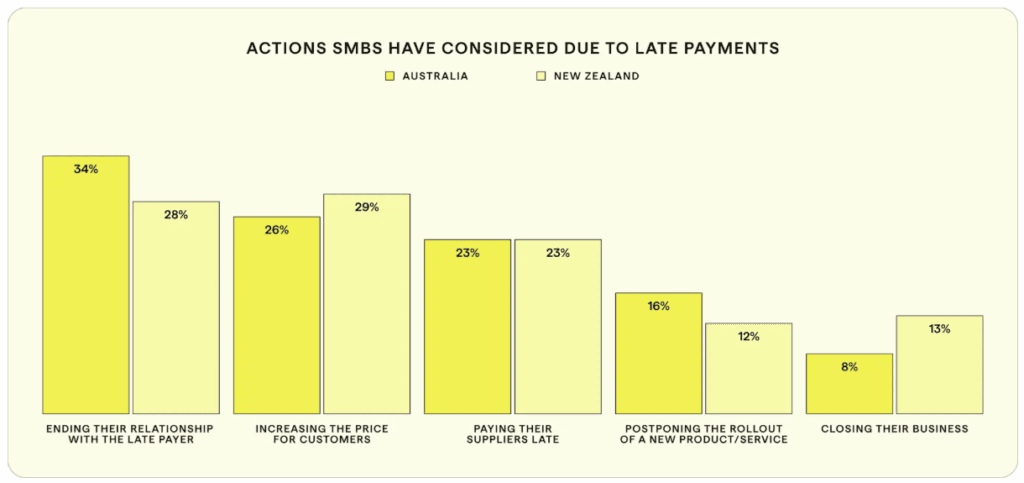
Delayed payments often mean poor cash flow and can result in businesses having to put a hold on future plans. Here are a few growth-stunting actions Australia and New Zealand SMBs have been forced to take due to late payments:

  • Ending their relationship with the late payer
  • Increasing the price for their customers
  • Being late paying their suppliers
  • Postponing the rollout of a new product or service
  • Closing their business

4. Late payments don’t have to be inevitable

So, what’s the solution? The good news is that SMBs are hungry for change. Two-thirds of the businesses we surveyed said they’re interested in using new technology to get a handle on late payments.

That’s where technology comes in. By adopting modern methods like bank payments with GoCardless (think, payments that are made from one bank account directly to another, including BECS Direct Debit and PayTo) you can create, schedule and collect payments for your client invoices on their due date – all from your existing Xero setup.

It’s time to put a stop to the endless admin, reduce costly payment failures, and get paid up to 47% faster. Connect GoCardless to Xero to automate invoice payments, and take back control of your business’s cash flow and growth. 

Was this article helpful?

YesNo


Source link