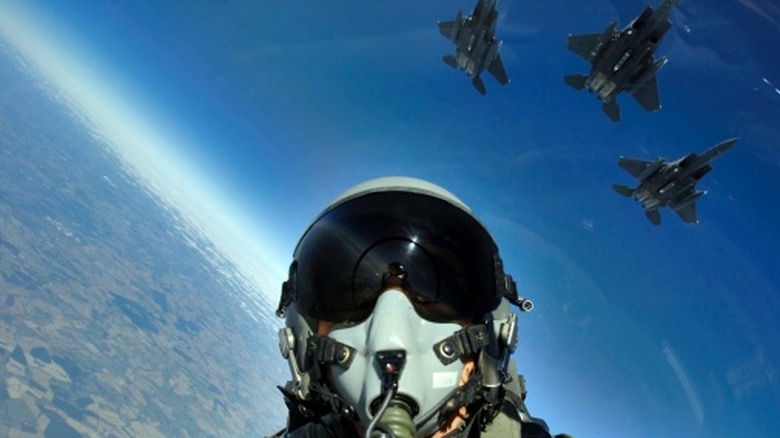
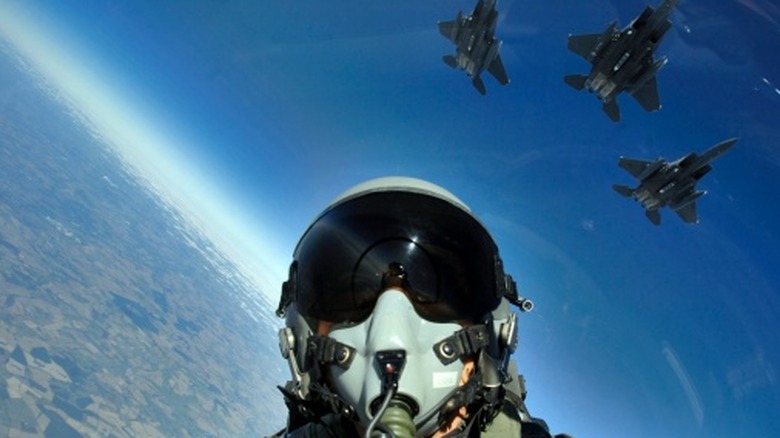
Does The Air Force Pay Pilots More Than Airlines? The Answer Might Be A Surprise


Air Force pilots, who routinely put their lives at risk by flying into hazardous situations, are paid based on their rank (as with all military personnel across all branches), not what they encounter during the course of their duties. An O-1 earns less than $50,000 a year, while an O-4 earns between $75,000 and $100,000. By the time they reach O-7 through O-10, they’ve maxed out at $19,000 a month, or $228,000 annually. 

Meanwhile, private-sector airline pilots aren’t paid by rank but based on free-market demand for their skills. While wages can vary dramatically, the U.S. Bureau of Labor Statistics reports that the average yearly wage for airline pilots, copilots, and flight engineers (as of 2024) was $226,600, and for commercial pilots, almost $123,000 annually. While first-year commercial regional pilots typically make about $85,000, senior captains at major airlines (which have an interesting method for choosing which planes they fly) can rake in $485,500 a year. 

It’s this very disparity in pay that has left the Air Force with a severe shortage of qualified pilots, with some estimates reaching as high as 1,800, even after increasing bonuses to $50,000 a year (maxing out at 12 years for a total of $600,000). That’s on top of benefits like pensions, free healthcare, and basic allowances for both housing (BAH) and a monthly food stipend (BAS). Still, the Air Force is not only finding it hard to recruit new pilots but also to keep those it already has on the team.

Flying the friendly skies earns more
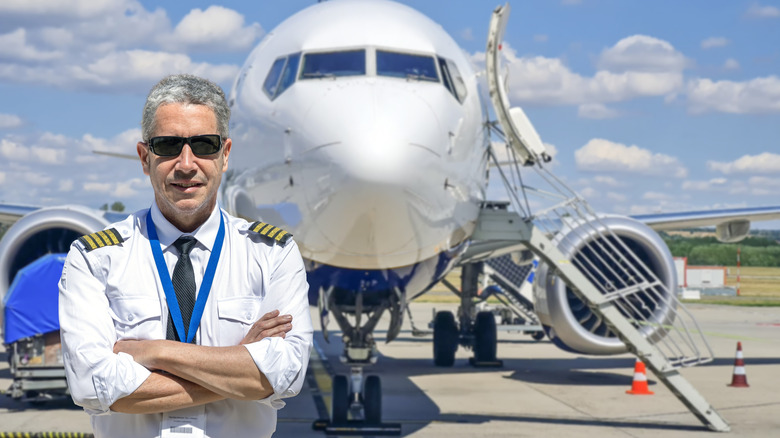
The commercial aviation industry is facing a pilot shortage as well, estimating a shortfall of some 24,000 pilots in 2026. Much like the military, many airlines are offering signing bonuses up to $50,000, retention incentives totaling $100,000, and Delta Air Lines recently increased retirement contributions to 18% – all to keep the pilots they do have. Ironically, in the early days of commercial aviation, most pilots came from the military. As recently as the 1980s, roughly two-thirds of all commercial airline pilots were former military; however, that ratio has dropped in recent years to about one-third.

One might think that pilot pay would be commensurate not just with skill and experience, but also with the planes (and scenarios) they’re flying. For instance, a Lockheed Martin F-35A Lightning II sits around $82.5 million, but an F-35B can soar to $109 million. The stealthy F-22 Raptor costs $143 million but might realistically top $369 million. Those are bargains compared to the B-2 Spirit Stealth Bomber, which, at over $2 billion per plane, makes it the most expensive military aircraft ever made. Meanwhile, passenger planes like Boeing’s 737 and Airbus’s A320 cost between $50 million and $110 million, while Boeing’s 777-9 tops $442 million, effectively putting all these disparate planes at relatively similar price points.

Ultimately, it boils down to desire. If a person is possessed by that quintessential “need for speed,” and is unwaveringly duty-driven and honor-bound to serve the greater good, becoming a fighter pilot is the clear choice. However, if casually shuttling people between Newark and Des Moines without ever evading a missile lock sounds ideal, then a commercial airline pilot career path might offer better earning potential.


Source link

Leave a Reply

Subscribe to Our Newsletter

Get our latest articles delivered straight to your inbox. No spam, we promise.

Recent Reviews


As an ardent, perhaps obsessive, Harry Potter fan, I can’t say I was thrilled when I learned HBO was rebooting the beloved film franchise as a TV show. 

Like millions of other Harry Potter enthusiasts, the books and movies have been a key part of both my adolescence and adulthood, offering a magical refuge from a not-so-dazzling Muggle world. Theme parks, Broadway shows, mega stores and audiobooks have kept the spellbinding story alive not just for my generation, but for younger Potterheads as well. 

But I never thought we’d get an on-screen retelling just a decade and a half after the films wrapped up. What was the point of doing it all again with a brand-new cast, beyond the obvious monetary gain?

Hollywood is stuck in a loop of recycling successful TV shows and movies to make an easy buck. I thought Harry Potter was safe from that phenomenon, at least for a while, given the ongoing relevance of the films. Over the years, I’ve gone to multiple Harry Potter screenings with audiences of all ages, highlighting the franchise’s broad cultural appeal across generations. Surely, there was still room for future generations to take part in something that’s brought us so much joy. 

Despite controversy surrounding author JK Rowling’s views on transgender issues, which run counter to the series’ themes of love, inclusivity and justice, Harry Potter remains a meaningful part of many fans’ lives. Its stories, characters and themes continue to resonate, fostering a sense of connection and belonging for those who have adopted the wizarding world as their own. 

Now, the enchantment of the original films would be supplanted by a shiny new TV franchise. A world that had come to life so vibrantly on screen would be repurposed before the magic had run out. I wasn’t on board with the idea at all.

But recently, something changed. 

As more details began to emerge about the upcoming TV series, I felt myself softening toward the endeavor. Starting later this year, the episodes will be released on HBO and HBO Max over a decade, with each season focusing on one of the seven books for a more in-depth telling of the story than the film adaptations. As much as I love the movies, having more time to delve into side stories and details that didn’t make it on screen the first time doesn’t sound like such a bad idea. 

When HBO dropped the first trailer for Harry Potter and the Philosopher’s Stone this week, I felt a mixture of trepidation and curiosity. Just how familiar — or not — would this reimagined world feel? As I hit play, those feelings quickly gave way to an unexpected excitement. 

In the trailer, we glimpse the loneliness of Harry’s upbringing as he’s tossed in the cupboard under the stairs, reprimanded by his aunt and bullied by his cousin. We hear him lament how little he knew his parents. We see him take in the splendor of Hogwarts with wonder. We watch him light up as he finds joy with new friends. 

The actors playing the golden trio of Harry (Dominic McLaughlin), Ron (Alastair Stout) and Hermione (Arabella Stanton) appear well-suited for their roles, even in the brief glimpses we get of them navigating this enigmatic and enchanting world.

The iconic lightning bolt scar, the calligraphic acceptance letter, the homey Hogwarts Express — it’s all so familiar and yet entirely new. Despite my earlier hesitation, it’s thrilling to be part of this second wave of magic — even if I still see the show as a clear attempt to further profit from a successful franchise. But rather than viewing the TV series as a departure or replacement of the beloved movies, I’m choosing to see it as another way to keep the wizarding world alive through a fresh lens.

If the train is leaving the station, I might as well hop aboard and enjoy the ride. When Harry Potter and the Philosopher’s Stone debuts in December, I’ll be watching, Butterbeer in hand. As Hagrid wisely put it, “What’s comin’ will come, an’ we’ll meet it when it does.”


Source link