
On a spring afternoon in downtown Duluth, Missy Jellison parked a large white van across the street from the sheltered entrance to the city’s bus terminal. She stepped onto the sidewalk, brushed her brown hair off her shoulders, and assessed the scene.
The area attracts people in crisis – some were resting alongside buildings, others were stepping out of a nearby pub. So Jellison came prepared. Her van was packed with medical supplies, safe drug-use kits, hepatitis C tests, clean socks and snacks.
It didn’t take long to spot Dorothy, William and their mutt puppy, Peanut. As the trio ambled down Michigan Street, Jellison approached them. Casually, she inquired about their living situation, if they needed clean syringes and if they had a supply of Narcan to reverse potentially fatal overdoses. If they needed anything, she said, they could visit Harm Reduction Sisters, the nonprofit nearby where Jellison works.
“We’re there all day,” she said. “Stop by if you want.”
Jellison understands this crowd – she spent part of her adulthood struggling with an addiction to methamphetamines. But now, she’s a bridge connecting people in crisis to the resources they need to survive and possibly to heal. She doesn’t push sobriety, but aims to meet people where they’re at, without judgement, and help them find health and balance.
“My goal is to make people feel seen and heard,” Jellison said. “All these people need help.”

‘We are saving lives every day and I know that.’
Not long ago, the idea of harm reduction was considered radical. As the name suggests, it’s not a treatment for substance use disorder but a set of approaches aimed at reducing the negative consequences of drug use, including infections and overdoses, until users can manage a safer, more stable lifestyle. Today, it is largely accepted by medical and public health professionals as a life-saving approach to the addiction crisis.
But over the past year, harm reduction has become a political target tied up with rhetoric around crime-ridden streetscapes and open-air drug use. Directives from President Donald Trump and his appointees threaten to criminalize key harm reduction practices, throwing the future of nonprofits like Harm Reduction Sisters, and the people they serve, into uncertainty.
Harm Reduction Sisters’ founder, Sue Purchase, grew up in Clouquet and Duluth, where she started using alcohol and illegal drugs as a child. She left the region for more than 30 years, sought treatment, and became a nationally-respected advocate for harm reduction. In 2018, she returned to Duluth and founded Harm Reduction Sisters. “I had unfinished business that I needed to address,” she said.
Staffers like Jellison consider themselves front-line responders in a region that has struggled mightily with addiction and poverty. In St. Louis County – the Duluth area north to the Canadian border – about 7% of adults need treatment for substance use disorder, according to the Minnesota Department of Human Services. In the Twin Cities metro, the rate is only slightly higher at 8%.

But Purchase believes that she and her colleagues have made a difference. “We are saving lives every day and I know that,” she said.
The numbers appear to support her. Provisional federal data shows a steep decline in deaths by overdose in St. Louis County over the past three years – the result of multiple efforts and significant investments. In the year leading up to September 2025, overdoses took the lives of 37 people in the county, d0wn from 85 people in the year leading up to April 2023, according to data from the National Center for Health Statistics.
Additionally, a wealth of scholarly research has shown the success of harm reduction methods in reducing the transmission of potentially fatal diseases like HIV and hepatitis C.
Even in Minnesota, the birthplace of the abstinence-centered “Minnesota Model” of recovery that fueled addiction treatment giants like Hazelden Betty Ford, harm reduction methods have taken hold. Most providers in the state now accept, if not embrace, the approach that allows participants to use prescription medications to support their recovery, for instance, or to use legal substances like marijuana.
But despite what they see as clear successes, Purchase and other leaders in the movement worry that policymakers are turning back the clock on addiction treatment to a time before the opioid crisis carved its deadly path across the nation. By threatening key harm reduction practices and pushing an all-or-nothing, abstinence-based approach to addiction, lives could be lost, they say.

Becoming a political target
In July 2025, President Trump signed an executive order titled “Ending Crime and Disorder on America’s Streets.” After decrying the “tens of billions of dollars on failed programs that address homelessness but not its root causes,” the order directed federal agencies to prioritize resources for states and cities that take a hard-line approach, for example by criminalizing “urban camping and loitering.”
The order went on to direct the U.S. Health and Human Services department not to fund “programs that fail to achieve adequate outcomes, including so-called ‘harm reduction’ or ‘safe consumption’ efforts that only facilitate illegal drug use and its attendant harm.”
In a letter dated July 29, 2025, and signed by Art Kleinschmidt, then-SAMHSA principal deputy assistant secretary, the agency further outlined its stance on harm reduction, saying “SAMHSA funds will no longer be used to support poorly defined so-called ‘harm reduction’ activities.” It went on to list supplies and services it would and would not fund.
A SAMHSA spokesperson told MinnPost that “the phrase ‘harm reduction’ has come to conflate practices that are supported by SAMHSA, such as the distribution of lifesaving opioid overdose reversal medications and fentanyl and/or xylazine test strips, with practices that are incompatible with federal law.”

A ‘whatever it takes’ approach
Joy Rucker, co-founder of the Black Harm Reduction Network, said she is deeply concerned about the impact that shifting federal priorities will have on organizations like Harm Reduction Sisters. “That’s all the work we’ve done for over three decades to get those institutions to support the work that we’re doing,” she said. “It’s all been wiped away.”
She sees harm reduction not as a treatment for SUD, but a necessary response to a public health crisis. Harm reduction takes a “whatever it takes” approach by providing safe-use supplies, tests that detect the presence in drugs of dangerous additives, overdose inhibitors like Narcan, and drugs to reduce opioid cravings. The goal is to save lives in any way possible.
For Jellison, the federal shifts hit home. While SAMHSA says it will continue to fund the distribution of overdose inhibitors, test strips, and testing and prevention education around HIV and hepatitis, other items in her van are threatened: safer smoking kits, clean syringes, sterile substances to facilitate safer drug use.
“We need these things to do our job,” Jellison said. “This stuff helps keep people alive.”

Recovery as a continuum
At Harm Reduction Sisters, staff is focused on supporting program participants however they need to be supported. “We’re not saying, ‘You’ve got to get into a treatment program,’” Purchase said. But they’re not opposed to it, either. “If that’s something that people want help with, we facilitate that process.”
Harm reductionists see recovery as a continuum, with no beginning or end. And they realize that even after going through residential treatment, many people struggle to stay sober in the outside world. “If you start using again, I want you to feel like you can come back here. We are not judging you,” Purchase said.
In Duluth and throughout northern Minnesota, her organization has gained traction. What started around Purchase’s kitchen table now employs 18 people, operating from a light-filled office in what was once a Catholic school overlooking downtown. Its $2.25 million budget is supported by private donations and state grants.
For now, Harm Reduction Sisters’ state funding feels secure. Teresa Steinmetz, assistant commissioner of the Department of Human Services’ Behavioral Health Administration, said the nonprofit has “been a well-known partner with the Department of Human Services for many years” doing “pretty amazing work when it comes to harm reduction interactions with the community.”
But in today’s political environment, Purchase said, nothing feels certain. She fears that a federal disavowal of many harm reduction practices could trickle down to state-level funding.
“You can’t really plan on anything,” she said. “The politics of today impact how people trust or believe in [harm reduction].” And a shifting attitude out of Washington “just destabilizes the whole movement.”

‘You messed up. Whatever.’
Jellison believes that harm reduction saved her life. When she was in the depths of addiction, estranged from family and friends, she somehow found her way to Harm Reduction Sisters’ Duluth office.
Staff helped her put her life back together without making abstinence a requirement, and Jellison eventually developed her own form of recovery. “I’ve been off meth for two full years,” she said. But she’s not completely drug-free: “I still smoke weed and dabble in mushrooms.”
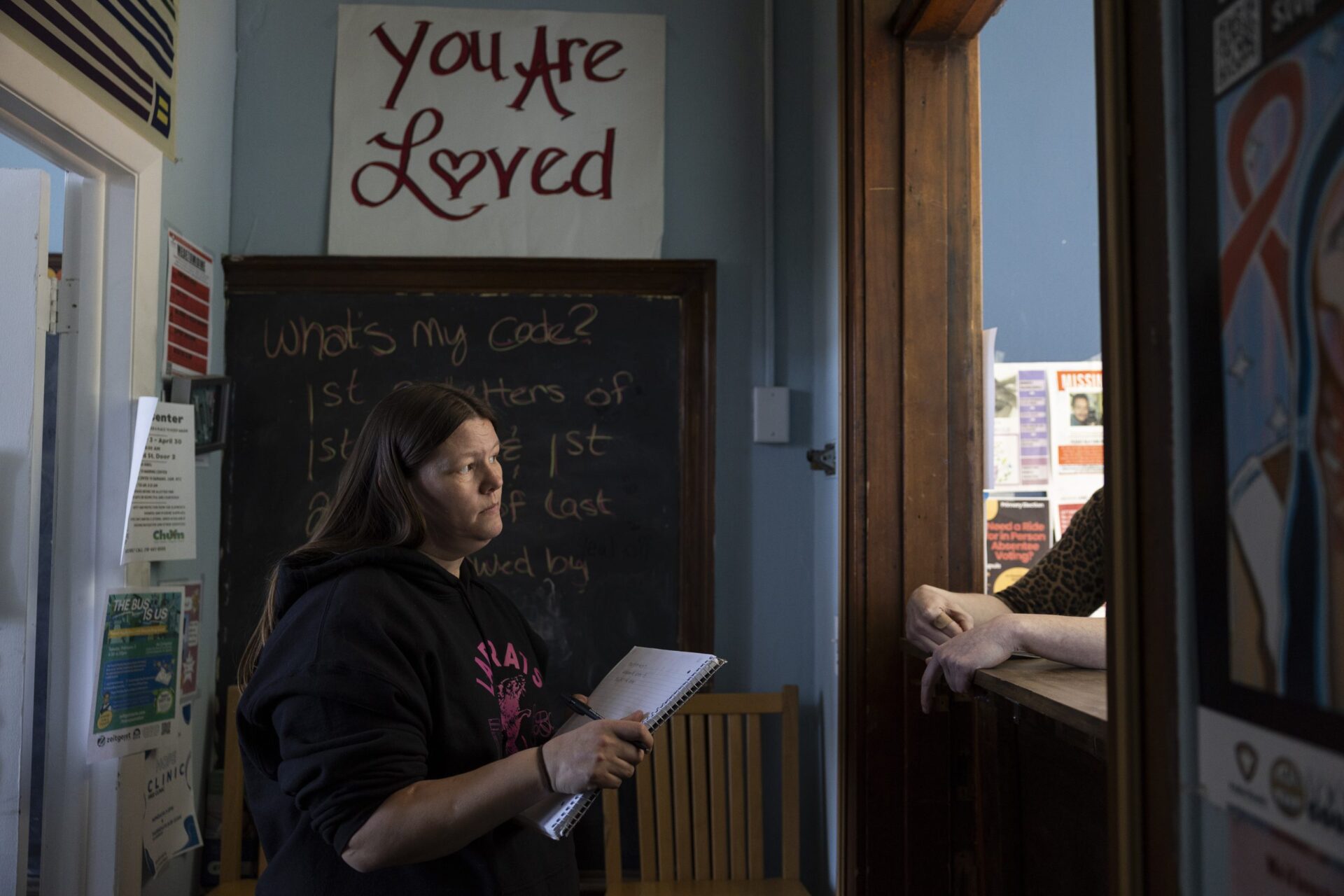
As her life stabilized, Jellison began volunteering at the nonprofit. Now she’s on staff full time. When she’s not driving the van, she delivers safe-use supplies and hands out fresh syringes, advice and Narcan from the office’s busy half-door supply window.
Jellison called the work the best job she’s ever had. “I loved drugs but I love helping people, too. I’ve put my two loves together with this work, and I’m making a difference.” With a regular paycheck, she’s been saving for a down payment on a house big enough for herself and her eight kids.
Delainey Hardy heard about Harm Reduction Sisters in 2021, when she was an IV drug user newly diagnosed with HIV. She grew up on the Leech Lake reservation but spent more and more time in Duluth as her addiction spiked.
At Harm Reduction Sisters, Hardy met Purchase, who made her feel welcome in a way she hadn’t for a long time. “Sue took me under her wing,” Hardy said. “I started becoming more open about my [HIV] status.”
Hardy didn’t follow a straight line to sobriety, but she knew she was always welcome to come back, no questions asked. “Without their support I don’t think I would’ve made it this far,” she said.
She now works full time as a peer navigator, helping others manage addiction and recovery. She takes suboxone to curb her cravings and uses marijuana and gabapentin for pain management. She keeps up with her medication for HIV, which has become undetectable.
Her lifestyle requires “a lot of responsibility and discipline,” she said. But it’s led her to a place where she feels she belongs. “It is a calling for me, to help not only my Native people and women, but also people living with HIV.”
Both Jellison and Hardy credit the flexibility built into harm reduction with allowing them the space they needed to improve. An all-or-nothing, abstinence-only approach can backfire, said Ry Preap, Harm Reduction Sisters director of program operations.
“When I was dealing with my own drug and alcohol use, everything that was being poured onto me was, ‘You have to stay abstinent,’” she said. But harm reduction takes a different stance: “You messed up. Whatever. Let’s move on from here.”

Proof of concept
One morning in the spring, Jellison piloted the Harm Reduction Sisters van through a brick-paved Duluth alley. Inside, the van was stocked with neatly-organized drawers labeled “Safe smoking supplies,” “Fentanyl test strips,” “Booty bump kits,” “Tampons,” “Safe sex and skincare,” “Plan B, lube, Band-Aids.”
Outside, graffiti scrawled on a utility box read: “Throw away your needles.” In a way, it was harm reduction principles in action, Jellison said – a sign that her work has caught on.
Her hands gripped the steering wheel as she scanned the alley for stragglers. “It feels like we’re making things better here. I’d hate to see that go away.”
This story was produced as part of the Pulitzer Center’s StoryReach U.S. Fellowship.
Related