
Verdict
With its huge 12kg wash and 8kg drying capacity, the Hisense WD5I1245BBR washer dryer is brilliant for those who have a lot of washing but don’t have the space for separates. Impressively, this KitchenFit model is designed so that it won’t stick out beyond your regular kitchen counter, making it easy to fit anywhere.
It has good running costs on the Eco 40-60 cycle, and excellent stain removal options. Tumble drying is good, but as with all washer dryers, expensive compared to a standalone machine. With its competitive pricing and smart app control, this is a smart choice for those who need its large capacity.
-
Great value
-
Huge capacity
-
Excellent stain removal
-
Smart app control
-
Expensive for tumble drying
Key Features
-
Large capacity
12kg wash and 8kg dry.
-
Auto dosing
Uses liquid detergent and doses the correct amount.
-
Smart control
Works with the ConnectLife app
Introduction
Washer dryers are usually a compromise all-round, particularly in terms of the amount that you can wash and dry. The Hisense WD5I1245BBR redresses that balance, with a massive 12kg wash capacity and an 8kg dry capacity that nearly matches most standalone tumble dryers.
Smart and exceptionally capable of removing stains, is this the perfect all-in-one machine for larger households?
Design and Features
- Auto dosing
- Large capacity: 12kg wash, 8kg dry
- Compatible with ConnectLife
The Hisense WD5I1245BBR is one of the company’s KitchenFit models, which means that it’s been designed to fit under a regular kitchen counter without sticking out. Overall, this washer dryer is just 595mm deep, so even with the hoses, it will sit flush with your kitchen cupboards.
That’s particularly impressive in a washer dryer, which has extra electronics for the drying component, and even more so for a machine that can take so much washing.
With a 12kg maximum load weight, the Hisense WD5I1245BBR is about as big as you can get in a home machine, matching the capacity of the washer-only Hisense WF5I1245BBR.
With this kind of capacity, you can fit in larger items, such as duvets, with ease, and put in larger loads. Machines like this are best used when full, so are ideal for larger households that have a lot of washing to get through each week.
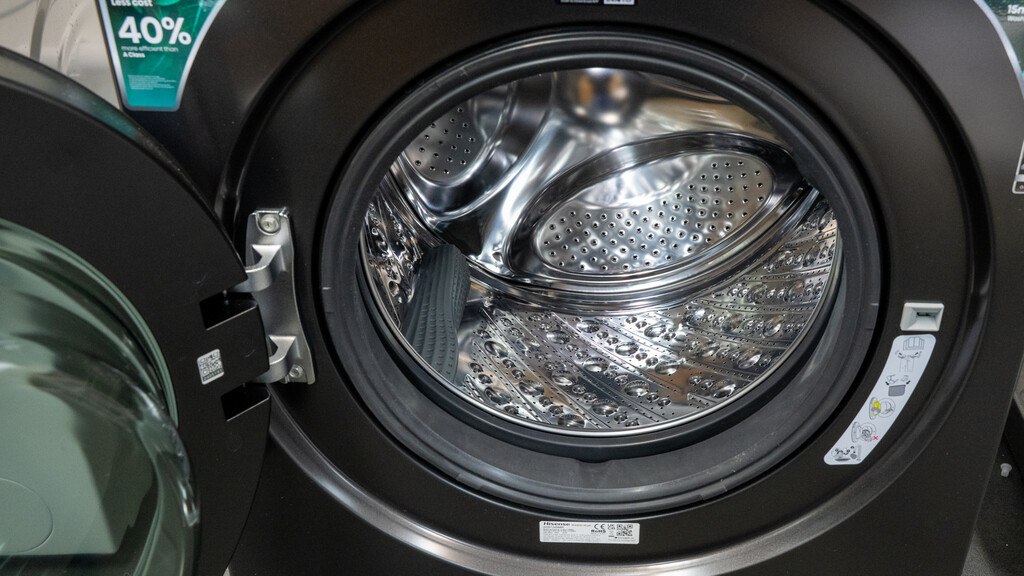
A larger drum than you’d normally expect in a washer dryer also has benefits for the drying system: here the Hisense WD5I1245BBR has an 8kg (wet) maximum drying capacity, which is only 1kg less than I’d expect to see on a regular tumble dryer.

Drying costs are higher for a washer dryer compared to a standalone model, but the higher capacity here at least means you can dry single loads that other washer dryers would need to tackle in two separate loads.
It’s good to see the light in the spacious drum, which makes it easier to see what you’re doing when loading and unloading washing.
As with other recent Hisense laundry appliances, the Hisense WD5I1245BBR has the same bright interface, with a control dial to move through the available cycles. The colour LCD then shows more detail about the cycle, including the maximum load, default temperature, spin speed and estimated time.

This clear interface makes it easier to select the right cycle without having to refer back to the manual. Individual touch buttons allow overrides (cycle dependent) including temperature, spin speed and steam.
Some cycles support the QuickBoost feature, which reduces wash times for ½ and ¼ loads, too.
While drying can be added to many loads, it’s good to see a dedicated drying-only mode. All washer dryers are capable of this, but many require you to select a wash cycle first and then, counterintuitively, turn on drying and turn off washing. By having a dedicated mode, the Hisense WD5I1245BBR is quicker to use.
The level of drying you want is hidden in a sub menu, so it’s a little clunky to change beyond the default of the cupboard dry setting.

This sub menu is also used in wash cycles to select additional options, such as dedicated stain removal programmes.

Speed lovers have a couple of choices here. For 1kg or less of washing, there’s a 15-minute wash cycle, which can have drying added for a total cycle time of 49 minutes. You can also just wash a full load in 39 minutes.
The Hisense WD5I1245BBR is self-dosing. The main detergent compartment takes liquid detergent, and the second one can be used for additional detergent or fabric softener. You can also manually add detergent, say to use handwash liquid or powdered washing.

ConnectLife is available, providing remote control and monitoring of the washing machine. It’s useful for getting notifications when a wash cycle finishes, checking the details of a cycle, and even for adjusting the auto-dosage amounts.
Performance
- Good wash running costs
- Exceptional stain removal
- Expensive for tumble drying
I started my tested with the Eco 40-60 wash cycle, which gave me a decent running cost of 25p for the cycle, which is similar to the running cost for Hisense’s 12kg washing machine. My clothes came out 41.94% heavier than they went in due to water retention. I’d prefer a result under 40%, but this machine is only slightly above that.
I measured stain cleaning performance with a stain strip, which has, left to right, red wine, cooking oil, ketchup, orange juice and gravy. Cleaning performance was exceptional, with the Hisense WD5I1245BBR able to remove all stains, bar the faint outline of red wine. Due to some twisting, the tough ketchup stain left a bit of residue.
Next, I moved to the Cotton 30° cycle. Due to relatively high water use, this cycle cost 47p to run (again similar to the wash-only version of this machine). My clothes gained 41.94% in weight.
Again, cleaning performance was excellent. All of the stains gone, bar a faint outline of red wine and a little bit of ketchup.
To see what the Hisense WD5I1245BBR is really capable of, I used a 60° wash cycle and added steam. This pushed running costs to 79p for the cycle, and my clothes came out 40.41% heavier.
Cleaning performance was excellent, with all stains fully removed, bar the red wine stain, which was more visible here than on the previous washes (colder water is often better for this stain).
I then tried a 20°C wash, which brought the running cost down to 22p, while my clothes added 41.94% in weight through water retention. Cleaning performance was good, although twisting of the stain strip left more ketchup behind than with the Eco or 30°C wash.
To see what the Hisense WD5I1245BBR was like for a fast wash, I ran the 39-minute full load. This is suitable for lightly soiled items, and cost 31p to run. My clothes were a touch wet, gaining 51.61% in weight through water retention, so they would have benefitted from an extra spin.
If you’ve got a few clothes that just need to be refreshed, the steam refresh programme can do that, and it cost 12p to run.
For drying, I used the Eco 40-60 load with my 5kg load first, and then I tried different drying modes. For the cupboard dry setting, 100% of the moisture was removed, although the cycle was quite expensive at 74p.
The extra dry cycle had the same results, so I wouldn’t use this option, unless I had very saturated items.
There’s no hanging-dry option, but there is an iron-dry setting. This reduced the cycle cost to 56p, and 95.02% of the moisture was removed, which is ideal for ironing.
A setting in the middle of the cupboard and an iron dry would have been nice, as that would give slightly lower running costs but leave clothes fine to fold and put away.
I ran the 49-minute wash and dry cycle, which is good for 1kg of dry clothing. This cost just 25p to run, although only 92.59% of water was removed in the drying cycle, so the clothes felt a little damp and needed a bit of airing before I could use them.
Should you buy it?
You only have space for one machine and wash a lot
If you’ve got big loads to get through and don’t have space for separates, this washer dryer is an excellent choice.
You typically have smaller loads
Smaller capacity machines tend to be a bit cheaper to run for smaller loads.
Final Thoughts
Washer dryers are always going to be more expensive to run than buying separates from my guide to the best washing machines and best tumble dryers. But, they’re great space savers and the ultimate in convenience. With the Hisense WD5I1245BBR, you get even fewer compromises than normal, as it has a large wash capacity and the highest drying capacity that I’ve seen in a washer dryer.
Running costs for washing are generally good, particularly on the Eco 40-60 cycle, but stain removal is exceptional across the range. If you have a large household and don’t have space for separates, this is a brilliant choice.
How We Test
Unlike other sites, we test every washer dryer we review thoroughly over an extended period of time. We use standard tests to compare features properly. We’ll always tell you what we find. We never, ever, accept money to review a product.
Find out more about how we test in our ethics policy.
- We test compatibility with the main smart systems (HomeKit, Alexa, Google Assistant, SmartThings, IFTTT and more) to see how easy each machine is to remote control. Smart washing machines only.
- We test each machine with the same stains to see which ones are best at cleaning.
- We test with the <strong>same sets of clothes for each machine, run through a cycle on our test washing machine, so we can compare energy costs and drying performance between tumble dryers</strong>
FAQs
Yes, you can control and monitor it using the ConnectLife app.
Test Data
| Hisense WD5I1245BBR | |
|---|---|
| Energy consumption 30C wash | 0.504 kWh |
| Water consumption 30C wash | 110.8 litres |
| Percentage water remaining 30C wash | 41.94 % |
| Energy consumption 40C wash | 0.389 kWh |
| Water consumption 40C wash | 48.6 litres |
| Percentage water remaining 40C wash | 51.61 % |
| Energy consumption cupboard dry | 2789 kWh |
| Energy consumption hanging dry | 2.09 kWh |
| Water consumption cupboard dry | 2.8 litres |
| Water consumption hanging dry | 3.1 litres |
Full Specs
| Hisense WD5I1245BBR Review | |
|---|---|
| Manufacturer | – |
| Size (Dimensions) | 595 x 595 x 885 MM |
| Weight | 75 KG |
| Release Date | 2026 |
| First Reviewed Date | 18/06/2026 |
| Model Number | Hisense WD5I1245BBR |
| Rated Efficiency | A |
| Dryer type | Condenser |
| Sensor drying | Yes |
| Drying Capacity | 8 kg |
| Drum Capacity | 12 kg |
| Spin speed | 1400 rpm |
| Countdown timer | Yes |
| Delay timer | Yes |
| App Control | Yes |

Stephan is the sports journalist for the Maple Grove Report.