HOKA Unveils the Skyward X 2 Through a Makati Community Run Experience


GO BIG. GO FAR. Maximum cushioning meets plate-powered momentum.

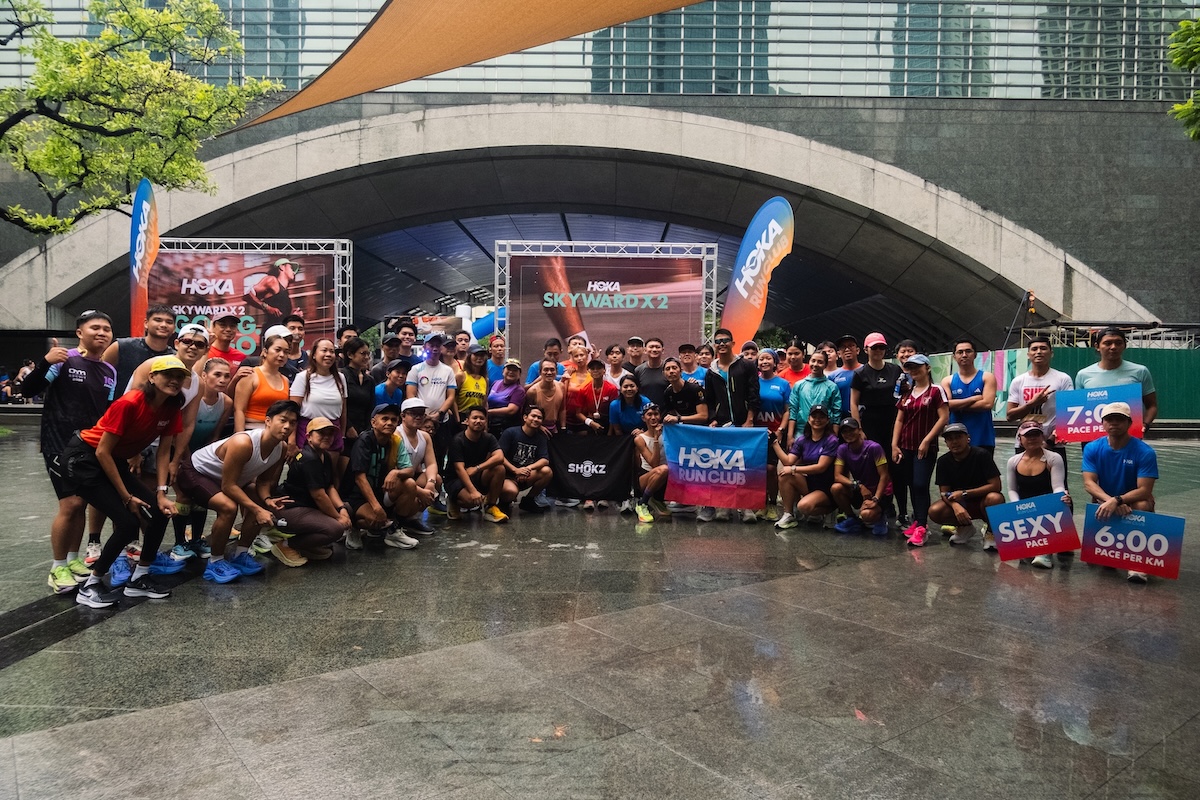
HOKA hosted a special HOKA Run Club session that brought together runners, media, and its expanding running community to celebrate the launch of the Skyward X 2, the company’s latest maximal-cushion road-running shoe.
HOKA Introduces the Skyward X 2 Through Community Run Experience in Makati

HOKA Introduces the Skyward X 2 Through Community Run Experience in Makati

Held during Ayala’s Car-Free Sunday at Ayala Triangle Gardens, the event allowed participants to experience the Skyward X 2 firsthand through a guided 60-minute easy run led by Coach Dan Hilaria, Lead Run Captain of HOKA Run Club Philippines.

Attendees received their Skyward X 2 trial pairs and tested the shoes on the streets of Makati, experiencing their ultra-soft cushioning, carbon-assisted propulsion, and smooth ride. For some, preparing for the Manila Marathon, the run also served as a relaxed shakeout session before the race.

“We wanted runners to feel what makes the Skyward X 2 different the moment they laced it up,” said Coach Dan. “It’s a shoe that delivers comfort for long miles while maintaining an energetic, responsive ride that keeps you moving forward.”

Hilaria, the Lead Run Captain of HOKA Run Club Philippines, organizes community runs, shoe trial sessions, and training programs nationwide. Additionally, he is a strength coach, competitive runner, and HYROX athlete who promotes smart and sustainable training practices for runners of all skill levels.
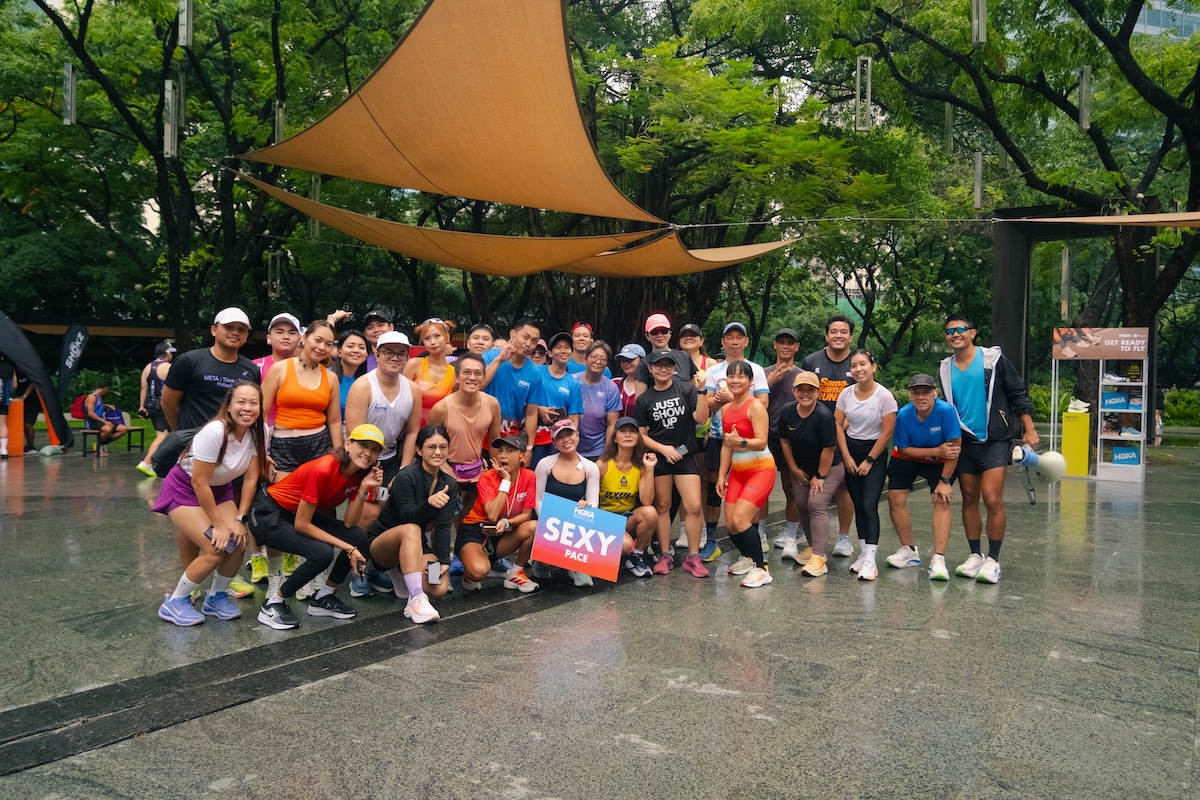
HOKA Run Club session

The Skyward X 2 showcases HOKA’s newest development in high-cushion performance shoes.

Made for long distances, recovery runs, and daily training, this shoe features a thick PEBA midsole foam paired with a high-performance EVA rocker frame, delivering a cushioned yet efficient ride. HOKA’s signature MetaRocker™ geometry ensures smooth transitions, helping runners propel forward with each step.

A notable feature of the Skyward X 2 is its convex carbon fiber plate, producing a distinctly suspended sensation when you walk. This results in a lively, springy feel that pairs well with the shoe’s well-cushioned platform.

The Skyward X 2 is lighter and more aerodynamic than its predecessor, with a lower stack height, yet it still offers the comfort and protection expected from a maximalist trainer.

Skyward X 2
Skyward X 2

Beyond the shoe experience, the event showcased HOKA’s dedication to fostering a vibrant and inclusive running community. Attendees took part in food, refreshments, and activities provided by event partners such as Shopee, SaladStop!, SHOKZ, and other sponsors.

Skyward X 2 can now be found at HOKA exclusive stores in One Ayala Mall, GH Mall, SM Aura, Ayala Malls Manila Bay, Trinoma, Ayala Center Cebu, SM Iloilo, and Abreeza Mall Davao. It is also available for purchase online at hoka.ph.

Follow and subscribe to OutofTownBlog.com on Facebook , Twitter, Instagram, Pinterest, and YouTube for more Travel-related updates.

Read: Café-Hopping the Archipelago: Must-Try Coffee Spots in Popular Philippine Cities


Source link

Leave a Reply

Subscribe to Our Newsletter

Get our latest articles delivered straight to your inbox. No spam, we promise.

Recent Reviews


Another day, another politically motivated attack in the United States.

This morning’s shooting at a Dallas ICE detention facility – where a sniper killed two detainees and wounded another before taking his own life prompted me to revisit a question that’s been troubling me: Is political violence actually increasing in America, or does it just feel that way?

To explore this, I’ve conducted what I’ll call a methodological experiment.

Rather than relying on traditional datasets, I’ve used ChatGPT and Claude to construct a synthetic index of political violence in the US since 1945. Let me be absolutely clear: this isn’t conventional data. It’s data generated through language models, with all the limitations that implies.

The Methodology (and Its Limitations)

Here’s what I did: I asked both ChatGPT and Claude to generate lists of politically motivated violent incidents since 1945, then had them score each incident’s severity on a scale where 50 represents a “normal” level.

The models assessed both casualties and symbolic significance, and I used them to cross-check each other’s work. I then quality-checked the output myself and categorised perpetrators by political affiliation where this was clearly established.

This approach is, admittedly, unorthodox. Language models are trained on existing texts and may reflect biases in their training data. They might overweight highly publicised events or recent incidents that featured prominently in their training corpus.

The “data” we’re looking at is essentially a structured synthesis of what these models have absorbed about American political violence.

Yet there’s something intriguing here. These models have processed vast amounts of information about political violence – news reports, academic studies, government documents. Their output might capture patterns that traditional datasets miss, though it might also amplify certain narratives or blind spots.

What the Synthetic Data Reveal

With those caveats firmly in mind, the patterns that emerge from this exercise are concerning. The model-generated index shows a clear upward trend in political violence over the past decade.

Looking at the breakdown by perpetrator ideology (where clearly established), the data suggest that right-wing extremist groups have been responsible for the majority of incidents in recent years, though we cannot draw conclusions about today’s attack whilst investigations are ongoing.

The synthetic data align with some empirical observations. Princeton’s Bridging Divides Initiative recorded over 600 incidents of threats and harassment against local officials in 2024 – a 74% increase from 2022. The University of Maryland found that in the first half of 2025, 35% of violent events targeted U.S. government personnel or facilities – more than twice the rate in 2024.

The Charlie Kirk Assassination and Recent Patterns

The September assassination of conservative activist Charlie Kirk marked a particularly dark moment.

The incident followed numerous recent acts of political violence, including the murder of Minnesota Democratic state Rep. Melissa Hortman and her husband, and two assassination attempts on President Trump in 2024.

What the synthetic data reveal is not just increased frequency but a shift in patterns. While overall levels of physical political violence remained low in 2024 compared to years prior, acts of vigilante violence grew as a proportion of all reported incidents.

We’re seeing less organised group violence and more lone-wolf attacks – a pattern that’s harder to predict and prevent.

The Epistemological Challenge

When we use language models to generate “data” about social phenomena, what exactly are we measuring? We’re essentially extracting structured information from the collective corpus of human writing about these events. It’s aggregating distributed information, but through an AI intermediary rather than traditional data collection methods.

This raises fascinating questions.

The models suggest that right-wing extremist violence has been responsible for a fairly large majority of U.S. domestic terrorism deaths since 2001. But how much of this reflects actual patterns versus the way these events are covered and discussed in the sources the models were trained on?

The synthetic data are, in a sense, a mirror of our collective discourse about political violence. They reflect not just what happened, but how we’ve talked about what happened. That’s both a limitation and, potentially, a feature – understanding the narrative landscape around political violence might be as important as counting incidents.

An Experimental Tool

I’ve built an interactive app (using the AI coding tool Lovable) based on this language model-generated violence index.

Users can explore the synthetic data, examine patterns across different time periods and perpetrator groups, and understand the methodology behind it. Think of it as an experiment in using AI to structure historical information rather than a definitive dataset.

The value isn’t in treating this as gospel truth, but in what it reveals about how these events are recorded, remembered, and synthesised in our collective digital memory.

When language models trained on our civilisation’s text output show rising political violence, it tells us something – even if that something is as much about narrative as about underlying reality.

This morning’s tragedy in Dallas reminds us that behind every data point – whether traditionally collected or AI-generated – there are real victims and real consequences. Understanding the patterns, however imperfectly, is the first step toward addressing them.

Try the tool here.


Source link