How Many Marines And Sailors Can A US Aircraft Carrier Hold?


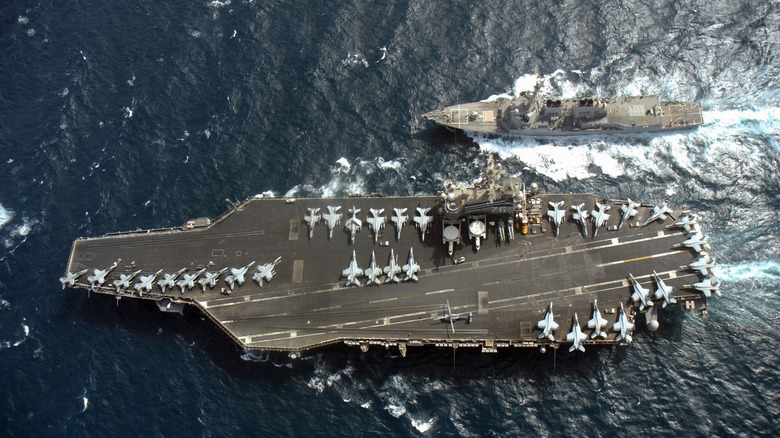
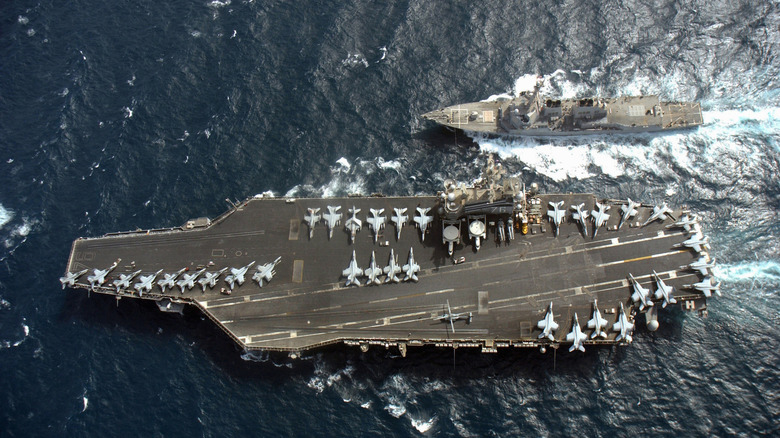
Aircraft carriers sailing with the United States Navy are floating cities meant for projecting military force wherever there’s an ocean. Each carrier is considered a literal piece of sovereign US territory, allowing it more freedom of navigation than some other surface ships. 

The current Gerald R. Ford class of aircraft carrier has a massive crew of 4,660 sailors, officers, staff, and aviators split between the people running the ship and the air wing to operate and maintain the ship’s air capabilities. The earlier, yet still in service, Nimitz-class carrier has a crew of 3,200 sailors and officers and an additional crew of 2,480 for the air wing. Both classes of ships are 1,092 feet long and, thanks to nuclear power, can remain at sea nearly indefinitely. 

However, despite all the staff and sailors onboard, there are very few, if any, Marines onboard aircraft carriers. Marine detachments on most naval vessels in general, dates back to the founding of the country, but the practice was discontinued in 1998.

Amphibious assaults

However, that doesn’t mean the U.S. Navy isn’t in the practice of moving Marines. It’s just that a more conventional aircraft carrier isn’t doing the heavy lifting. That task goes to a ship like the Wasp-class amphibious assault ship. The Wasp-class is a bit of an oddball when it comes to classification. It looks like an aircraft carrier, and it can, in fact, carry a number of different helicopters and fighter jets like the F-35 variants that are capable of taking off vertically. It’s a much “smaller” vessel at a length of 844 feet.

When it comes to carrying Marines, a Wasp-class can carry a detachment of 1,687 personnel, the majority of Marines that comprise a Marine Expeditionary Unit. Altogether, a Marine Expeditionary Unit is around 2,200 Marines and sailors spread out over several vessels.

Aircraft carriers, are huge, imposing, and powerful, but everyone onboard usually has a job dedicated to running the ship or aircraft onboard.


Source link

Leave a Reply

Subscribe to Our Newsletter

Get our latest articles delivered straight to your inbox. No spam, we promise.

Recent Reviews


A new class-action lawsuit, filed on Monday by three teenage girls and their guardians, alleges that Elon Musk’s xAI created and distributed child sexual abuse material featuring their faces and likenesses with its Grok AI tech.

“Their lives have been shattered by the devastating loss of privacy, dignity, and personal safety that the production and dissemination of this CSAM have caused,” the filing says. “xAI’s financial gain through the increased use of its image- and video-making product came at their expense and well-being.”

From December to early January, Grok allowed many AI and X social media users to create AI-generated nonconsensual intimate images, sometimes known as deepfake porn. Reports estimate that Grok users made 4.4 million “undressed” or “nudified” images, 41% of the total number of images created, over a period of nine days. 

X, xAI and its safety and child safety divisions did not immediately respond to a request for comment.

The wave of “undressed” images stirred outrage around the world. The European Commission quickly launched an investigation, while Malaysia and Indonesia banned X within their borders. Some US government representatives called on Apple and Google to remove the app from their app stores for violating their policies, but no federal investigation into X or xAI has been opened. A similar, separate class-action lawsuit was filed (PDF) by a South Carolina woman in late January.

The dehumanizing trend highlighted just how capable modern AI image tools are at creating content that seems realistic. The new complaint compares Grok’s self-proclaimed “spicy AI” generation to the “dark arts” with its ease of subjecting children to “any pose, however sick, however fetishized, however unlawful.”

“To the viewer, the resulting video appears entirely real. For the child, her identifying features will now forever be attached to a video depicting her own child sexual abuse,” the complaint reads.

AI Atlas

The complaint says xAI is at fault because it did not employ industry-standard guardrails that would prevent abusers from making this content. It says xAI licensed use of its tech to third-party companies abroad, which sold subscriptions that led abusers to make child sexual abuse images featuring the faces and likenesses of the victims. The requests ran through xAI’s servers, which makes the company liable, the complaint argues.

The lawsuit was filed by three Jane Does, pseudonyms given to the teens to protect their identities. Jane Doe 1 was first alerted to the fact that abusive, AI-generated sexual material of her was circulating on the web by an anonymous Instagram message in early December. The filing says she was told about a Discord server by the anonymous Instagram user, where the material was shared. That led Jane Doe 1 and her family, and eventually law enforcement, to find and arrest one perpetrator.

Ongoing investigations led the families of Jane Does 2 and 3 to learn their children’s images had been transformed with xAI tech into abusive material.


Source link