The Twin Cities Jazz Festival is busting out. From Thursday through Saturday this week, there will be festival-related gigs and events happening at a retirement community and a piano store; an Ethiopian restaurant and a hotel lobby; a haberdashery and a museum; a Jewish community center and a library; a theater and a supper club. Not to mention a passel of bars and breweries.
The higher-profile acts will still perform on the main stages at either side of Mears Park in St. Paul’s Lowertown. But 27 years after the first Twin Cities Jazz Festival took place on a solitary stage over a single day in Minneapolis, the festival has put together its most widespread and varied program across 18 different venues.
And except for a couple of “pre-festival” shows on Thursday, all of it remains free of charge.
From 2018: Where are the women in the Twin Cities Jazz Festival?
While many of the secondary performance spaces are within walking distance of Mears Park, others involve a drive or a longer hike that might create difficult decisions about who to see and whether you can score a precious seat or a choice space for your lawn chair. Fortunately, the festival organizers have detailed all the logistics, including a map, links to the venue websites and biographies of the musicians who will be performing.
What follows is a necessarily subjective user’s guide on how best to negotiate the cornucopia of options. Everyone has their own taste, and given the nature of jazz (best defined as “the sound of surprise”) and the array of choices – not only about who to see but where to be – you might manage your time very differently. That said, here’s one exciting and relatively stress-free way to enjoy this weekend’s riches.
Thursday, June 18
6:15 p.m. Black Market Brass at Lowertown Sounds in Mears Park
8 p.m. The New Standards and Friends at Lowertown Sounds in Mears Park
These are the easiest decisions of the weekend, giving you the chance to size up the set-up of the festival’s anchor location in Mears Park and catch two nifty shows against scant competition.
Black Market Brass meld Fela Kuti’s Afro-funk with frenetic fusion jazz via an octet of four horns, two strings and two percussionists.
The New Standards are a trio of alumni from cherished rock bands like the Suburbs and Trip Shakespeare who jazz up a wide swath of genres with flair and a dollop of kitsch.
Friday, June 19
2 p.m. Jon Weber at Episcopal Homes
4 p.m. Guvenc, Burk & O’Keefe Orchestra at Erta Ale Ethiopian Restaurant
7 p.m. Bernadette Spray at Zamboni’s on 7th
9:30 p.m. Leslie Vincent at MetroNOME Brewery in Fingal’s Cave
Pianist Jon Weber has logged the most gigs in Twin Cities Jazz Festival history and this afternoon solo show at the retirement community along University and Fairview is his first of three gigs at three different venues, showcasing his versatility and infectious energy.
The GBO Orchestra specializes in classical Turkish music that delightfully careens into Anatolian rock (set that wah-wah pedal loose!), stately folklore on traditional stringed instruments, and gypsy gallops in 9/8 time. Prepare to clap and dance.

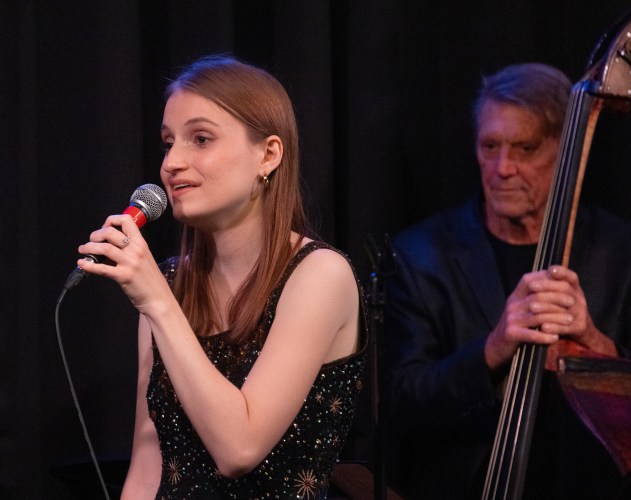
Bernadette Spray found that singing forged an avenue of communication through her autism but her interpretation of the Great American Songbook requires no modifiers, especially with the quartet of top-notch talent backing her here. Her duo with bassist Billy Peterson on “Fever” is simply exquisite.
Snappy swing tunes are Leslie Vincent’s forte and her charismatic energy and elan in front of another ace collection of local musicians is a great way to close out the day.
Honorable mentions
Late afternoon presents some of the toughest choices of the festival. Duo CORDA features the captivating cellist Jacqueline Ultan and guitarist Pavel Javy at the Minnesota Museum of Art at 4 p.m. And for creative mainstream jazz, it is hard to top the Jake Baldwin Quartet at the Nautilus Music-Theater at 4:30.
Most people will be jammed into Mears Park to catch The Yellowjackets, the technically adroit, high-octane quartet who is the biggest draw on the festival bill at 8:30. But if you’re inclined to stay put, Friday is a rare chance to catch four quality gigs in near-succession, for free, on the four separate stages of the elegant and listener-friendly Crooners Supper Club, 15 miles from Mears Park.
Or, within walking distances from the main stages, MetroNOME, Nautilus and Zamboni’s provide a steady stream of free, high-level performances that will probably reward your steady attendance.

Saturday, June 20
Noon “We’re Just Making This Up,” film documentary at George Latimer Central Library
1:30 p.m. Red Planet at Nautilus Music-Theater
3 p.m. Music of Clifford Brown and Max Roach with Steve Wagner and Phil Hey at Nautilus Music-Theater
4 p.m. Zacc Harris on the AARP Main Stage at Mears Park
6 p.m. Sullivan Fortner Trio on the AARP Main Stage at Mears Park
9:30 p.m. How Birds Worked at MetroNOME Brewery in Fingal’s Cave
Saturday allows us to celebrate the bedrock musicians that make the Twin Cities jazz scene so vibrant, with time out to catch our pick for the top attraction of the festival.
“We’re Just Making This Up,” a documentary film directed by Kelle Green and Bill Kersey, is an homage to Artists’ Quarter, a deservedly treasured jazz club that began off Nicollet Avenue in South Minneapolis and moved to downtown St. Paul. It was owned by musicians and attracted the kind of under-the-radar bands and musicians diehard jazz heads wanted to see more than the stars.
Red Planet used to be one of the best trios in the region, with Dean Magraw on guitar, Chris Bates on bass and drummer Jay Epstein all being first-call musicians with an intrepid spirit. But with the addition of the piano phenom Kavy Kaviraj and a weekly residency at MetroNOME, they’ve taken a thrilling step forward.

Clifford Brown and Max Roach pretty much invented hard bop jazz in the 50s (especially when the great, now late, saxophonist Sonny Rollins was in the band) and their iconic catalogue is in good hands with Steve Wagner and Phil Hey taking it out for what should be a memorable joyride.
If he never played a note, guitarist Zacc Harris would still be a jazz hero for his herculean work founding and running the Shifting Paradigm record label, now nationally renowned for its consistent outpouring of durable Midwestern-based jazz albums. But Harris is also an ace guitarist with filigreed, buffered and tasty licks, and a band leader with deep connections that will surround him with superb sidemen on this Main Stage gig.
If you see one show at Twin Cities Jazz Festival, make it the Sullivan Fortner Trio. At age 39, Fortner finished third in the latest Downbeat Critics’ Poll for Best Jazz Pianist. He broke through via seven years in Roy Hargrove’s band and is a stellar collaborator who won Grammys with vocalists Cecile McLorin Salvant and Samara Joy. His 2025 trio record, “Southern Nights,” won a Grammy this year for Best Instrumental Jazz Album. It is at once a seamless and adventurous meld of the New Orleans piano tradition and postbop innovation. Saturday night’s trio finds him with longtime cohorts Kayvon Gordon on drums and bassist Tyrone Allen.
Related: ‘Jazz saved my life’: Electric newcomer Leslie Vincent brings warmth and connectivity to Pride, Twin Cities Jazz Festival stages
Ending the night with How Birds Worked is a full circle experience, given that the original incarnation of the band (How Birds Work) was a mainstay at Artists’ Quarter during the heyday of the club. Drummer Kenny Horst and bassist Billy Peterson were co-owners of the AQ and Horst was a co-producer of “We’re Just Making This Up.” The inimitable guitarist Dean Granros is also back for this new edition of the group, with the formidable young pianist Will Kjeer replacing the late (and sorely missed) Peter Schimke.
Honorable mentions

There is a strong incentive simply to stay in Mears Park all day, as Peruvian-American saxophonist Lucia Sarmiento has made a significant mark on the local scene for a decade now and leads a fine quintet at 2 p.m. And after Fortner’s trio set, the smooth, Bobby McFerrin-like vocals of Michael Mayo will pair with the stalwart large ensemble JazzMn Orchestra at 8:30 p.m.
If you want back-to-back performances of the ineffable grace of Brazilian music, begin with the trio Alma Brasilia featuring vocalist Lucia Newell at 3p.m. in The Minnesota Museum of Art, then hustle down to Bigos 6th Street Stage to catch the quintet Choro Borealis at 5 p.m.
Speaking of thematic pairings, contemporary tributes to landmark bands and albums can be had beyond the numerous examples just mentioned. Start over in the North Loop of Minneapolis, at Berlin, to see the trio of Vasich, Granowsky and Hepola resurrect the music of “Money Jungle,” the legendary disc concocted by Duke Ellington, Charles Mingus and Max Roach. That’s at 4:30 p.m.
Then hop in the car and buzz back across the river for a 6 p.m. MetroNOME gig honoring the pianist Lennie Tristano and his saxophone acolytes, whose experimentations formed a bridge between bebop and “free jazz.” Entitled “The Tristano School: A Tribute to Lee Konitz and Wayne Marsh,” the show features Sophia Kickhofel on alto (Konitz’s main horn) and Sarah Navratil on tenor (Marsh’s instrument of choice).
Last but not least, the late-night jazz jam is a memorable staple of Twin Cities Jazz Festival and jazz festivals in general. This is the time when lightning can be caught in a bottle by an artist you’ve never heard before or an incandescent moment from a venerable favorite. It’s both a community and an informal cutting contest, where musicians seek to “top” each other. This year it takes place at 10 p.m. on both Friday and Saturday at Zamboni’s, an appropriately raucous venue.
Jam sessions are why jazz has always drawn a disproportionate number of night owls. Here’s to sounds that will make their heads spin.
Related