NASA Orders ISS Crew Members to Briefly Shelter During Leak Repair Work


On Friday, NASA directed five people on the International Space Station to temporarily shelter in a SpaceX Dragon spacecraft after engineers discovered air leakage in the Russian segment of the station. Four SpaceX Crew-12 crew members and NASA astronaut Chris Williams entered the SpaceX Dragon spacecraft in case NASA required an evacuation. After a few hours, they returned to regular operations.

Astronauts detected two new air leaks on the transfer tube immediately adjacent to the Zvezda service module. This 43-foot-long module serves as the primary living quarters and houses the life support systems on the Russian orbital segment of the ISS. Russian astronauts repaired one of the leaks and decided to do more expensive repairs on the other. 

“Following new leaks, Roscosmos has elected to proceed with a more extensive repair operation on Friday, June 5,” said Bethany Stevens, NASA spokesperson, in a post on X. “Out of an abundance of caution, NASA has directed all four of the agency’s SpaceX Crew-12 members and NASA astronaut Chris Williams to assume an elevated safety posture in the Dragon spacecraft while the repair is underway.”

A representative for NASA did not immediately respond to a request for comment. 

A diagram showing the various parts of Russia's Zvezda module

The air leaks occur in the transfer tunnel leading out of the Zvezda module.

Boeing

A nagging problem

Air leaks in the Zvezda service module have been an ongoing issue for NASA and Roscosmos, Russia’s national space agency. The first sustained pressure drops were identified around 2019, many years after the module entered service in 2000. Investigations have focused on the transfer compartment area connecting Zvezda to the rest of the station. While multiple repair attempts have been made, the exact source of the leaks has not been confirmed, and engineers continue to evaluate possible causes, including structural aging and joint integrity.

There are procedures in place to mitigate a major failure. The hatch leading to the transfer area that connects Zvezda to docked ships in the Russian segment of the ISS, called the PrK, is closed when not in use. When it is accessed, another hatch leading to the US orbital segment of the ISS is closed. If a failure does happen, only the Russian orbital segment is affected. 

The future of the ISS remains uncertain

The current plan is to keep the ISS active until its planned retirement at the end of 2030. NASA’s plan includes a specialized SpaceX spacecraft that will push the football-field-sized space station out of orbit and back to Earth. Lawmakers are debating leaving the space station up for another couple of years, until 2032, so a replacement can be built and launched. 

Private partners are expected to build the replacement, a move NASA hopes will kickstart new opportunities in space. Those planned commercial space stations are scheduled for completion and launch before the agency eventually removes the ISS from orbit.


Source link

Leave a Reply

Subscribe to Our Newsletter

Get our latest articles delivered straight to your inbox. No spam, we promise.

Recent Reviews


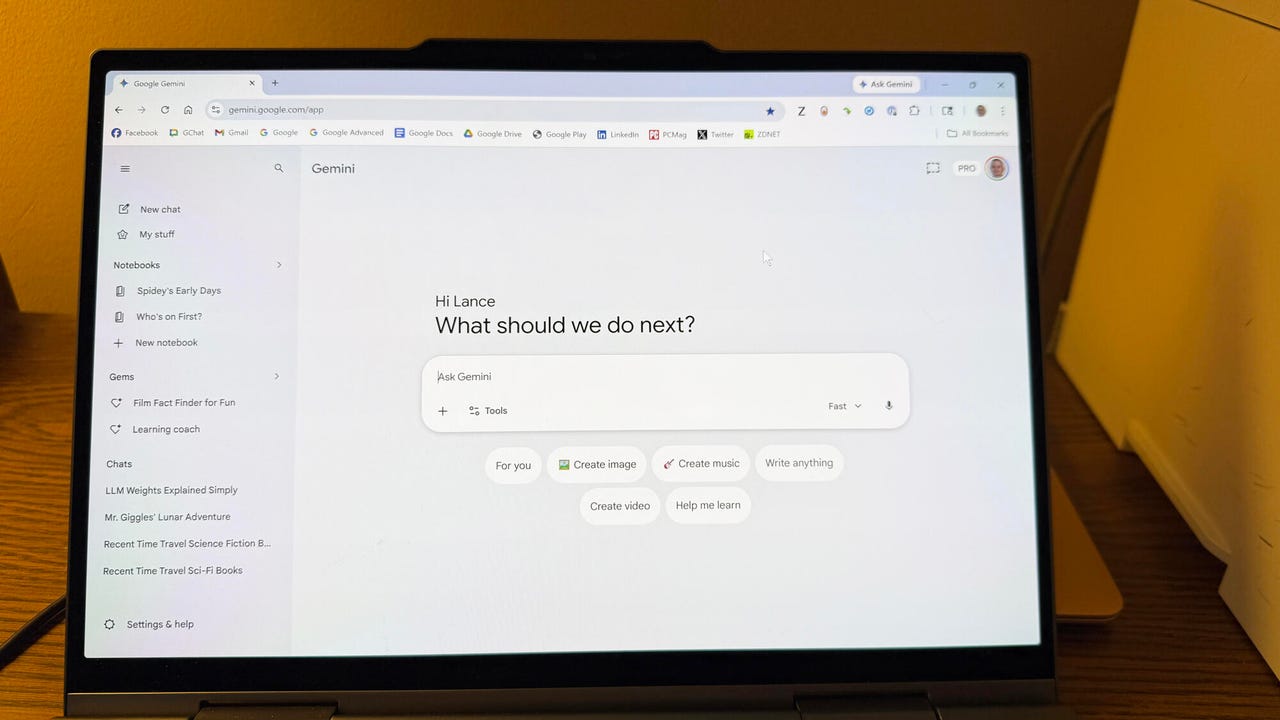
Google Gemini

Lance Whitney/ZDNET

Follow ZDNET: Add us as a preferred source on Google.


ZDNET’s key takeaways

  • Google is downloading a 4GB file to the PCs of many Chrome users.
  • The file is harmless and is used for the Gemini Nano on-device LLM.
  • You’ll see it if you’ve opted into the on-device AI setting in Chrome.

Google is silently saving a Chrome-related file to many computers. That’s nothing earth-shaking. But this file is a hefty 4GB in size, which has caught the attention of some Google watchers. What is the file, why is it being installed, and how can you check for it?

Also: I let Chrome’s AI agent shop, research, and email for me – here’s how it went

In a new blog post, computer scientist Alexander Hanff, aka the Privacy Guy, pulled back the curtain on this mysterious file. Named weights.bin, the file is being downloaded deep within the user data folder of many Chrome users. The file itself is related to Gemini Nano, which Google is using as the on-device AI model for Chrome users.

If you delete the file, it comes back

Though there’s nothing risky or dangerous about the file, Hanff and others have expressed concerns that it’s being downloaded without users’ knowledge or permission. And if you delete the file, it eventually comes back, Hanff said. That by itself is hardly alarming; that’s part of any software update. Rather, some of the criticism centers on the file’s size. If you have ample hard disk space, then 4GB is likely not a big deal. But if you’re running low, that big a file might chew up space you can’t spare.

Traditionally, AI models like Gemini use the cloud to interact with you. Submit a request, ask a question, or kick off a conversation, and the AI taps into its online data and resources to respond. But that method can be slow and naturally requires that you be connected. By traveling between your device and the cloud, your data can also be exposed.

A trend has emerged in which companies are experimenting with locally stored LLMs (large language models). That not only speeds up the process, but it also means you can use the AI offline and more securely. Gemini Nano has already been in play on Google’s own Pixel phones.

That explains why the file is so large; it has to pack in a lot of data. In this case, a weights file contains numbers that measure the level of importance an AI model assigns to your input. The AI uses these values to determine what should come next. For example, let’s say you start typing the phrase “Why did my new phone cost me an arm and a…” at the prompt. The AI assigns weights to your input to help it predict that the next word would be “leg.”

Also: This powerful Gemini setting made my AI results way more personal and accurate

How can you tell if the file has been downloaded to your PC? First, open Chrome, go to Settings, and select System. On the System screen, check whether the On-device AI option is turned on. If so, then you probably have the file or will soon get it.

To double-check, you’ll have to navigate to the user folder on your PC. That location varies based on your operating system. On my Windows 11 PC, I ran a search in File Explorer for weights.bin. The search took a long journey through the following path: C:\Users\lance\AppData\Local\Google\Chrome\User Data\OptGuideOnDeviceModel\2025.8.8.1141. At that final location, the weights.bin file appeared, measuring 4GB.

Since the file is downloaded again if you simply delete it, you’ll have to take an extra step to get rid of it permanently. After you delete the file, go back to Settings in Chrome and select System. Then  turn off the switch for On-device AI.

But as long as you have enough disk space (and if you can’t spare 4GB, then it’s time to clean up your drive), the file is little cause for concern. Just forget about it, especially if you’re keen to try on-device AI, and we’ll see what the future holds for Gemini Nano.


Source link