These 40-Year-Old F-16 Fighter Jets Are Still Ready To Fly At A Moment’s Notice


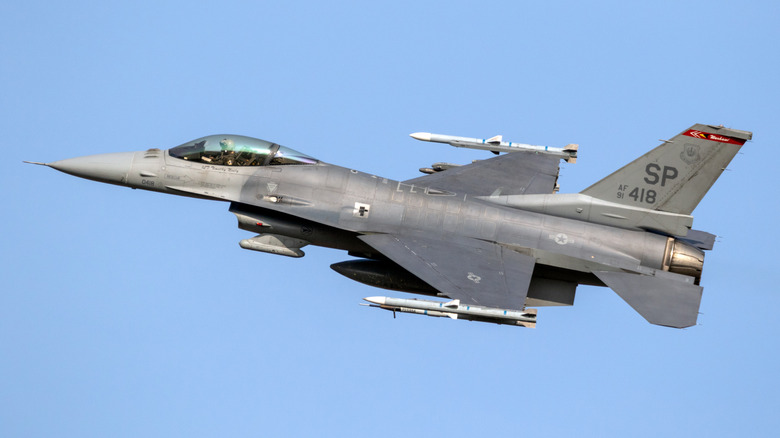
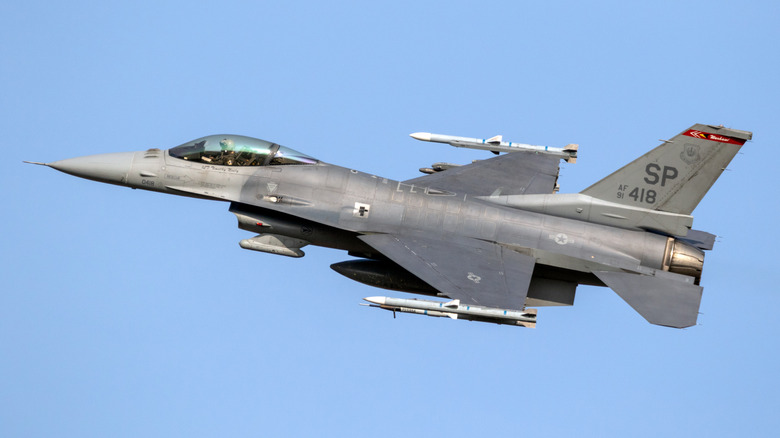
Throughout the years numerous fighter jets have taken to the skies, but few are as iconic as the General Dynamics F-16 Flying Falcon. Even at nearly 50 years in service, and its retirement on the horizon, it remains the United States Air Force’s most widely-used fighter jet. That’s not just an accolade held by this type of aircraft either; there are individual F-16 units still in service that were built and hit the runway for the first time around four decades ago. This a testament to both the individuals who constructed these now-aged jets in the first place way back when, as well as those currently tasked with keeping them as up to modern standards as possible.

These tenured F-16s call Buckley Space Force Base home, with those in the Colorado Air National Guard (COANG) overseeing their operation and upkeep. Speaking to CBS News, Colonel Christopher Melka, the operations group commander for the 140th Wing, explained that despite their old age, these F-16s are ready for action thanks to routine updating. “It’s because of these airmen out here — hours and hours and hours, blood, sweat, and tears keeping these planes airborne,” he said. This is done through physical inspection, where the craft is picked apart and put back together to ensure structural viability, and software updates. These maintenance tasks are crucial to ensure the 140th Wing can get its jets up in the air at a moment’s notice, and so they stand a chance in an ever-technological battlefield.

Naturally, the decades of service these F-16s have seen indicates they still have roles to play in the Colorado Air National Guard’s operations. In fact, these jets have served multiple purposes in their lifetime.

The role F-16s play at Buckley Space Force Base

Throughout their years in operation, the Colorado Air National Guard has brought out its F-16s on many occasions. For example, in November 2022, the COANG F-16s made headlines at the likes of 9News for their role in night flying training. They took to the Aurora, Colorado skies as late as 10 p.m., with those in the 140th Wing explaining that these operations were crucial on multiple fronts. They helped to make 140th Wing members more efficient at getting their jets in the air, and to better prepare those in the cockpit for potential short-notice missions that could hit in the middle of the night.

That latter reason for the nighttime training speaks to the larger rationale for COANG and the wider United States Air Force to keep their F-16s around at Buckley Space Force Base. Ever since 9/11, COANG has been tasked with being prepared to defend the states around Colorado, as well as the entire U.S. when necessary, from outside hostile forces. Thus, in keeping with that defense mission statement, the F-16s are routinely repaired, improved, and remain at the ready 24 hours a day, seven days a week, and 365 days a year.

Many fighter jets can hold their own against the F-16, but there’s no denying the Flying Falcon’s place in the military history books. While they won’t take to the skies forever, at least for the time being, Colorado Air National Guard and other subsections of the U.S. military will continue to put them to use — even at their advancing age.


Source link

Leave a Reply

Subscribe to Our Newsletter

Get our latest articles delivered straight to your inbox. No spam, we promise.

Recent Reviews


Payments are at the heart of any accounting and bookkeeping firm. But what happens when your clients don’t pay on time? The cost isn’t just financial. There’s often an emotional toll, a drain on time, and a real barrier to growth.

We surveyed 800 small-to-medium business (SMB) decision-makers across Australia and New Zealand to better understand the state of late payments today, and the findings are powerful.

The GoCardless Pursuing Payments 2025 report uncovers the true impact of late payments and what you can do to break the cycle.

1. The pursuit of payments is still a time drain for many businesses

Over a quarter of small businesses report spending up to an hour every single week just chasing down late payments.

Think about that – a full hour of every work week, gone. That’s an hour that could be spent onboarding new clients, innovating, or simply focusing on what you do best. Instead, it’s lost to the frustrating and awkward task of debt collection.

Unfortunately, the problem isn’t getting any better. Nearly half of SMBs are waiting longer for payments now than they were just 12 months ago (48% in Australia and 51% in New Zealand). And with rising living costs, it’s no surprise that 59% are worried this trend will only get worse.

2. Late payments take a financial and emotional toll

While the time sink is bad enough, the financial and emotional impact can be far-reaching.

41% of Australian SMBs and 35% of New Zealand SMBs report that their payments are, on average, more than 14 days overdue. And these delayed payments inflict a substantial financial hit with 15% of SMBs in both countries losing up to $1,000 every month.

Our research also showed the heavy emotional cost. Chasing money creates tension with customers, causes stress, and makes business owners feel anxious and frustrated. It’s a vicious cycle that can distract from your day-to-day business and core purpose.

3. Bad cash flow is bad for growth

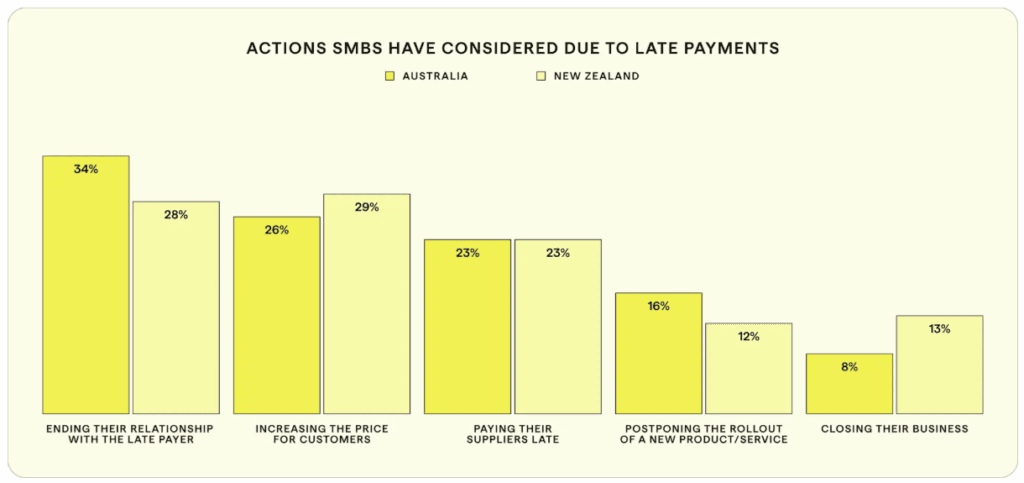
Delayed payments often mean poor cash flow and can result in businesses having to put a hold on future plans. Here are a few growth-stunting actions Australia and New Zealand SMBs have been forced to take due to late payments:

  • Ending their relationship with the late payer
  • Increasing the price for their customers
  • Being late paying their suppliers
  • Postponing the rollout of a new product or service
  • Closing their business

4. Late payments don’t have to be inevitable

So, what’s the solution? The good news is that SMBs are hungry for change. Two-thirds of the businesses we surveyed said they’re interested in using new technology to get a handle on late payments.

That’s where technology comes in. By adopting modern methods like bank payments with GoCardless (think, payments that are made from one bank account directly to another, including BECS Direct Debit and PayTo) you can create, schedule and collect payments for your client invoices on their due date – all from your existing Xero setup.

It’s time to put a stop to the endless admin, reduce costly payment failures, and get paid up to 47% faster. Connect GoCardless to Xero to automate invoice payments, and take back control of your business’s cash flow and growth. 

Was this article helpful?

YesNo


Source link